Headphones Pexels Sega Square Sony MP3

MDFourier Project Seeks The Genesis Of SEGA 16-bit Sound

It always sounded a bit crunchy, but crunchy in a good way. SEGA’s 16-bit console, whether you call it the Genesis or Mega Drive, always had a unique sound thanks to it’s Yamaha YM2612 sound chip. The chip’s ability to reproduce shredding guitars and blasting bass drums was a joy to hear when placed in the hands of capable game developers. Games such as Toe Jam & Earl, Streets of Rage 2, and Sonic the Hedgehog 3 provided some of the most incredible game soundtracks of the ’90s; and while the retail shelf life of those games may have passed, their influence on sound design should not. One individual that is seeking to preserve that quintessential SEGA sound is [Artemio] whose MDFourier project seeks to capture it for future generations to hear.
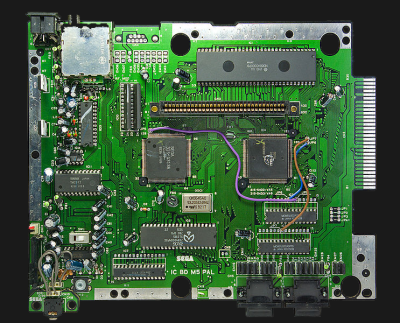
Sega Mega Drive model 1 motherboard. (Bertram, Wikimedia Commons)

MDFourier is a crowd sourced project. Users are asked to use two pieces of software to first generate common audio through a videogame console, and another to analyze the output as to form an audio signature of that machine. Of course SEGA were not always known for their stellar manufacturing record. Throughout the dozen or so board revisions of the Model 1 console there were factory bodge wires, there was also the Model 2 console, Model 3 console, Nomad handheld, Mega Jet, CDX/Multi-Mega, and Wondermega karaoke machine. Each new revision of machine created a slightly new soundscape, and no single piece of emulation software takes them all into account. [Artemio] wants to aggregate all of this data in order to improve SEGA Genesis/Mega Drive emulators, FPGA implementations, or whatever else the future may hold.

Fans of the suite of SEGA consoles, or even fans of great documentation, can take a look at some of initial results as well as the written procedure for contributing to the MDFourier project. For those seeking a more visual step-by-step approach there is this video from YouTube channel RetroRGB below: If you’d like that Sega sound for your MIDI instrument, take a look at this MIDI synth using a Genesis sound chip.

Continue reading “MDFourier Project Seeks The Genesis Of SEGA 16-bit Sound”
Tiny ThinkPad Plays Tiny Games

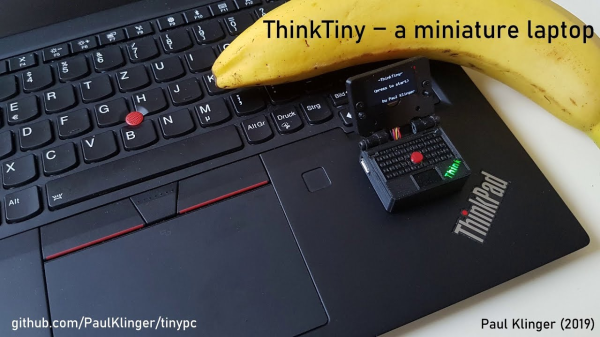
[Paul Klinger] can’t seem to get enough of building tiny, amazing gaming rigs, and we love him for that. They combine two of our favorites: miniatures and portable gaming. His newest creation honors the form of the formidable ThinkPad.

Of course it has the red nipple and lid LED—wouldn’t be a ThinkPad without ’em. ThinkTiny’s nipple is a 5-way joystick that plays Snake, Tetris, Lunar Lander, and more on an OLED screen. Like its predecessor the Tiny PC, [Paul] used an ATtiny1614, which (FYI) has a new one-wire UDPI interface. He can easily reprogram it through pogo pin holes built into the case.

There are some nice stylistic details at play here, too. The lid LED is both delivered and diffused by a 2mm grain of fiber-optic cable. And [Paul] printed the cover with a color change to transparent filament to make the Think logo and the charging LEDs shine through. Maneuver your way past the break to see it in action.

If you haven’t leveled up to AVR programming yet, introduce yourself to Arduboy.

Continue reading “Tiny ThinkPad Plays Tiny Games”

Run Your Own Phone To Bring The Dreamcast Back Online

Playing a video game online is almost second nature now. So much so that almost all multiplayer video games have ditched their split-screen multiplayer modes because they assume you’d rather just be alone at your house than hanging out with your friends. This wasn’t always the case though. In the early days of online multiplayer, systems had to rely on dial-up internet before broadband was readily available (and still had split screen if you didn’t even have that). Almost no one uses dial up anymore though, so if you still like playing your old Dreamcast you’re going to have to do some work to get it online again.

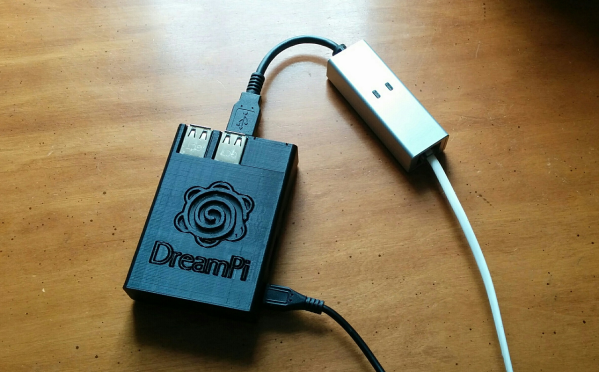
Luckily for all of us there’s a Raspberry Pi image to do almost anything now. This project from [Kazade] uses one to mimic a dial-up connection for a Dreamcast so you can connect with other people still playing Quake 20 years later. It’s essentially a network bridge, but you will need some extra hardware because phone lines use a high voltage line that you’ll have to make (or buy) a solution for. Once all the hardware is set up and working, you’ll need to make a few software configuration changes, but it’s a very straightforward project.

Granted, there have been ways of playing Dreamcast games online before, but this new method really streamlines the process and makes it as simple as possible. The Dreamcast was a great system, and there’s an argument to be made that the only reason it wasn’t more popular was that it was just slightly too far ahead of its time.

Thanks to [Rusty] for the tip!

Gesture Controlled Doom

DOOM will forever be remembered as one of the founding games of the entire FPS genre. It also stands as a game which has long been a fertile ground for hackers and modders. [Nick Bild] decided to bring gesture control to iD’s classic shooter, courtesy of machine learning.

The setup consists of a Jetson Nano fitted with a camera, which films the player and uses a convolutional neural network to recognise the player’s various gestures. Once recognised, an API request is sent to a laptop playing Doom which simulates the relevant keystrokes. The laptop is hooked up to a projector, creating a large screen which allows the wildly gesturing player to more easily follow the action.

The neural network was trained on 3300 images – 300 per gesture. [Nick] found that using a larger data set actually performed less well, as he became less diligent in reliably performing the gestures. This demonstrates that quality matters in training networks, as well as quantity.

Reports are that the network is fairly reliable, and it appears to work quite well. Unfortunately, playability is limited as it’s not possible to gesture for more than one key at once. Overall though, it serves as a tidy example of how to do gesture recognition with CNNs.

If you’re not convinced by this demonstration, you might be interested to learn that neural networks can also be used to name tomatoes. If you don’t want to roll your own pose detection, check out this selfie drone that uses CMU’s OpenPose library. Video after the break.

Continue reading “Gesture Controlled Doom”

Counter-Strike At 20: Two Hackers Upend The Gaming Industry

Choices matter. You’ve only got one shot to fulfill the objective. A single coordinated effort is required to defuse the bomb, release the hostages, or outlast the opposition. Fail, and there’s no telling when you’ll get your next shot. This is the world that Counter-Strike presented to PC players in 1999, and the paradigm shift it presented was greater than it’s deceptively simple namesake would suggest.

The reckless push forward mantra of Unreal Tournament coupled with the unrelenting speed of Quake dominated the PC FPS mind-share back then. Deathmatch with a side of CTF (capture the flag) was all anyone really played. With blazing fast respawns and rocket launchers featured as standard kit, there was little thought put towards conservative play tactics. The same sumo clash of combatants over the ever-so inconveniently placed power weapon played out time and again; while frag counts came in mega/ultra/monster-sized stacks. It was all easy come, easy go.

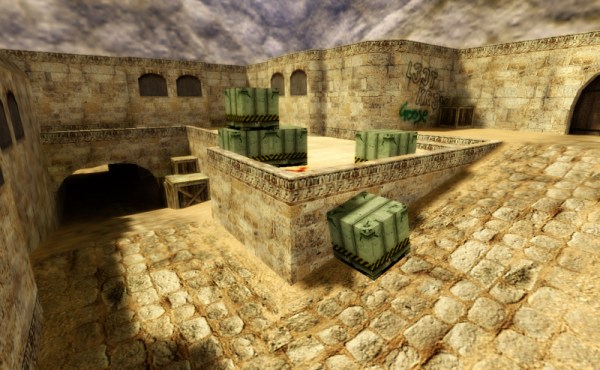
Counter-Strike didn’t follow the quick frag, wipe, repeat model. Counter-Strike wasn’t concerned with creating fantastical weaponry from the future. Counter-Strike was grounded in reality. Military counter terrorist forces seek to undermine an opposing terrorist team. Each side has their own objectives and weapon sets, and the in-game economy can swing the battle wildly at the start of each new round. What began as a fun project for a couple of college kids went on to become one of the most influential multiplayer games ever, and after twenty years it’s still leaving the competition in the de_dust(2).

Even if you’ve never camped with an AWP, the story of Counter-Strike is a story of an open platform that invited creative modifications and community-driven development. Not only is Counter-Strike an amazing game, it’s an amazing story.

Continue reading “Counter-Strike At 20: Two Hackers Upend The Gaming Industry”

Wimbledon 2019: IBM’s Slammtracker AI Technology Heralds The Demise Of The Human Player

Whilst we patiently wait for the day that Womble-shaped robots replace human tennis players at Wimbledon, we can admire the IBM powered AI technology that the organisers of the Wimbledon tennis tournament use to enhance the experience for TV and phone viewers.

As can be expected, the technology tracks the ball, analyses player gestures, crowd cheers/booing but can’t yet discern the more subtle player behaviour such as serving an ace or the classic John McEnroe ‘smash your racket on the ground’ stunt. Currently a large number of expert human side kicks are required for recording these facets and manually uploading them into the huge Watson driven analytics system.

Phone apps are possibly the best places to see the results of the IBM Slammtracker system and are perfect for the casual tennis train spotter. It would be interesting to see the intrinsic AI bias at work – whether it can compensate for the greater intensity of the cheer for the more popular celebrities rather than the skill, or fluke shot, of the rank outsider. We also wonder if it will be misogynistic – will it focus on men rather than women in the mixed doubles or the other way round? Will it be racist? Also, when will the umpires be replaced with 100% AI?

Finally, whilst we at Hackaday appreciate the value of sport and exercise and the technology behind the apps, many of us have no time to mindlessly watch a ball go backwards and forwards across our screens, even if it is accompanied by satisfying grunts and the occasional racket-to-ground smash. We’d much rather entertain ourselves with the idea of building the robots that will surely one day make watching human tennis players a thing of the past.

Copy Protection In The 80s, Showcased By Classic Game Dungeon Master

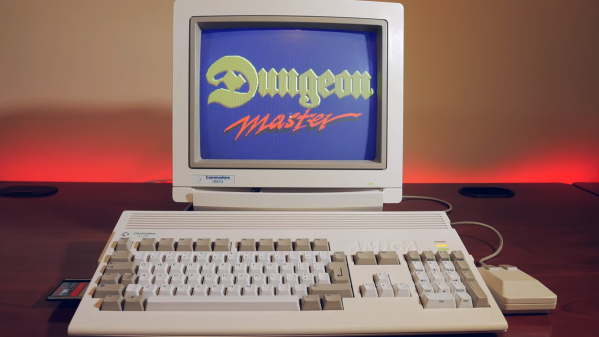
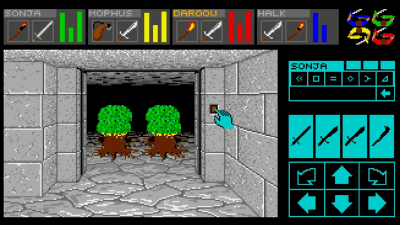
Making a copy of a purchased game used to be as simple as copying a disk. As the game industry grew, so did fear of revenue loss which drove investment in countermeasures. These mainly consisted of preventing the easy duplication of magnetic diskettes, or having users jump through tiresome hoops like entering specific words from the printed manual. These measures rarely posed much of a challenge to the dedicated efforts of crackers, but the copy protection in the classic 80s game Dungeon Master for the Atari ST and Amiga was next-level. It implemented measures that went well beyond its contemporaries, and while it was eventually defeated, it took about a year to happen. In an era where games were cracked within days or even hours of release, that was remarkable.

Dungeon Master was a smash hit at the time, and while the details of its own brand of what we would now call DRM may not be new, this video presentation by [Modern Vintage Gamer] (YouTube link) does a wonderful job of stepping through everything it did, and begins with an informative tour of copy protection efforts of the era for context.

The video is embedded below, but if you’d like to skip directly to the details about Dungeon Master, that all starts just past eight minutes in. What we now call DRM clearly had roots that preceded the digital world of today; an absurd timeline in which even cat litterboxes can have DRM.

Continue reading “Copy Protection In The 80s, Showcased By Classic Game Dungeon Master”