Universal Chip Analyzer: Test Old CPUs In Seconds

Collecting old CPUs and firing them up again is all the rage these days, but how do you know if they will work? For many of these ICs, which ceased production decades ago, sorting the good stuff from the defective and counterfeit is a minefield.

Testing old chips is a challenge in itself. Even if you can find the right motherboard, the slim chances of escaping the effect of time on the components (in particular, capacitor and EEPROM degradation) make a reliable test setup hard to come by.

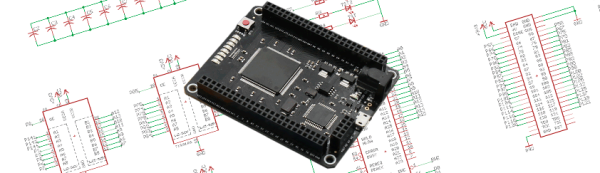
Enter [Samuel], and the Universal Chip Analyzer (UCA). Using an FPGA to emulate the motherboard, it means the experience of testing an IC takes just a matter of seconds. Why an FPGA? Microcontrollers are simply too slow to get a full speed interface to the CPU, even one from the ’80s.
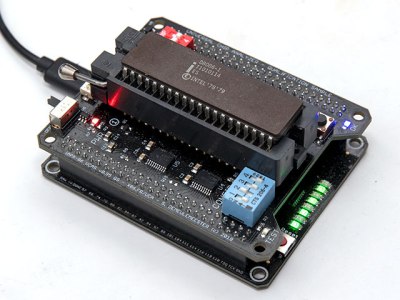
So, how does it actually test? Synthesized inside the FPGA is everything the CPU needs from the motherboard to make it tick, including ROM, RAM, bus controllers, clock generation and interrupt handling. Many testing frequencies are supported (which is helpful for spotting fakes), and if connected to a computer via USB, the UCA can check power consumption, and even benchmark the chip. We can’t begin to detail the amount of thought that’s gone into the design here, from auto-detecting data bus width to the sheer amount of models supported, but you can read more technical details here.

The Mojo v3 FPGA development board was chosen as the heart of the project, featuring an ATmega32U4 and Xilinx Spartan 6 FPGA. The wily among you will have already spotted a problem – the voltage levels used by early CPUs vary greatly (as high as 15V for an Intel 4004). [Samuel]’s ingenious solution to keep the cost down is a shield for each IC family – each with its own voltage converter.

Continue reading “Universal Chip Analyzer: Test Old CPUs In Seconds”
The Forgotten Workstation: Sun JavaStation

These days, conversations about Java tend to center around Oracle and Google fighting it out in court. But back in 1996, Sun was the keeper of Java and promoted it heavily. They even released a diskless workstation that only runs Java applets. The Sun JavaStation was affectionately called the “Mr. Coffee” and [Cameron Gray] wants to show you how it worked and what’s inside of it.

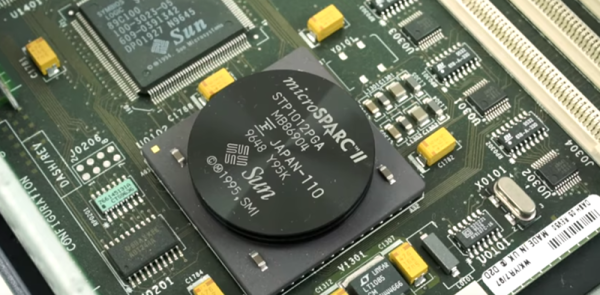
A single screw frees the innards from the small case. Inside looks like a dense PC from the era, although the parts inside are a far cry from a typical PC. The CPU was a 110 MHz microSPARC II soldered directly to the motherboard. The four RAM slots could take up to 64 megabytes of PC RAM.

Continue reading “The Forgotten Workstation: Sun JavaStation”

A Retrocomputer Disk On A Chip

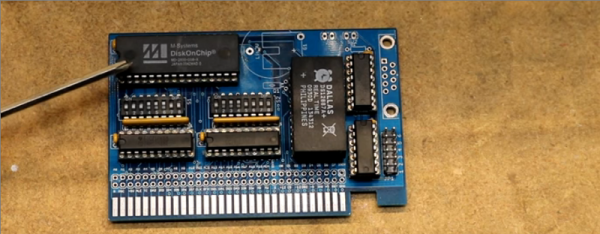
There have been a lot of different mass storage methods over the relatively short lifespan of the computer. Magnetic tapes, drums, all sorts of disks, and flash memory have each had their time. Each of these new innovations required some time to become easy to use. One of the early attempts to simplify using flash memory was the M-Systems DiskOnChip device. Looking like a standard 8K JEDEC-compatible memory device, it actually provided access to a flash disk drive ranging from 16MB to 1GB. [Smbakeryt] bought some of these devices and built an ISA board to provide a disk and clock for the old 8-bit bus. You can see a video discussion about the device below.

SanDisk bought M-Systems and discontinued the devices back in 2007. Of course, you can still design flash memory into your system, but the simple and efficient interface of the DiskOnChip is no more. It is a testament to how simple the interface is that the schematic for the little board fits on a page, including the DS12885 real time clock.

Continue reading “A Retrocomputer Disk On A Chip”

Forth Version 1 Runs Again

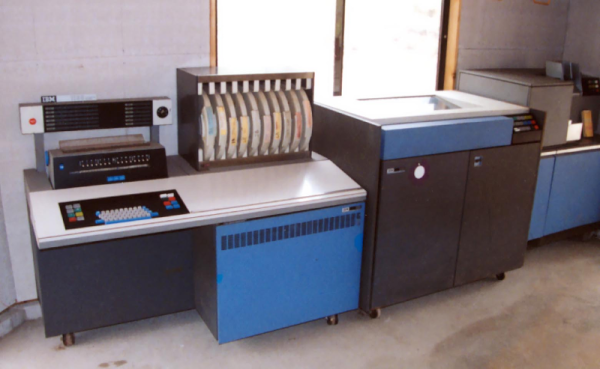
Some people love Forth and some people hate it. However, you usually think of Forth as something running on a little computer such as an 8-bit microcomputer. When [Chuck Moore] developed the system back in the 1960s though, it ran on an IBM 1130. [Carl Claunch] took a scanned listing of the original code and got it running once again.

There are actually a few blog posts with details. Luckily, Forth is pretty simple — especially the core parts. However, there are a lot of differences from a modern Forth. The most obvious is that the dot keyword starts a definition and does not print the top of stack. However, internal details are different too — the system, for example, stores characters in packed EBCDIC — an ASCII-like code used by IBM computers.

Continue reading “Forth Version 1 Runs Again”

Compaq Portable III Rises Again For A Noble Cause

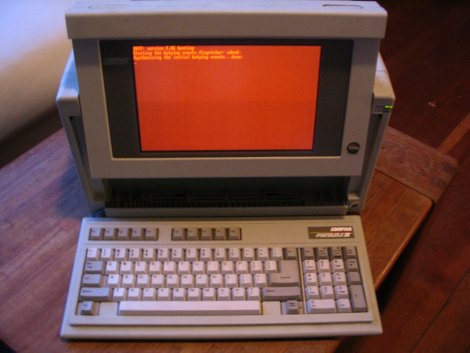
[Autuin] found a Compaq Portable III destined for the scrap bin at Free Geek Vancouver. Upon seeing it he realized that it still had some fight left in it — perfect to go up against the tyranny of hipsters and their shiny Macbook Pros at his local coffee shop.

Unfortunately, being a 286, the computer couldn’t do much. He could take the usual route; which is to remove all the internals, and use the vast amount of space to fit a more modern computer inside. However, he decided to go a different path and save the internals, leaving it in original working order. The computer didn’t have enough power to browse the web, but it had just enough room to fit a small single-board computer inside, to which he could connect through serial. He hasn’t taken it down to the coffee shop yet, but we’re hoping for a few horrified hipsters and a full mission report when he does.

Thanks to [Alec Smecher] for the tip.

Portable Atari 2600

atari 2600 portable

benjamin heckendorn of portable playstation 2 fame has been working on a prototype for a mass produced portable atari 2600, code named ‘phoenix’.

it has a 3.5″ screen, takes 6 aa batteries, uses standard atari game cartridges, and will someday allow me to play hours and hours of joust and moon patrol on international flights.

ben recently started a phoenix blog to help us stay on top of the latest phoenix development news.  thanks for the tip jesse!

Continue reading “Portable Atari 2600”

MIDIbox SID — Serious C64 Sound

c64 midi box

sign-language sent us a link to some instructions for turning your old commodore’s sid chip into a midi controlled synth capapble of pumping more grooves than you ever thought possible.  i was really excited to post a commodore hack, but then i scrolled down and saw this image.  c64 slayings are really hard for me to stomach.

let’s keep it clean, folks.

Continue reading “MIDIbox SID — Serious C64 Sound”