Sliding Wrench Leaves A Little To Be Desired

[Ben Conrad] received an interesting tool as a gift that purported to be a better mousetrap. It was a crescent wrench (made by the Crescent company, even) that didn’t have a tiny adjusting wheel like a traditional wrench. Instead, it had a slide running down the length of the handle. The idea is that you would push the slide to snug the wrench jaws against the bolt or nut, and that would be fast and easy compared to a conventional wrench. As [Ben] notes, though, it doesn’t work very well. Most of us would have just dumped it in the back of the tool chest or regifted it. [Ben] tore his apart to find out what was wrong with it.

A typical adjustable wrench has four parts. This one has 19 parts and looks like a conventional wrench with an extra slide and screw running down the length of the handle. [Ben] found the parts were poorly made, but that wasn’t the main problem.

Continue reading “Sliding Wrench Leaves A Little To Be Desired”

Seriously, Don’t Buy This Mopping Robot

The original Roomba robotic vacuum cleaner led to loads of clones and lookalikes over the years, and one of them is the ALEE mopping “robot”. [Raymond] tears it down and reveals what’s inside. Turns out it contains mostly regret! Although it does host some design cleverness in its own way.

Technically the ALEE, which cost [Raymond] a cool $85 USD, is not a robot since it has no sensors. And unless a dragging a wet cloth pad kept moist by a crude drip reservoir counts as “mopping”, it’s not much of a mop, either.

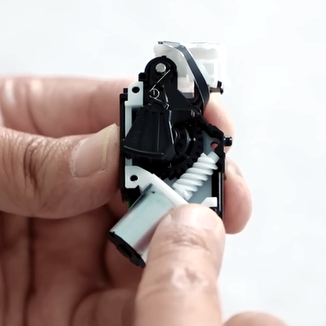
This one-motor unit (and tiny battery) is responsible for both motion and direction control. There are no sensors.

There is one interesting aspect to this thing, and it’s to do with the drive system and direction control. The whole thing is driven by a single motor, and not a very powerful one. The center of the robot has a pair of wheels that are both driven at the same rate and speed, and the wheel assembly can pivot around its axis. That’s about it. There are not even any bump sensors of any kind.

So how does this thing move, let alone change direction to (poorly) emulate an original Roomba-like crisscross pattern? The control board appears to have one job: if the motor stalls, reverse direction. That, combined with the fact that the drive unit can pivot and the enclosure is dragging a wet rag, appears to be all the chaos that’s needed to turn bonking into a wall into an undefined direction change.

It’s not great performance, but it sure is some impressive cost-cutting. You can see it bonk around unimpressively in a short video, embedded below the page break.

Just to be clear, [Raymond] knows perfectly well what he’s in for when he obtains cheap tech items from overseas retailers for teardowns. The ALEE does have some mildly interesting secrets to share, but overall, it really wasn’t worth it. Sometimes cheap tech has hacker potential, but there’s no such potential here. Seriously, don’t buy this thing.

Continue reading “Seriously, Don’t Buy This Mopping Robot”

Mini Cheetah Clone Teardown, By None Other Than Original Designer

[Ben Katz] designed the original MIT Mini Cheetah robot, which easily captured attention and imagination with its decidedly un-robotic movements and backflips. Not long after [Ben]’s masters thesis went online, clones of the actuators started to show up at overseas sellers, and a few months after that, clones of the whole robot. [Ben] recently had the opportunity to disassemble just such a clone by Dogotix and see what was inside.

Mini sheep, meet mini cheetah.

Amusingly, one of the first things he noticed is that the “feet” are still just off-the-shelf squash balls, same as his original mini cheetah design. As for the rest of the leg, inside is a belt that goes past some tensioners, connecting the knee joint to an actuator in the shoulder.

As one may expect, these parts are subject to a fair bit of stress, so they have to be sturdy. This design allows for slender yet strong legs without putting an actuator in the knee joint, and you may recall we’ve seen a similar robot gain the ability to stand with the addition of a rigid brace.

It’s interesting to read [Ben]’s thoughts as he disassembles and photographs the unit, and you’ll have to read his post to catch them all. But in the meantime, why not take a moment to see how a neighbor’s curious sheep react to the robot in the video embedded below? The robot botches a backflip due to a low battery, but the sheep seem suitably impressed anyway.

Continue reading “Mini Cheetah Clone Teardown, By None Other Than Original Designer”

What’s Inside A Super-Cheap Projector? Not A Lot!

[Raymond Ma] has a penchant for browsing Aliexpress and purchasing curious pieces of hardware that are as high on promises as they are low on cost. This is a process he aptly sums up with his opening line of “I should have known better, but…” Luckily, these devices all get torn down and analyzed so we can each enjoy and share a little slice of disappointment.

One such item is the $30 USD YT200 mini projector, which at 320×180 is almost as low on pixels as it is on cost. Still, [Raymond] looks inside to find out if there is perhaps more hacking potential than there is image resolution.

The YT200 lacks any kind of normal video input, and the anemic 15 lumen output is brazenly branded as a feature to protect children’s eyes from excessive brightness.

Light from the single LED is collimated with some Fresnel lenses. That light passes through an LCD panel, and from there the image bounces off a mirror and through a focusing lens housed in a spiral guide. Focal adjustments are made with a small lever, and the whole assembly provides just enough friction to prevent the lens from moving out of focus on its own.

The device actually does work fairly well for what it is: a way to play a range of different media types off a connected USB storage device. As long as one is in a dark room, anyway.

[Raymond] hopes to find some alternate use for the device. Might we suggest projecting into a frosted glass globe to create a sort of spherical display? A spooky eye animation on a USB stick might pair well with that.

Sonos Speakers Free To Sing Again

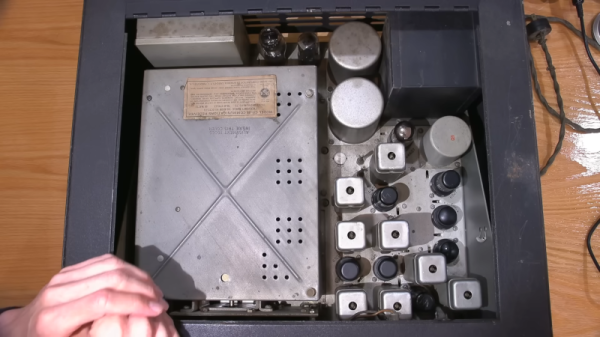
Over at the EEVBlog, [Dave Jones] takes a second look at the Sonos Play 5 Gen 1 that he rescued from the dumpster recently. Despite being solidly built, [Dave] discovered that even the stereo line-in jack can’t be used without registering an account with Sonos. Not to be defeated, he hacks these speakers to make them work standalone.

Bluetooth Audio Amplifier Module (Fosi Audio)

The hack here involves fitting the speaker cabinet with new “guts” in the form of a wireless stereo 2×50 watt digital amplifier [Dave] found online for under $30. This particular model, the Fosi TB21, is almost a perfect fit for the Sonos cabinet — with only minimal Dremel tool encouragement required. It turned out the power supply section of the Sonos main board was easy to isolate. [Dave] couldn’t use the existing amplifiers, so he removed them from their power supply and re-routed the power supply to the Fosi module. He also removed the Sonos wireless interface board from the cabinet, and used an online design tool to make a simple first order Butterworth crossover network set to 2800 Hz to connect the speakers.

The new amplifier board is mounted in the shallow base of the speaker cabinet. It could have easily been oriented either way, but [Dave] chose to install it knobs-forward. This also gave him a reason to toss out the Sonos badge. The resulting modified unit looks very professional, and works well as a Bluetooth speaker for the lab.

We wrote about the opposite conversion last year, where old speakers from the 1960s were hacked to add Sonos capability. You can read about the controversy surrounding Sonos here, and we discussed the issue on the Hackaday Podcast in episode 058.

Continue reading “Sonos Speakers Free To Sing Again”

The Story Behind The TVGuardian Curse Catcher

The recent flurry of videos and posts about the TVGuardian foul language filter brought back some fond memories. I was the chief engineer on this project for most of its lifespan. You’ve watched the teardowns, you’ve seen the reverse engineering, now here’s the inside scoop.

Gumby is Born

TVG Model 101 Gumby (Technology Connections)

Back in 1999, my company took on a redesign project for the TVG product, a box that replaced curse words in closed-captioning with sanitized equivalents. Our first task was to take an existing design that had been produced in limited volumes and improve it to be more easily manufactured.

The original PCB used all thru-hole components and didn’t scale well to large quantity production. Replacing the parts with their surface mount equivalents resulted in Model 101, internally named Gumby for reasons long lost. If you have a sharp eye, you will have noticed something odd about two parts on the board as shown in [Ben Eater]’s video. The Microchip PIC and the Zilog OSD chip had two overlapping footprints, one for thru-hole and one for SMD. Even though we preferred SMD parts, sometimes there were supply issues. This was a technique we used on several designs in our company to hedge our bets. It also allowed us to use a socketed ICs for testing and development. Continue reading “The Story Behind The TVGuardian Curse Catcher”

Portable Commodore 64 Lives!

When you think of a luggable computer, you might think of the old Compaq or — if you are old enough — a Kaypro. But you don’t see as many Commodore SX-64 computers. [The 8-Bit Guy] has wanted one for a while and finally got one, but it wasn’t working. No problem! Just fix it!

The device actually looks sleek compared to some other portables of the era and had a color screen, but — probably due to the price — they didn’t sell very well. The outside of the device looked pretty clean other than some loose screws and clips. The space key was quite yellow but at least there was a keyboard cable which is nearly impossible to find anymore.

Continue reading “Portable Commodore 64 Lives!”