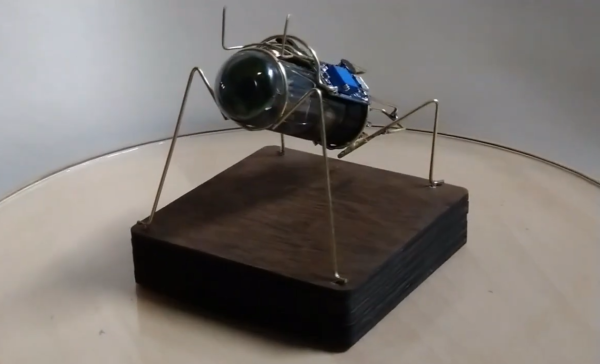
If you’ve ever used an old tube radio, you might be familiar with that mysterious little green display that helps you to tune exactly to a station. That display is called a tuning indicator, or magic eye tube; in essence it’s a minimalistic cathode ray tube that can sweep its electron beam along only one axis. It thereby outputs a kind of bar graph that varies with the input voltage.
With few modern uses other than being pretty, it only makes sense that these tubes find their way into works of art: [Patrice] used one to make an insect-like piece of circuit sculpture. The tube he used is an EM34, which is one of the most common indicator tubes around and has a circular, iris-like display area. This becomes a large eye, peering forward from the bug’s body. The legs are made from 1.5 mm thick brass wire, while a DC/DC converter generates the 210 Volts DC needed to operate the tube.
An interesting “touch” is the addition of two antennae that are hooked up in such a way that the tube’s image changes when you push them; this interactivity makes the bug come alive a little bit. Speaking of touch, we think it would be prudent to put some insulation around the 210 V wires; even though the bug is battery-powered, touching the high voltage and ground wires simultaneously would deliver a nasty shock.
Nevertheless, the bare-wire retro design looks beautiful and would make a great ornament for any electronics-lover’s office. We’ve seen magic eye tubes being used for various purposes: you can turn them into a spectrum analyzer, measure capacitors with them, or simply use them as a bar-graph display. Continue reading ““Buggy” Circuit Sculpture Based On A Tuning Indicator Tube”