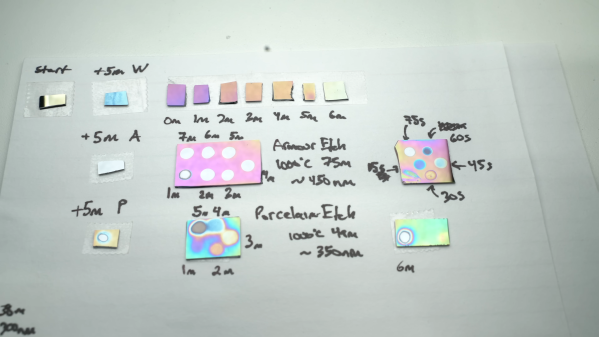
Doing anything that requires measurements in nanometers is pretty difficult, and seems like it would require some pretty sophisticated equipment. But when the task at hand is growing oxide layers on silicon chips in preparation for making your own integrated circuits, it turns out that the old Mark 1 eyeball is all you need.
Alert readers may recall that [ProjectsInFlight] teased this process in his previous video, which covered the design and construction of a DIY tube furnace. In case you missed that, a tube furnace is basically a long, fused quartz tube wrapped in electrical heating elements and lots of insulation, which is designed to reach the very high temperatures needed when making integrated circuits. The tube furnace proved itself up to the task by creating a thin layer of silicon dioxide on a scrap of silicon wafer. Continue reading “Growing Oxides On Silicon On The Road To DIY Semiconductors”→
For a lot of reasons, home etching of PCBs is somewhat of a dying art. The main reason is the rise of quick-turn PCB fabrication services, of course; when you can send your Gerbers off and receive back a box with a dozen or so professionally made PCBs for a couple of bucks, why would you want to mess with etching your own?
Convenience and cost aside, there are a ton of valid reasons to spin up your own boards, ranging from not having to wait for shipping to just wanting to control the process yourself. Whichever camp you’re in, though, it pays to know what’s going on when your plain copper-clad board, adorned with your precious artwork, slips into the etching tank and becomes a printed circuit board. What exactly is going on in there to remove the copper? And how does the etching method affect the final product? Let’s take a look at a few of the more popular etching methods to understand the chemistry behind your boards.
There’s some nifty research from the University of Bayreuth, together with partners in China and the U.S., on creating supremely tough aluminosilicate glass that boasts an unusual structure. The image above represents regular glass structure on the left, and the paracrystalline structure on the right.
Aluminosilicate, which contains silicon, aluminum, boron and oxygen, is a type of oxide glass. Oxide glasses are a group to which borosilicate and other common glasses belong. Structurally speaking, these glasses all have a relatively disordered internal structure. They’re known for their clarity, but not especially their durability. Continue reading “Supremely-tough Glass Performs Under Pressure”→
[Sebastian] probably didn’t think he was wading into controversial waters when he posted on his experimental method for etching PCBs (in German). It’s not like etching with hydrochloric acid and peroxide is anything new, really; it was just something new to him. But is it even possible these days to post something and not find out just how wrong you are about it?
Sadly, no, or at least so it appears from a scan of [Sebastian]’s tweet on the subject (Nitter). There are a bunch of ways to etch copper off boards, including the messy old standby etchant ferric chloride, or even [Sebastian]’s preferred sodium persulfate method. Being out of that etchant, he decided to give the acid-peroxide method a go and was much pleased by the results. The traces were nice and sharp, the total etching time was low, and the etchant seemed pretty gentle when it accidentally got on his skin. Sounds like a win all around.
But Twitter wouldn’t stand for this chemical heresy, with comments suggesting that the etching process would release chlorine gas, or that ferric chloride is far safer and cleaner. It seems to us that most of the naysayers are somewhat overwrought in their criticism, especially since [Sebastian]’s method used very dilute solutions: a 30% hydrochloric acid solution added to water — like you oughta — to bring it down to 8%, and a 12% peroxide solution. Yes, that’s four times more concentrated than the drug store stuff, but it’s not likely to get you put on a terrorism watch list, as some wag suggested — a hair stylist watchlist, perhaps. And 8% HCl is about the same concentration as vinegar; true, HCl dissociates almost completely, which makes it a strong acid compared to acetic acid, but at that dilution it seems unlikely that World War I-levels of chlorine gas will be sweeping across your bench.
As with all things, one must employ caution and common sense. PPE is essential, good chemical hygiene is a must, and safe disposal of spent solutions is critical. But taking someone to task for using what he had on hand to etch a quick PCB seems foolish — we all have our ways, but that doesn’t mean everyone else is wrong if they don’t do the same.
For hundreds of years, Icelanders have relied on the ocean for survival. This is perhaps not surprising as it’s an isolated island surrounded by ocean near the Arctic circle. But as the oceans warm and fisheries continue to be harvested unsustainably, Iceland has been looking for a way to make sure that the fish they do catch are put to the fullest use, for obvious things like food and for plenty of other novel uses as well as they work towards using 100% of their catch.
After harvesting fish for food, most amateur fishers will discard around 60% of the fish by weight. Some might use a portion of this waste for fertilizer in a garden, but otherwise it is simply thrown out. But as the 100% Fish Project is learning, there are plenty of uses for these parts of the fish as well. Famously, cod skin has been recently found to work as skin grafts for humans, while the skin from salmon has been made into a leather-type product and the shells of crustaceans like shrimp can be made into medicine. The heads and bones of fish can be dried and made into soups, and other parts of fish can be turned into things like Omega-3 capsules and dog treats.
While we don’t often feature biology-related hacks like this, out-of-the-box thinking like this is an important way to continue to challenge old ideas, leave less of a footprint, improve human lives, and potentially create a profitable enterprise on top of all of that. You might even find that life in the seas can be used for things you never thought possible before, like building logic gates out of crabs.
[The Slo Mo Guys] caught something fascinating while filming some firearms at 82,000 frames per second: a visible emission of light immediately preceding a bullet impact. The moment it occurs is pictured above, but if you’d like to jump directly to the point in the video where this occurs, it all starts at [8:18].
The ability to capture ultra-slow motion allows us to see things that would otherwise happen far too quickly to perceive, and there are quite a few visual spectacles in the whole video. We’ll talk a bit about what is involved, and what could be happening.
Spotting something unusual on video replay is what exteme slo-mo filming is all about.
First of all, the clear blocks being shot are ballistic gel. These dense blocks are tough, elastic, and a common sight in firearms testing because they reliably and consistently measure things like bullet deformation, fragmentation, and impact. It’s possible to make homemade ballistic gel with sufficient quantities of gelatin and water, but the clear ones like you see here are oil-based, visually clear, and more stable (they do not shrink due to evaporation).
We’ve seen the diesel effect occur in ballistic gelatin, which is most likely the result of the bullet impact vaporizing small amounts of the (oil-based) gel when the channel forms, and that vaporized material ignites due to a sudden increase in pressure as it contracts.
In the video linked above (and embedded below), there is probably a bit more in the mix. The rifles being tested are large-bore rifles, firing big cartridges with a large amount of gunpowder igniting behind each bullet. The burning powder causes a rapid expansion of hot, pressurized gasses that push the bullet down the barrel at tremendous speed. As the bullet exits, so does a jet of hot gasses. Sometimes, the last bits of burning powder are visible as a brief muzzle flash that accompanies the bullet leaving the barrel.
A large projectile traveling at supersonic velocities results in a large channel and expansion when it hits ballistic gel, but when fired at close range there are hot gasses from the muzzle and any remaining burning gunpowder in the mix, as well. All of which help generate the kind of visual spectacles we see here.
We suspect that the single frame of a flashlight-like emission of light as the flat-nosed bullet strikes the face of the gel is also the result of the diesel effect, but it’s an absolutely remarkable visual and a fascinating thing to capture on film. You can watch the whole thing just below the page break.
It started with [KB9ENS] looking into paints or coatings for passive or radiative cooling, and in the process he decided to DIY his own. Not only is it perfectly accessible to a home experimenter, his initial results look like they have some promise, as well.
[KB9ENS] read about a type of ultra-white paint formulation that not only reflects heat, but is able to radiate it into space, cooling the painted surface to below ambient temperature. This is intriguing because while commercial paints can insulate and reflect heat, they cannot make a surface cooler than its surroundings.
Anecdotally speaking, this painted battery section of a solar recharger gets too hot to touch in full sunlight. But when painted over, it was merely warm.
What really got [KB9ENS] thinking was that at its core, the passively-cooling paint in the research is essentially a whole lot of different particle sizes of barium sulfate (BaSO₄) mixed into an acrylic binder. These two ingredients are remarkably accessible. A half-pound of BaSO₄ from a pottery supply shop was only a few dollars, and a plain acrylic base is easily obtained from almost any paint or art supplier.
[KB9ENS] decided to mix up a crude batch of BaSO₄ paint, apply it to some things, and see how well it compared to other paints and coatings. He wetted the BaSO₄ with some isopropyl alcohol to help it mix into the base, and made a few different concentrations. A 60% concentration by volume seemed to give the best overall results.
There’s no indication of whether any lower-than-ambient cooling is happening, but according to a non-contact thermometer even this homemade mixture does a better job of keeping sunlight from heating things up compared to similarly-applied commercial paints (although it fared only slightly better than titanium dioxide-based white paint in the initial test.)
[KB9ENS] also painted the battery section of a solar recharger with his homemade paint and noted that while under normal circumstances — that is to say, in full sunlight — that section becomes too hot to touch, with the paint coating it was merely warm.
Actual passive cooling can do more than just keep something less warm than it would be otherwise. We’ve seen it recently used to passively and continuously generate power thanks to its ability to create a constant temperature differential, day and night.