Magic 8 Ball Business Card Will Answer All Your Questions

The PCB business card has long been a staple amongst the freelance EE set. It’s a way to show potential clients that you can do the job, as well as leave a great first impression. Some are simple blinkenlights devices, others have contact information on USB storage. We reckon that [Seamus] has really hit it out of the park with this one, though.

That’s right- this business card riffs on the classic Magic 8-ball toy. Ask a question, shake the card, and it’ll light an LED with the corresponding answer to your query. Use it as a desk toy, or break deadlocks in meetings by looking to the card for the correct course of action.

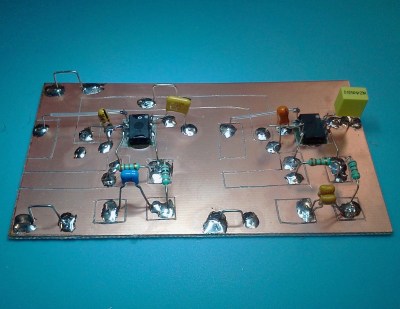
It’s a very tasteful build, showing off [Seamus]’s minimalist chops – consisting of just a decade counter, a tilt sensor, and some LEDs. When the card is shaken, the tilt sensor outputs a series of pulses to the clock line of the decade counter, whose outputs are the 8 LEDs. When the tilt sensor settles, it lands on the final answer.

We think it’s a great card, which shows off both fundamental technical skills as well as a certain flair and creativity which can be key to landing exciting projects. It doesn’t hurt that it’s good fun, to boot. For another take on the Magic 8-ball, check out this build that can give you a Yes/No answer on demand.

3D Print A Thinner Car Key

Almost all modern cars come with keyless entry, some even come with keyless start. Of course, the price you pay for this technology is a bulky plastic keyfob that is an absolute pain to remove from your pockets, and generally spoils the lines of your carefully chosen outfit. [Jeremy] decided enough was enough.

The project begins with a careful disassembly of the original key. This is important to avoid damaging the PCB inside, particularly if there are any delicate wire links between different sections of the keyfob. With the piece disassembled, it was then time to start designing a replacement encasement to hasten escapement while pacing the pavement.

The 3D printer really is the perfect tool for the job here, and [Jeremy] employs it well. With this being a proximity-based keyfob, the buttons are only necessary if you want to operate the locks at a distance. They simply took up too much vertical space, so they had to go. In the end, with a redesigned housing for the PCB, and while retaining the backup mechanical key, the new fob is just 11mm, down from 18mm – a nearly 40% saving in thickness!

It’s a tidy way to clean up your pockets and make life easier. We’ve seen similar work before, too.

Pepper Mill Locks Your Door

Pepper! If you’ve ever tried to grind it, you’ve probably noticed it takes a bit of elbow grease. It’s actually possible to source electric pepper mills to grind it for you, in fact. It just so happens that [MarioM66] had one to hand, and a door lock that needed automating.

Seeing as grinding pepper requires at least as much torque as turning an average key in an average lock, the electric pepper mill makes perfect sense to use as a lock actuator. This build actually uses the electric pepper mill to directly turn the key in the lock, courtesy of an adapter to couple the square output shaft to the key. The adapter was crafted out of a moldable plastic called MultiMorph. The pepper mill is being used for its high-torque motor & gearbox, which makes it absolutely perfect for this application.

The rest of the project leans heavily on the hacker’s go-to, an Arduino and some off-the-shelf gesture recognition modules. Now, it’s possible to lock and unlock the door at the press of a button or the wave of a hand! Video after the break.

It’s great to see run-of-the-mill objects hacked into useful parts for new projects. In the same vein, check out this car that lets you fistbump to unlock.

Continue reading “Pepper Mill Locks Your Door”

Reverse Engineering Bottle Threads For Fun And Profit

Recently, one of [Eric]’s clients asked him to design a bottle. Simple enough for a product designer, except that the client needed it to thread into a specific type of cap. And no, they don’t know the specs.

But that’s no problem, thought [Eric] as he turned on the exhaust fan and reached for the secret ingredient that would make casting the negative image of the threads a breeze. He mixed up the foul-smelling body filler with the requisite hardener and some lovely cyan toner powder and packed it into the cap with a tongue depressor. Then he capped off the cast by adding a small PVC collar to lengthen the cast so he has something to grab on to when it’s time to take it out.

Bondo does seem like a good choice for casting threads. You need something workable enough to twist out of there without breaking, but rigid enough that the small detail of the threads isn’t lost. For the release agent, [Eric] used Johnson’s Paste Wax. He notes from experience that it works particularly well with Bondo, and even seems to help it cure.

Once the Bondo hardened, [Eric] made sure it screwed in and out of the cap and then moved on to CAD modeling and 3D printing bottle prototypes until he was satisfied. We’ve got the video screwed in after the break to cap things off.

Did you know that you can also use toner powder to tint your epoxy resin? Just remember that it is particulate matter, and take precautions.

Continue reading “Reverse Engineering Bottle Threads For Fun And Profit”

An 8-Bit ALU, Entirely From NAND Gates

One of the things that every student of digital electronics learns, is that every single logic function can be made from a combination of NAND gates. But nobody is foolhardy enough to give it a try, after all that would require a truly huge number of gates!

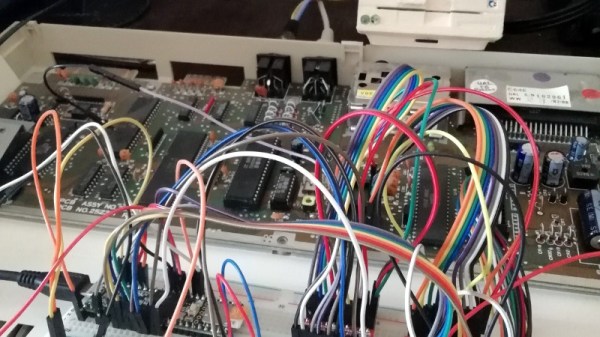
Someone evidently forgot to tell [Notbookies], for he has made a complete 8-bit ALU using only 4011B quad NAND gates on a set of breadboards, and in doing so has created a minor masterpiece with his wiring. It’s inspired by a series of videos from [Ben Eater] describing the construction of a computer with the so-called SAP (Simple As Possible) architecture. The 48 4011B DIP packages sit upon 8 standard breadboards, with an extra one for a set of DIP switches and LEDs, and a set of power busbar breadboards up their sides. He leaves us with the advice borne of bitter experience: “Unless your goal is building a NAND-only computer, pick the best IC for the job“.

We have covered countless processors and processor components manufactured from discrete logic chips over the years, though this makes them no less impressive a feat. The NedoNAND has been a recent example, a modular PCB-based design. TTL and CMOS logic chips made their debut over 50 years ago so you might expect there to be nothing new from that direction, however we expect this to be  well of projects that will keep flowing for may years more.

Via /r/electronics/.

Build Your Own Antenna For Outdoor Monitoring With LoRa

LoRa and LPWANs (Low Power Wide Area Networks) are all the range (tee-hee!) in wireless these days. LoRa is a sub 1-GHz wireless technology using sophisticated signal processing and modulation techniques to achieve long-range communications.

With that simplified introduction, [Omkar Joglekar] designed his own LoRa node used for outdoor sensor monitoring based on the HopeRF RFM95 LoRa module. It’s housed in an IP68 weatherproof enclosure and features an antenna that was built from scratch using repurposed copper rods. He wrote up the complete build, materials, and description which makes it possible for others to try their hand at putting together their own complete LoRa node for outdoor monitoring applications.

Once it’s built, you can use this simple method to range test your nodes and if you get really good, you might be setting distance records like this.

This Is How The Fonz Would Play MP3s

Here at Hackaday, we love to see old hardware treated with respect. A lovingly restored radio or TV that’s part of our electronic heritage is a joy to behold, and while we understand the desire to stream media from a funky retro case, it really grates when someone throws away the original guts to make room for new electronics.

Luckily, this Seeburg jukebox wall remote repurposing is not one of those projects. [Scott M. Baker] seems to have an appreciation for the finer things, and when he scored this classic piece of Mid-Century Americana, he knew just what to do. These remotes were situated around diners and other hangouts in the 50s and 60s and allowed patrons to cue up some music without ever leaving their seats. They were real money makers back in the day, and companies put a lot of effort into making them robust and reliable.

[Scott]’s first video below shows the teardown of this unit; you can practically smell the old transformer and motor windings. His goal in the second video was to use the remote to control his Raspberry Pi jukebox; he wisely decided to leave everything intact and use the original electromechanically generated pulses to make selections. His analysis led to a nicely executed shield for his Pi which conditions the pulses and imitates coin drops; happily, the coin mechanism still works too, so you can still drop a quarter for a tune.

The remote is working well now, but [Scott] still needs to finish up a few odds and ends to bring this one home. But we love the look and the respect for tradition here, as we did when this juke got a Raspberry Pi upgrade to imitate a missing wall remote.

Continue reading “This Is How The Fonz Would Play MP3s”