The Seemingly Impossible Oscillator

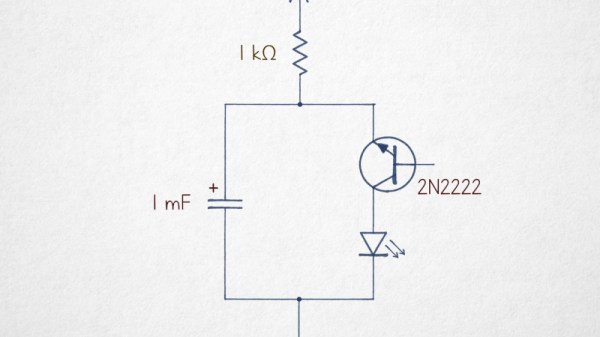
Back in the days when an integrated circuit meant a simple but expensive device such as a 741 or a 555, most electronics enthusiasts made do with discrete transistor circuits. The common emitter amplifier and its variants are the most familiar, but the humble 3-legged device can do so much more. A particularly obtuse circuit is the subject of examination by [lcamtuf], the reverse avalanche oscillator. A 2N2222, a capacitor, an LED, and a resistor, the transistor is the wrong way round, and there’s nothing on its base. Yet the LED flashes, what on earth is up!

The answer lies in avalanche breakdown, the behavior of a reverse biased diode junction as the voltage across it increases. Eventually the electric field reaches the point at which an avalanche of electrons crosses the depletion layer, and the junction conducts. When connected across an RC circuit, the voltage in the capacitor slowly rises to the point at which avalanche breakdown occurs, and the capacitor abruptly discharges. As the voltage falls the avalanche conduction stops, and the cycle repeats itself. It’s a relaxation oscillator.

We’re treated to an explanation of why a transistor behaves this way and why a simple diode doesn’t, due to a “hump” in its I/V curve, and why the emitter-base junction has a lower breakdown voltage than the collector-base. It’s one of those circuits which looks as though it shouldn’t work, but never fails to oscillate.

Want to know more about transistors? Do we have the series for you!
Voltmeter-Based Floating Point Calculator Does It In Style

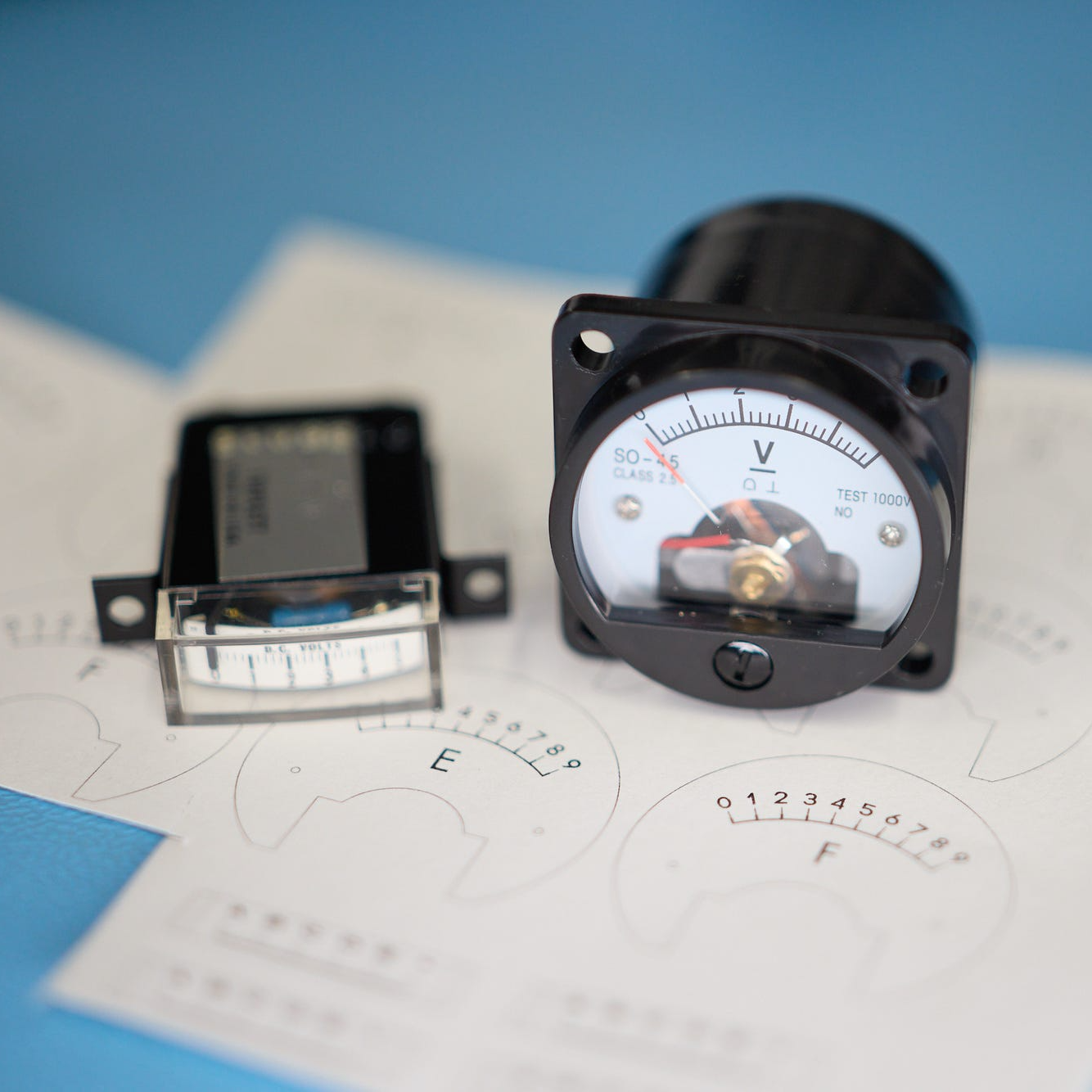
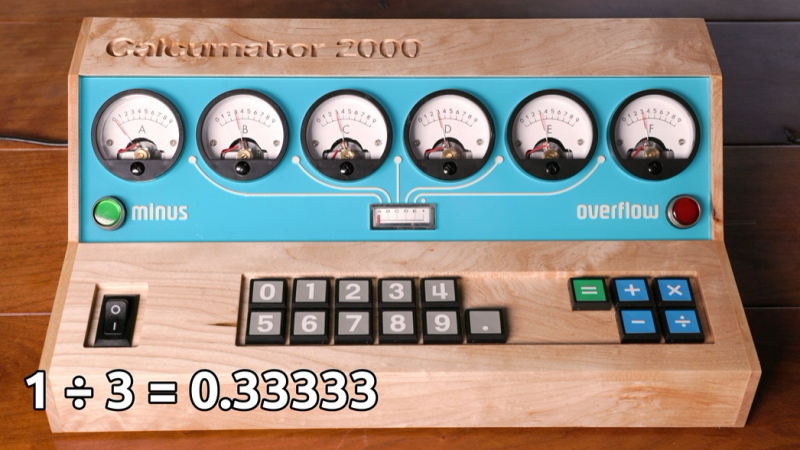
[lcamtuf] is not just a calculator superfan, but also a skilled builder. That much is evident in the fabulous  design of Calcumator 2000, an electromechanical calculator that uses voltmeter readouts as digits (plus one at the bottom to represent decimal place). There are plenty of high-quality build images, so give it a look!

Meters like the one on the right (numbered 0 to 9) act as digit displays. The meter on the left indicates decimal position.

Calcumator 2000 is a bit of a love letter to a time when display technology hadn’t quite yet produced anything suitable for calculator use. This resulted in calculator designs that are generally unrecognizable compared to the 7-segment display based devices we see today. The Calcumator 2000, in all its electromechanical glory, would have fit right in that era.

The Calcumator 2000 has all the usual buttons one would expect from a simple calculator and drives a total of seven readouts, one of which acts as the decimal point. The idea of using voltmeters as digit displays came from [lcamtuf]’s voltmeter clock, an earlier work with a similar attention to detail in its design and assembly.

We want to take a moment to admire how clean the blue panel is. [lcamtuf] made it by painting one side of an acrylic panel, cutting the letters and design out on a CNC mill, then filling with white paint. The depth of the cuts gives the white elements a nifty multi-layer effect that really complements the design.

Want to see it work? Oh yes, you do. Check out the video, embedded just below.

Continue reading “Voltmeter-Based Floating Point Calculator Does It In Style”

Three Different Digital Counters To Remind Us How Good We Have It

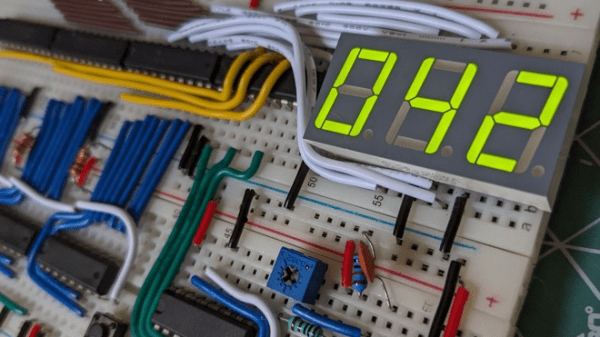
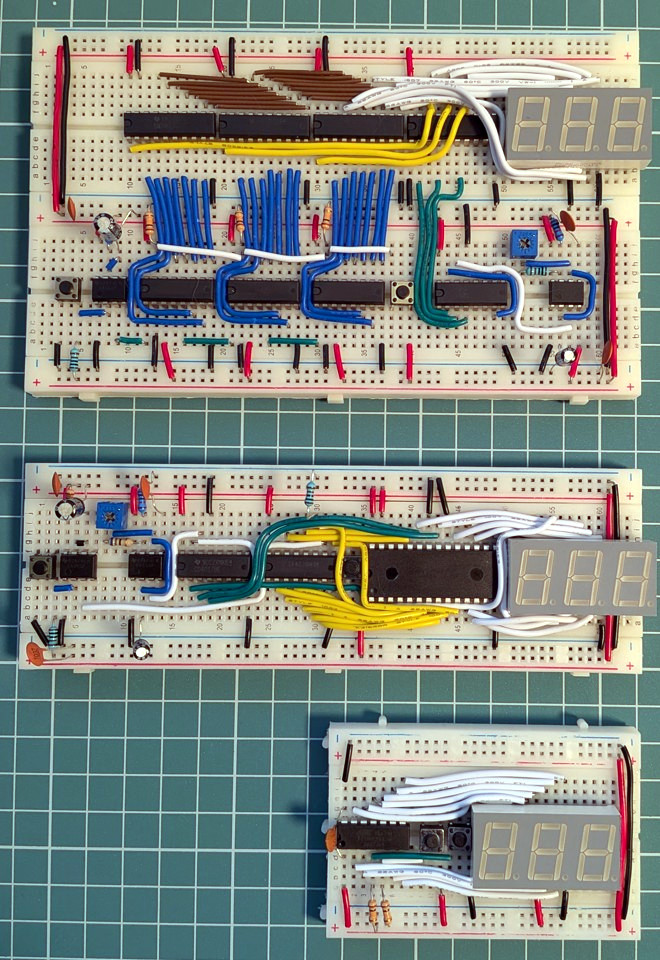
Integrated electronic modules like counters and displays are convenient and space-saving, which may also make them easy to take for granted. [Nagy Krisztián] demonstrates this by making three very different digital counter designs, each breadboarded with a 7-segment LED display. Push a button, and the displayed number increments by one for each press. It was a personal project that ended up educational in more ways than one.

The progressively-integrated designs shrink in part count and board space, but the complexity doesn’t disappear. It just moves into software.

The first version uses discrete components only, and even though it handles the counting with CD4026B decade counter ICs instead of building counters from scratch with NAND gates, it’s still by far the largest of the three. The second version simplifies driving the display with an AT28C64B EEPROM acting as a sort of hardware lookup table translating binary counts into 7-segment digit display patterns. The third uses an ATtiny24A microcontroller, and unsurprisingly has the smallest footprint.

All of this highlights two things. One is that implementing even a simple counter and 7-segment LED readout is a nontrivial affair when one gets right down to it, even when taking advantage of purpose-built ICs. The second is that the complexity that is on full display in the first version doesn’t simply disappear as the footprint and component count goes down. Rather, it moves into software and other infrastructure, like the need for compilers and chip programmers.

The whole thing is both educational and a reminder of how good the average hardware hacker has it today. There are so many effective electronic assemblies, available to just about anyone at low cost, that it can be very easy to take it all for granted and forget just how much breadboard space and wires were needed for even simple-seeming things.

[Nagy] is certainly no stranger to dealing with a lot of wires, as we’ve seen when he fooled a 286 processor into thinking it was plugged into a functioning vintage motherboard.

The Organ That Forgot To Use Transistors

When we think of 1960s synthesizers it’s usual to imagine instruments with vast arrays of controls and patch cables for configuring their many filters, oscillators, and other parameters. They created the templates for much of what we know today as electronic music.

In all the rush to look at full-blown synths though, it’s easy to forget their more mundane cousin, the electric organ. These instruments graced many a ’60s suburban home or church hall, and [Emma Repairs] has an interesting one. It’s a Philips Philicordia, and it’s sent us here at Hackaday down one of those rabbit holes when we should really be writing.

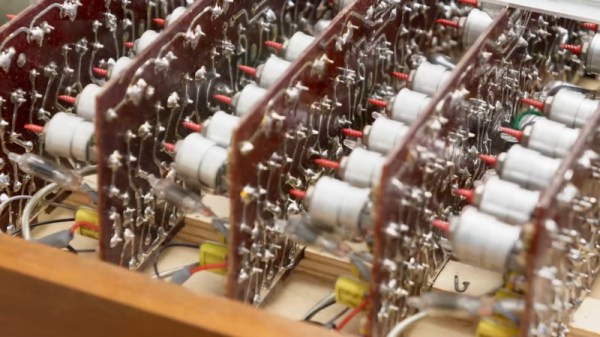
The instrument is a relatively straightforward single voice electric organ on the outside, but under the hood it’s a different matter. In an age when the transistor was revolutionizing electronic music, the folks in Eindhoven designed this one using tubes. There are a set of conventional enough tubes performing the role of amplifiers and oscillators, but the real party piece of this unit is the array of neon tube dividers. A neon bulb can be used as a switching element, and in those days when affordable digital logic chips were several years away, it made sense to use them in digital circuits.

The inside of the Philicordia is a feast of vintage Philips parts that will be instantly familiar to anyone who’s worked on Western European electronics of this era. The exterior design of the instrument screams understated early-1960s cool, and after she’s introduced it you can hear her playing it in the video below. Further down that rabbit hole we found that one of these instruments provided the distinctive organ sound on Chris Montez’s 1962 hit Let’s Dance, so they weren’t all uncool.

Continue reading “The Organ That Forgot To Use Transistors”

Hard Drive Speakers Crank Out Classic Demo

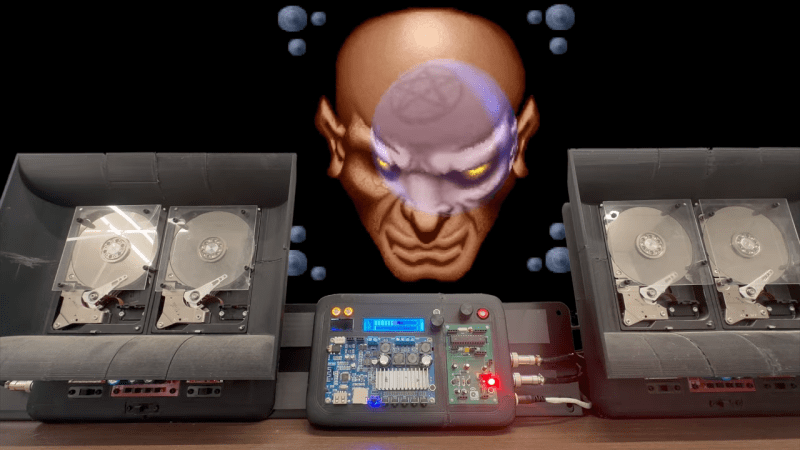
Second Reality is a legendary demoscene release by Future Crew, which won Assembly 1993 with its technical and artistic mastery. [Niv Singer] decided to give the classic demo a spin on a rather unconventional sound system with a particuarly techy twist.

Hard drives are great for storing data. They’re designed for this purpose. What they’re not designed for is acting as speakers, but you can hack them into acting that way if you’re so inclined. For this project, [Niv] pulled apart a whole stack of drives, so they could be repurposed in this way. The principle is simple enough—just feed audio to the coil driving the head, and it will vibrate and wiggle around, creating soundwaves in the air. It’s not particularly effective, and you get limited volume with a terrible frequency response, but that’s half the fun. [Niv] actually took some of this into account, too. Four Western Digital Caviar 500GB drives were chosen for this build, two for the left channel, and two for the right. Each channel had a crossover, allowing one drive to handle low frequencies while the other handled higher ones. For a further nice touch, the platters spin with the beat as well, with [Niv] providing a great explanation on how this was achieved with the use of some nifty PWM tricks.

Files are on Github for the curious. We’ve featured plenty of hard drive speakers before, too. Video after the break.

Continue reading “Hard Drive Speakers Crank Out Classic Demo”

Alan Turing’s Remarkable, Nearly-Forgotten Voice Encryption Device

[Popular Mechanics] has an interesting article about Alan Turing’s nearly-forgotten speech encryption device. Codenamed Delilah, it was in many ways an early form of digital encryption. It was secretly developed alongside his most famous wartime achievement of breaking the encryption used by the Nazis’ Enigma machine; itself a remarkable device we’ve covered in detail in the past.

Delilah was developed at a separate location, and Turing worked with a young electrical engineer by the name of Donald Bayley who not only helped Turing implement design concepts and theory as practical circuitry, but took copious notes of their work and discussions. His documents went up for auction in 2023, a few years after his death, and they reveal a first-hand account of their work.

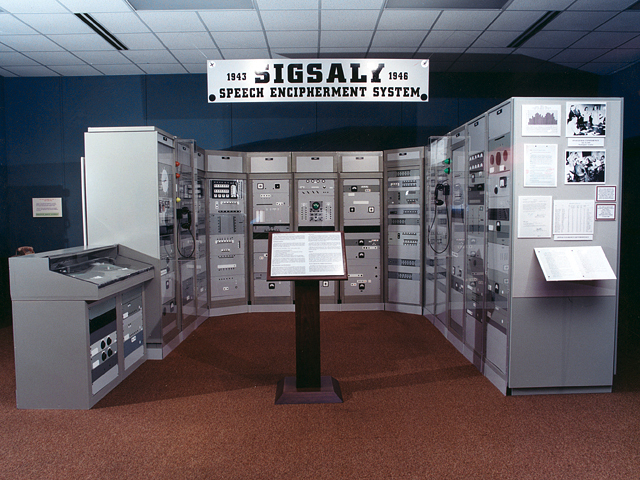
SIGSALY (the name is not an acronym, by the way) was a working voice encryption system whose main drawbacks were its massive size, weight, and power requirements. [image: Wikipedia]
Back then, a vocal encryption system did exist. Bell Labs had developed SIGSALY, a seriously top-secret system that provided encrypted voice communications at the highest levels. But one of SIGSALY’s biggest drawbacks was that it was absolutely monstrous.

Delilah did the same job, but was portable and battery-powered. Delilah was three small boxes weighing around 39 kg, and it’s hard to overstate just how remarkable of a feat of miniaturization this was. However, by the time Delilah was wrapped up, the war was over and the project wound down without ever being produced or deployed in any meaningful way.

Encrypted communications is standard stuff today, but back then there was simply no need for a vocal encryption system in peacetime. The reason we know what we do today is thanks mainly to the effort Bayley put into documenting things. It’s yet another achievement by a man for whom life was far from being either easy or fair; Turing was prosecuted by his own government for “homosexual acts” and ultimately took his own life in the years following the war.

It again demonstrates that if the people involved don’t write things down while they know it, that knowledge can simply disappear. Sometimes people make the effort and the rest of us benefit, like with the Delilah project and also with the history of liquid rocket propellants — a dry-sounding topic that we assure you is anything but.

New Record Resurrects Long-Dead CD Graphics Format

Audio CDs were the ubiquitous audio format of the 1990s. Lesser known were the extensions to the format that packaged all kinds of interesting additional data into a musical release. Now, a new record from [Aizysse Baga] has brought back some of the most quirky and obscure CD features that time and industry long forgot.

[Aizysse Baga] worked with [Adelaide] on the Divacore record, which was to be released on a mini-CD. The original plan was to include additional CD+G data, featuring artwork to go with the music. CD+G, or CD+Graphics, was often used to display synchronized lyrics for karaoke releases, and stored data in formerly-unused subcodes next to the track start, track number, and running time data. This format allowed storing a slideshow of images with a resolution of 288 x 192 with a 16 color palette.

Note the quality difference between the 16-color CD+G and the 256-color CD+EG images.

The duo got handy with art and some smart dithering to get great 16-bit artwork packed in to the audio CD release, with the aid of a custom Python encoder. CD-TEXT metadata was thrown in for good measure. Then, the existence of the more advanced CD+EG became apparent. This was a 256-color extension to the CD+G format that was backwards compatible to boot. It was a format that was barely ever implemented on any commercial releases, and very little hardware could even display it. Naturally, Divacore had to have it. Much work was done to understand the Red Book documentation on the standard and figure out how to implement even higher quality artwork for the record.

After so much work to understand and implement the CD+G and CD+EG data, the question was whether it would survive the CD reproduction process for the final release. Thankfully, the final discs came out perfectly, and the full 256-color CD+EG artwork can be seen in all its glory if you happen to play Divacore on a Sega Saturn or a super-obscure Victor VS-G2 or VS-G3. Throw it in a less-sophisticated karaoke machine or something like an Amiga CD32, and you’ll still get to see the 16-color versions for your trouble.

We love to see ancient formats brought back to life, particularly those that never got their time in the sun. If you’re working hard to resurrect something the mainstream media world has forgotten, let us know on the tipsline.