Wooden Wide-Angle Wonder Wows World

An old-fashioned film camera can be an extremely simple device to make, in that as little as a cardboard box with a pin hole in it will suffice. But that simplicity at heart leaves endless scope for further work, and a home-made camera can be every bit as much a highly-engineered object of beauty as its commercial stablemate. A great example comes from [Aaron Cré], whose desire for something close to a Hasselblad XPan panoramic camera led him to build his own equivalent out of wood.

The video below the break shows in detail how the wooden case is crafted, and how a lens mount ring sawn from a lens adapter is mounted on the front of it. He’s skipped making all the tiresome parts of the camera associated with winding and film transport and instead taken them from a cheap plastic snapshot camera. The original aspect ratio is stretched by cutting the guts of the snapshot camera apart, and extended to make a 75 mm long negative which also exposes over the sprocket holes.

The final camera is carefully finished to the point at which it really looks the part as well as taking those striking wide-angle photographs. We’re not photography buffs enough to identify the lens and shutter combination he’s using, but we can’t help envying him the results. Fancy making your own 35 mm camera too? Here’s another, in case you need inspiration.

Continue reading “Wooden Wide-Angle Wonder Wows World”

New Take On The Camera Obscura Brings Paris Indoors

We haven’t checked, but we’ll go out on a limb here and say this is the first project we’ve featured with a BOM that includes “an apartment in Paris with a breathtaking view of the Eiffel Tower.” We suppose there are other places in the world where a giant camera obscura like this would work too, but you’ve got to admit that the view is pretty spectacular.

Of course, a camera obscura is really just a dark room — that’s literally what it means in Latin — with a small aperture to admit light from the outside world. This projects an inverted image on the opposite wall, which must have looked absolutely magical to pre-technical people and honestly is still pretty stunning today. Either way, it’s a low-tech way of seeing the world in a different light. [Mathieu Stern] decided his camera obscura would turn the traditional design on its head. Literally — he wanted an upright image. Luckily, he found a supplier that makes special optics for camera obscura that do just that. It looks like the optic uses a Dove prism to invert the image, or in this case to turn it back into an upright image.

The real hack here was finding the perfect place with just the right view of the Eiffel Tower — not at all an easy task in a medieval city where streets go where they will and buildings tend to block the sightlines. [Mathieu] eventually managed to find just the right place. With a little aluminum foil to make the rented room really obscura and some strategically positioned sheets to improve the projection surface, he was able to project some beautiful images of the landmark and surrounding cityscape in a panorama on the apartment walls. The video below has some stills and time-lapse sequences that are pretty breathtaking.

We’ve seen other camera obscura before, including this mobile version which may have made things easier for [Mathieu], at the price of giving up a lot of the charm.

Continue reading “New Take On The Camera Obscura Brings Paris Indoors”

A Time-Lapse Film, Not A Time-Lapse Video

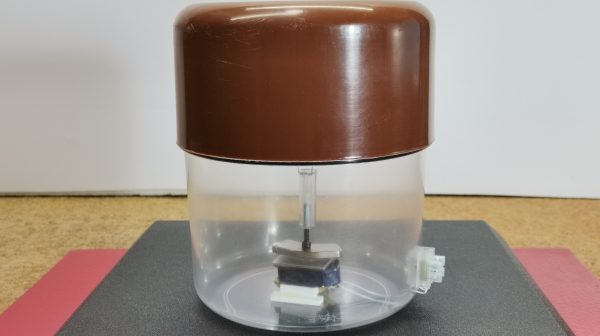
We’re used to time-lapse photography being merely a feature of our smartphone camera app, but of course it has its origins in film. A movie camera would be triggered frame by frame at fixed intervals, with the result being the timelapse. A dead art, you might wonder, were it not for [Kevin Santo Cappuccio], who is capturing his work in timelapse on 16mm film, with a vintage Bolex camera.

For those of us with a penchant for film the camera alone makes it worth a second look, but the actuation mechanism is at the heart of the project. It uses a slightly unusual but nevertheless strangely ubiquitous actuator, in the form of a car door central locking actuator. This in turn is triggered by an Arduino Nano, and he has the ultimate dream of using a 16mm film timelapse as part of a fully-16mm submission video for the Hackaday prize.

We think it’s a pity that more film-based projects don’t end up on these pages, so we’re very pleased indeed to see this one. If you’re curious about the other side of the 16mm system, well we’ve introduced you to the inner workings of a projector before, too.

Vintage Artificial Horizon Is Beautiful In Motion

Attitude indicators are super useful if you’re flying a plane, particularly in foggy conditions or over water. They help you figure out which way the plane is pointing relative to the unforgiving ground below. [Hack Modular] has been toying with a few, and even figured out how to get them powered up!

The attitude indicators use spinning gyroscopes to present a stable artificial horizon when a plane is in motion. Airworthy models are highly expensive, but [Hack Modular] was experimenting with some battered surplus examples. He sets about opening the delicate gauges, noting the seals and other features intended to protect the equipment inside. We get a great look at the gimbals and the reset mechanism used to zero out the device. He then pulls a classic mechanic’s trick, robbing a few screws from Peter to reassemble Paul.

We wouldn’t trust the gauges for flight duty, but they look great when powered up, all lit and spinning. They have the beautiful vintage glow that you only get from filament bulbs and deftly painted instrumentation. While avionics don’t come cheap off the shelf, it’s worth tinkering with cheap older gear if you can find it. The engineering involved, even in older equipment, is truly impressive. Video after the break.

Continue reading “Vintage Artificial Horizon Is Beautiful In Motion”

An LM386 Oscillator Thanks To Tungsten Under Glass

Once ubiquitous, the incandescent light bulb has become something of a lucerna non grata lately. Banned from home lighting, long gone from flashlights, and laughed out of existence by automotive engineers, you have to go a long way these days to find something that still uses a tungsten filament.

Strangely enough, this lamp-stabilized LM386 Wien bridge oscillator is one place where an incandescent bulb makes an appearance. The Wien bridge itself goes back to the 1890s when it was developed for impedance measurements, and its use in the feedback circuits of vacuum tube oscillators dates back to the 1930s. The incandescent bulb is used in the negative feedback path as an automatic gain control; the tungsten filament’s initial low resistance makes for high gain to kick off oscillation, after which it heats up and lowers the resistance to stabilize the oscillation.

For [Grug Huler], this was one of those “just for funsies” projects stemming from a data sheet example circuit showing a bulb-stabilized LM386 audio oscillator. He actually found it difficult to source the specified lamp — there’s that anti-tungsten bias again — but still managed to cobble together a working audio oscillator. The first pass actually came in pretty close to spec — 1.18 kHz compared to the predicted 1.07 kHz — and the scope showed a very nice-looking sine wave. We were honestly a bit surprised that the FFT analysis showed as many harmonics as it did, but all things considered, the oscillator performed pretty well, especially after a little more tweaking. And no, the light bulb never actually lights up.

Thanks to [Grug] for going down this particular rabbit hole and sharing what he learned. We love builds like this that unearth seemingly obsolete circuits and bring them back to life with modern components. OK, calling the LM386 a modern component might be stretching things a bit, but it is [Elliot]’s favorite chip for a reason.

Continue reading “An LM386 Oscillator Thanks To Tungsten Under Glass”

PentaBlinky – When One LED Is Not Blinky Enough

[michimartini] over on Hackaday.io loves playing with multivibrator circuits, and has come across a simple example of a ring oscillator. This is a discrete transistor RC-delay design utilizing five identical stages, each of which has a transistor that deals with charging and discharging the timing capacitor, passing along the inverted signal to its nearest neighbor. The second transistor isn’t strictly needed and is only there to invert the signal in order to drive the LED. When the low pulse passes by the LED lights, without it you’d see all the LEDs lit bar one, which doesn’t look as good.

Compare this with an astable multivibrator to understand how it works

Essentially this circuit is just the classic astable multivibrator circuit that has been split in half and replicated so that the low pulse propagates through more stages than just the two, but thinking about it as a single stage doesn’t work so well until you draw in a couple of neighbors to help visualize the behavior better.

[michimartini] does lament that the circuit starts up in a chaotic fashion and needs a quick short applying to one transistor element in order to get it to settle into a steady rhythm. Actually, that initial behaviour could be interesting in itself, especially as the timing changes with voltage and temperature.

Anyway, we like the visual effect and the curvy organic traces. It would make a neat pin badge. Since we’re thinking about blinkies, here are couple of somewhat minimalist attempts, the world’s smallest blinky, and an even smaller one. Now, who doesn’t love this stuff?

Continue reading “PentaBlinky – When One LED Is Not Blinky Enough”

A ZX Spectrum with a Microdrive emulator plugged into its expansion port

A Modern Replacement For The ZX Spectrum’s Odd Tape Storage System

Unless you were lucky enough to be able to afford a floppy disk drive, you probably used cassette tapes to store programs and data if you used pretty much any home computer in the 1980s. ZX Spectrum users, however, had another option in the form of the Microdrive. This was a rather unusual continuous-loop mini-tape cartridge that could store around 100 kB and load it at lightning speed, all at a much lower price point than a floppy drive. The low price came at the cost of poor durability however, and after four decades it’s becoming harder and harder to find cartridges that work reliably. [Derek Fountain] therefore set out to make a modern Microdrive emulator that stores data on SD cards.

Several projects already exist to replace Microdrives, but they typically also need the ZX Interface 1, a serial/network expansion module that’s becoming equally hard to find. Hence [Derek]’s choice to make his emulator a completely standalone system that directly plugs into the Spectrum’s expansion port.

A 3D-printed box with a PCB inside holding three Raspberry Pi Picos and an SD cardThe system is housed in a 3D-printed enclosure that holds two PCBs. Three Raspberry Pi Picos run the show inside: one to hold the ZX Interface 1’s ROM image and interface with the Spectrum’s bus, another to simulate the Microdrive, and a third to run the user interface and communicate with the SD card. The user can choose between eight tape images stored in .MDR format by using two pushbuttons and a rotary encoder, with a small OLED display showing the machine’s configuration.

While you might think that three dual-core 133 MHz ARM CPUs would run circles around the Spectrum’s Z80, it actually took quite a bit of work to get everyting running properly in real time. The 3.5 MHz bus clock rate gave the second Pico precious little time to fetch the required bytes out of its flash memory. Its RAM was fast enough for that, but too small to hold all eight tape images at the same time. In the end, [Derek] settled on using a separate 8 MB SPI DRAM chip that could easily keep up the data rate, with the Pi just using its GPIO ports to shuttle the data around.

All source code and extensive documentation are available on Derek’s excellent blog post and GitHub page. Be sure to also check out [Jenny]’s detailed review and teardown if you’d like to know more about the weird and wonderful Microdrive system.

Thanks for the tip, [Andrew]! Continue reading “A Modern Replacement For The ZX Spectrum’s Odd Tape Storage System”