Giant LEDs, Ruby Lasers, Hologram Displays, And Other Cool Stuff Seen At Maker Faire Rome

Hackers from all over Europe descended upon Rome last weekend for the Maker Faire that calls itself the “European Edition”. This three-day event is one of the largest Maker Faires in the world — they had 27,000 school students from all over Italy and Europe attend on Friday alone.

This was held at Fiera Roma, a gigantic conference complex two train stops south of the Rome airport — kind of in the middle of nowhere. I was told anecdotally that this is the largest event the complex hosts but have no data to back up that claim. One thing’s for certain, three days just wasn’t enough for me to enjoy everything at the show. There was a huge concentration of really talented hardware hackers on hand, many who you’ll recognize as creators of awesome projects regularly seen around Hackaday.

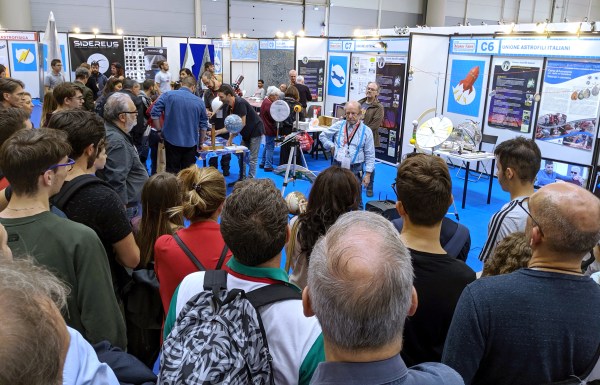
Here’s a whirlwind tour of some of my favorites. On that list are a POV holographic display, giant cast-resin LEDs, an optical-pump ruby laser built out of parts from AliExpress, blinky goodness in cube-form, and the Italian audience’s appreciation for science lectures (in this case space-related). Let’s take a look.

Continue reading “Giant LEDs, Ruby Lasers, Hologram Displays, And Other Cool Stuff Seen At Maker Faire Rome”

Tiny Cube Hosts A Hearty Tube

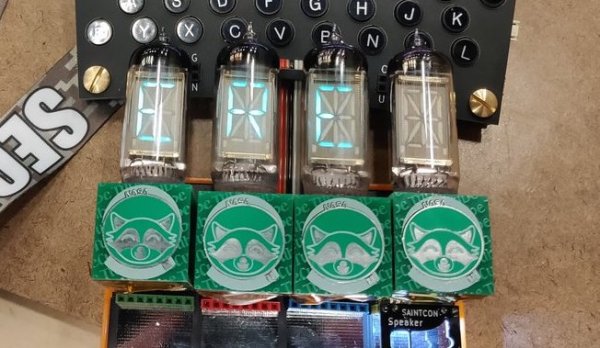
Tiny PCBAs and glowy VFD tubes are like catnip to a Hackaday writer, so when we saw [hamster]’s TubeCube tube segment driver we had to dig in to learn more. We won’t bury the lede here; let’s enjoy a video of glowing tubes before we go further:

The TubeCube is built to fit the MiniBadge badge addon standard, which is primarily used to host modules on the SAINTCON conference badge. A single TubeCube hosts a VFD tube, hardware to provide a 70 V supply, and a microcontroller for communication and control. Each TubeCube is designed to accept ASCII characters via UART to display on it’s display, but they can also be chained together for even more excitement. We’re not sure how [hamster] would be able to physically wear the beast in the video above, but if he can find a way, they all work together. If you’re interested in seeing the dead simple UART communication scheme take a look at this file.

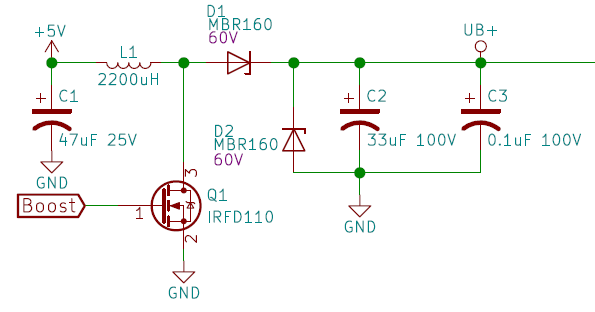
We think it’s also worth pointing about the high voltage supply. To the software or mechanically minded among us it’s easy to get trapped thinking about switching power supplies as a magical construct which can only be built using all-in-one control ICs. But [hamster]’s supply is a great reminder that a switching supply, even a high voltage one, isn’t as complex as all that. His design (which he says was cribbed from Adafruit’s lovely Ice Tube Clock) is essentially composed of the standard primitives. A big low voltage capacitor C1 to source the burst of energy which will be boosted, the necessary inductor/high voltage cap C2 which ends up at the target voltage, and a smoothing cap C3 to make the output a little nicer. It’s controlled by the microcontroller toggling Q1 to control the current flow through L1. The side effect is that by controlling the PWM frequency [hamster] can vary the brightness of the tubes.

Right now it looks like the repository has a schematic and sources, which should be enough to build a small tube driver of your own. If you can’t get enough TubeCubes, there’s one more video (of a single module) after the break.

Continue reading “Tiny Cube Hosts A Hearty Tube”

A Miniature Radio Telescope In Every Backyard

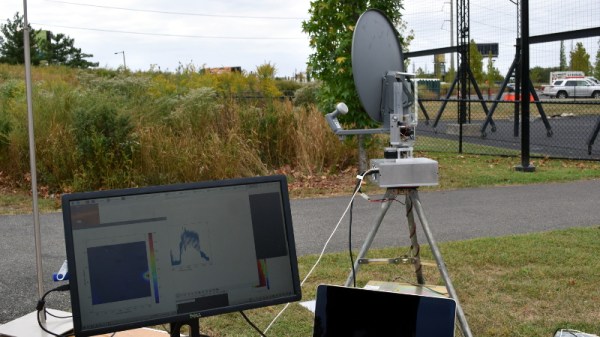
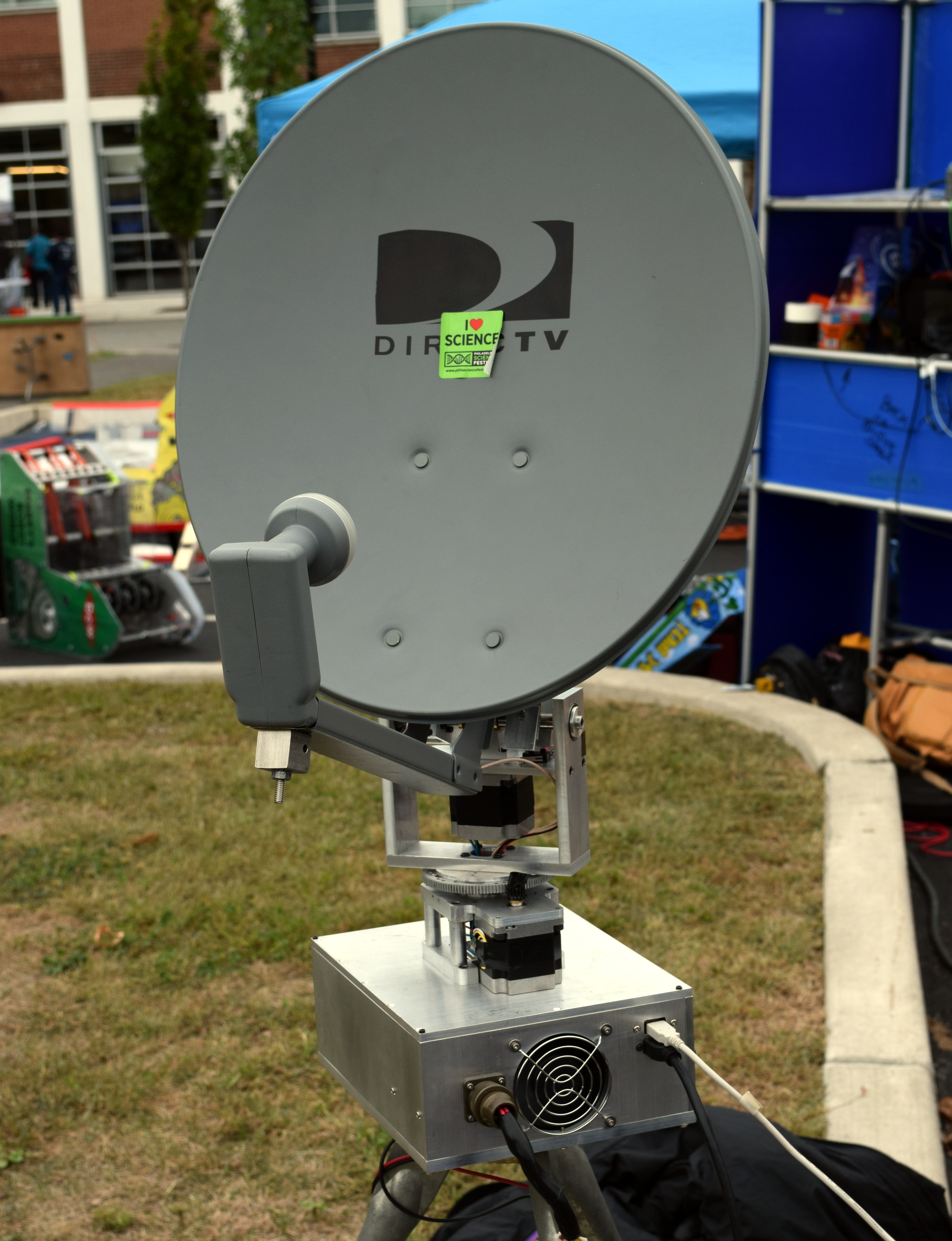
You probably wouldn’t expect to see somebody making astronomical observations during a cloudy day in the center of a dense urban area, but that’s exactly what was happening at the recent 2019 Philadelphia Mini Maker Faire. Professor James Aguirre of the University of Pennsylvania was there demonstrating the particularly compact Mini Radio Telescope (MRT) project built around an old DirecTV satellite dish and a smattering of low-cost components, giving visitors a view of the sky in a way most had never seen before.

Thanks to the project’s extensive online documentation, anyone with a spare satellite dish and a couple hundred dollars in support hardware can build their very own personal radio telescope that’s capable of observing objects in the sky no matter what the time of day or weather conditions are. Even if you’re not interested in peering into deep space from the comfort of your own home, the MRT offers a framework for building an automatic pan-and-tilt directional antenna platform that could be used for picking up signals from orbiting satellites.

With the slow collapse of satellite television in the United States these dishes are often free for the taking, and a fairly common sight on the sidewalk come garbage day. Perhaps there’s even one (or three) sitting on your own roof as you read this, waiting for a new lease on life in the Netflix Era.

Whether it’s to satisfy your own curiosity or because you want to follow in Professor Aguirre’s footsteps and use it as a tool for STEM outreach, projects like MRT make it easier than ever to build a functional DIY radio telescope.

Continue reading “A Miniature Radio Telescope In Every Backyard”

Maker Spirit Alive And Well At The Philly Maker Faire

For many of us, it’s difficult to imagine a world without Maker Faire. The flagship events in California and New York have served as a celebration of the creative spirit for a decade, giving hackers and makers a rare chance to show off their creations to a live audience numbering into the hundreds of thousands. It’s hard to overstate the energy and excitement of these events; for anyone who had the opportunity to attend one in person, it’s an experience not soon forgotten.

Unfortunately, a future without Maker Faire seemed a very real possibility just a few months ago. In May we first heard the events were struggling financially, and by June, we were saddened to learn that organizer Maker Media would officially be halting operations. It wasn’t immediately clear what would happen to the flagship Maker Faires, and when Maker Media reluctantly admitted that production of the New York Faire was officially “paused”, it seemed we finally had our answer.

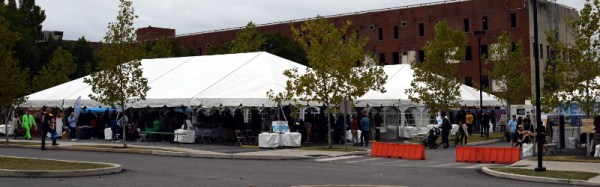
But as the recent Philadelphia Maker Faire proved, the maker movement won’t give up without a fight. While technically an independent “Mini” Faire, it exemplifies everything that made the flagship events so special and attracted an impressive number of visitors. With the New York event left in limbo, the Philadelphia Faire is now arguably the largest event of its type on the East Coast, and has the potential for explosive growth over the next few years. There’s now a viable option for makers of the Northeast who might have thought their days of exhibiting at a proper Maker Faire were over.

We’ll be bringing you detailed coverage of some of the incredible projects that were on display at the Philadelphia Maker Faire over the coming days, but in the meantime, let’s take a quick look at some of the highlights from this very promising event.

Continue reading “Maker Spirit Alive And Well At The Philly Maker Faire”

Name A Hacker Camp

Many of us look forward to visiting a summer hacker camp, as an opportunity to immerse ourselves in some of the coolest and most stimulating stuff that comes out of our community. The names trip off the tongue, ToorCamp, CCCamp, EMFcamp, BornHack, and more.

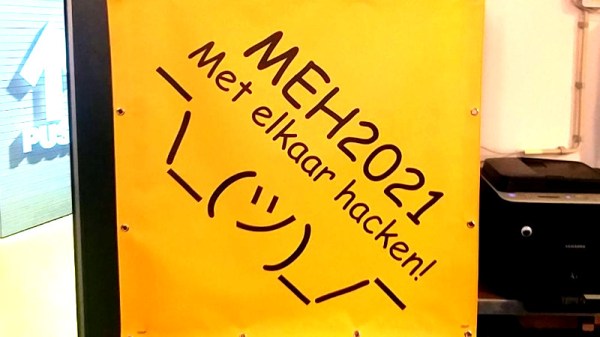
There’s one major event that doesn’t trip off the tongue in the same way though, because though it’s one of the oldest in our calendar it doesn’t have the same name every time. Since the end of the 1980s the Netherlands has seen a sequence of  hacker camps with three letter names such as HAR, OHM, and SHA. Every four years these events delight and amaze us, and every four years they need a new name. Do you think you can help them pick one for 2021?

There are a few ground rules to observe, for the would-be coiner of a new moniker. The tradition is of a three-letter acronym, usually one with a meaning somewhere in technology, and so far always containing the letter H somewhere to stand for “Hack” in some form. The idea is that it should somehow encapsulate the spirit of hacker camp culture rather than simply be three words containing “Hack”. HAR for example was Hacking At Random, OHM was Observe Hack Make, and SHA was Still Hacking Anyway. So if you can dream up a TLA within those parameters, there is a group of hackers in the Netherlands who might like to hear from you. We suspect that HAD is already taken.

If you want to know more about the Netherlands camps, read our review of SHA, in 2017.

Header image: [Renze]. “Met Elkaar Hacken” means something close to “Hack together”.

Speakers Taking The Stage At Supercon Plus A Hint Of The Hacking To Come

Four weeks from today the Hackaday Superconference comes alive for the fifth year. From engineering in challenging environments to elevating the art form of electronics, here are nine more talks that will make this a year to remember.

In addition to the slate of speakers below there are three other announcements, plus workshops. Jeroen Domburg (aka Sprite_TM) is designing this year’s badge based around a beefy FPGA running a RISC-V core and using open source synthesis tools. We’ll have more on that soon, but if you just can’t wait, check out the expansion board spec he just published, and join the conference chat room for the inside track. Badge hacking is sure to be the liveliest we’ve ever seen.

Tickets are sold out but you can still get on the waiting list and hope that one becomes available. If you are holding onto one of these hot commodities but are unable to use it, please return your ticket so that we can get it to someone waiting with their fingers crossed.

The Talks (Part Four of Many)


  • Laurel Cummings

    When it Rains, It Pours

    Over the last two years my work has been beyond ordinary, building and prototyping in strange locations like being stranded on a sailboat in the Atlantic Ocean, teaching US Marines in Kuwait, and building fuel gauge sensors for generators for vital systems in North Carolina post hurricane Florence. Some of the big lessons I’ve learned are about how to source materials and supplies in weird places, like finding potentiometers in the backwoods of North Carolina when Amazon cannot physically deliver across flooded highways, how to find welding gas in Kuwait City (and how a local chef could possibly be your best bet), or how far you can get with an O’Reilly’s Auto Parts store near the city docks. These situations help you really see the “engineer creep” that can happen to a project. I’ve learned that when you’re in high-risk situations, you really should stop caring about whether the edges of your 3D print are chamfered. In fact, version 1 of the hurricane fuel gauge sensor was demonstrated while being housed inside an elegant, tasteful sandwich baggie.


  • Angela Sheehan

    Building Whimsical Wearables: Leveling Up Through Playful Prototyping

    Whether it’s for a theme party, Halloween, cosplay, or That Thing in The Desert, designing wearables for whimsical self expression presents a great opportunity to challenge yourself as a maker, wearer, and collaborator. As an artist and designer who crash landed into a career in tech, I’ve found that imposter syndrome can often place limits on what feels personally achievable from an electronics and programming standpoint. Recontextualizing a project to shift the focus from ‘wearable tech hardware endeavor’ to ‘quirky mixed media experiment in personal styling’, I’ve created a safe space to play and try new things just outside my skill set and produced some of my most technically complex and polished personal work. Take a journey with me through the process of conceptualizing and building my Color Stealing Fairy project, an exercise in iterative design and upgrading an interactive wearable project over the course of two years and counting.


  • Michael Ossmann and Kate Temkin

    Software-Defined Everything

    The popularity of Software-Defined Radio (SDR) has led to the emergence of powerful open source software tools such as GNU Radio that enable rapid development of real-time Digital Signal Processing (DSP) techniques. We’ve used these tools for both radio and non-radio applications such as audio and infrared, and now we are finding them tremendously useful for diverse sensors and actuators that can benefit from DSP. In this talk we’ll show how we use the open source GreatFET platform to rapidly develop an SDR-like approach to just about anything.


  • Kelly Heaton

    “Hacking Nature’s Musicians” (or, “The Art of Electronic Naturalism”)

    The general lack of acceptance of electronic art results from a scarcity of critics, curators, collectors, and grantors who understand electronic media, compounded by a cultural gap between the artistic and engineering communities. In order to solve this problem, we must stretch our comfort zone and vocabularies to have a respectful, enlightening conversation with people with different educational backgrounds. In this talk I’ll discuss my wonderment at the simple, analog circuit designs that mimic life-like behavior such as chirping crickets and singing birds. This will include discussion of various schematics and demonstrations of a small. along with an abbreviated survey of my work to-date.


  • Jasmine Brackett

    Setting your Electronics Free

    In this panel we’ll discuss the key ways to get your projects from your workshop into the hands of the first few users, and what you can do to scale up from there. We’ll talk about common pitfalls, and also what are the best resources to draw upon.


  • David Williams

    MicroFPGA – The Coming Revolution in Small Electronics

    Big FPGA’s are awesome. They’re doing what they’ve always done, enabling AI, signal processing, military applications etc. However, there is a new possibility emerging – FPGA’s for small applications – which is quite possibly even more significant. Using open source tools, cheap flexible development boards, and new libraries, designers have a whole new set of options, creating incredibly high performance, flexible, low power projects and products.


  • Nick Poole

    Boggling the Boardhouse: Designing 3D Structures, Circuits, and Sensors from PCBs

    The presentation will be a series of design features or techniques with a few minutes of exploration into the ‘gotchas’ of each, as well as example layouts in EAGLE and physical examples. I’d like to cover as many different techniques as I can cram into 30 minutes, including bringing weird shapes into EDA, the inside corner problem caused by tab and slot, fillet soldering, stacking boards, imitating model sprues with mouse bites, manipulating the mask layer for custom displays, bendy tab buttons, working rotary encoder, and ergonomic design for handheld PCBs.


  • Ted Yapo

    Towards an Open-Source Multi-GHz Sampling Oscilloscope

    Tektronix designed a 14.5 GHz sampling oscilloscope in 1968. With the easy multi-layer PCB designs, tiny surface-mount parts, blazingly fast semiconductors, and computer horsepower available to the individual designer today, can a similar sampling head be re-created inexpensively with common, off-the-shelf components? Should be easy, right? It’s not. In this talk, I’ll discuss progress towards an open-source GHz+ sampling oscilloscope, including a lot of dead ends, plus some very promising leads.


  • Jeroen Domburg

    Building the Hackaday Superconference Badge

    The tradition of the Hackaday Supercon badge is to build something unlike any Supercon badge that came before. This year’s badge has an FPGA as its central component, and this comes with some extra challenges: the FPGA only comes in a BGA package with a whopping 381 pads to solder, and instead of just referring to the datasheet of the SoC to write the badge software, the SoC itself had to be written first.  I will discuss the development process of the badge, as well as the many challenges encountered along the way.


Keep Your Eye on Hackaday for the Livestream

The speakers you’ll see at Supercon have an amazing wealth of experience and we can’t wait to see their talks. But even if you couldn’t get a ticket, that doesn’t mean you have to miss out. Keep your eye on Hackaday for a link to the livestream which will begin on Saturday, November 16th.

Prusa Unveils New Mini 3D Printer, Shakes Up The Competition

For the last couple of years, consumer desktop 3D printer choices in the under $1,000 USD range have fallen into two broad categories: everything bellow $500 USD, and the latest Prusa i3. There are plenty of respectable printers made by companies such as Monoprice and Creality to choose from on that lower end of the scale. It wasn’t a luxury everyone could justify, but if you had the budget to swing the $749 for Prusa’s i3 kit, the choice became obvious.

Of course, that was before the Prusa Mini. Available as a kit for just $349, it’s far and away the cheapest printer that Prusa Research has ever offered. But this isn’t just some rebranded hardware, and it doesn’t compromise on the ideals that have made the company’s flagship machine the de facto open source FDM printer. For less than half the cost of the i3 MK3S, you’re not only getting most of the larger printer’s best features and Prusa’s renowned customer support, but even capabilities that presumably won’t make it to the i3 line until the MK4 is released.

Josef Průša was on hand to officially unveil his latest printer at the 2019 East Coast Reprap Festival, where I got the chance to get up close and personal with the diminutive machine. While it might be awhile before we can do a full review on the Mini, it’s safe to say that this small printer is going to have a big impact on the entry-level market.

Continue reading “Prusa Unveils New Mini 3D Printer, Shakes Up The Competition”