Hackaday Belgrade: Sophi Kravitz’s Blimp Army

Building things that fly is hard. The constraints on small, battery powered, radio-operated gear already presents a challenge, but adding weight, balance, and aerodynamic constraints takes it to a whole new level. Sophi Kravitz rises to the occasion and discusses each challenge of building a blimp from start to finish in her presentation at the 2018 Hackaday Belgrade conference.

One of the pleasures of writing for Hackaday comes through the incredible array of talent and experience to be found among our colleagues. We all do our own work, but one is humbled by that which flows from the benches of those one works alongside. Just such a project is the Remote Control Mini Blimp from our colleague Sophi Kravitz. It’s a game involving an obstacle course and a set of remote-controlled blimps. The challenges in such an endeavour have been pushing the limits of what is possible with off-the-shelf components. Continue reading “Hackaday Belgrade: Sophi Kravitz’s Blimp Army”

SMD Soldering Challenge Lands At DEF CON

Strap on the jeweler’s loupe and lay off the caffeine for a few days. You’ll need to be at your peak for the SMD Soldering Challenge at this year’s DEF CON (number 26 for those counting).

It’s exciting to see that a Soldering Skills Village has been added to the conference this year. It will be in the same room as the Hardware Hacking Village. After all, who doesn’t want to solder at a conference? This soldering challenge is a great way to ring in the new village, and will take place in eight heats of six people for a total of 48 contestants. If you want to compete, make sure you get to the village right away and sign up for a slot!

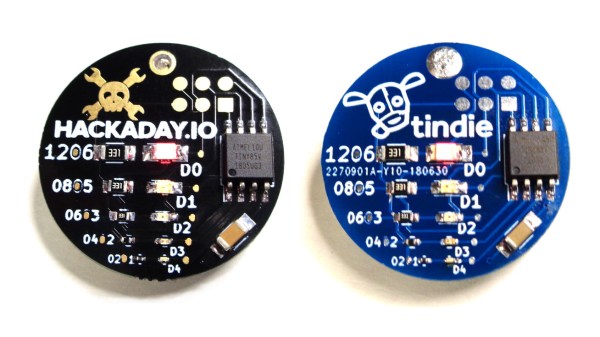
A familiar board is being used for the contest. It’s the SMD Challenge board which MakersBox developed. You can check out the Hackaday.io project page and even order one from their Tindie store if you like. The contest will be scored based on time, completion, functionality, precise orientation, and quality of the joints.

The SOIC ATtiny85 is a snap to place on the board, but things get harder with each step. To successfully complete it you need to solder both a resistor and an LED in 1206, 0805, 0603, 0402, and 0201 packages. Those oh-two-oh-ones are basically grains of sand… good luck with that! We’re really excited that MakersBox rolled some custom Hackaday and Tindie boards (pictured above) for this contest which we’re honored to sponsor. It sounds as if the winners will be announced during Hackaday and Tindie’s traditional Breakfast at DEF CON which is happening at 10:30am on Sunday in the HHV.

We plan to spectate during some of the heats and if you’re at the con you should too! For those participating, here’s our advice. Practice soldering the smallest of parts ahead of time (watch some videos on it at the very least). Bring a multimeter to test the diode polarity because you won’t be able to see the symbols on the smallest parts. You may even consider bringing some custom tools; this surface mount “clamp” comes to mind, you’ll just need a much smaller version.

If you have advice of your own, we’d love to hear it in the comments below!

This Weekend: The Vintage Computer Festival West

This weekend it’s all going down at the Vintage Computer Museum in Mountain View, California. The Vintage Computer Festival West is happening this weekend

What’s going on this year at VCF West? Far too much. The exhibits include everything from floptical disks, a fully restored and operation PDP-11/45, home computers from the UK and Japan, typewriters converted into teletypes, a disintegrated CPU, and LISP machines. The talks are equally spectacular, with a keynote from [Tim Paterson], the creator of 86-DOS, the basis of MS-DOS. You’ll also hear about PLATO, the Internet before the Internet, PDP-1 demonstrations, and if we’re lucky they’re going to fire up the ancient IBM 1401. There will also be a vintage computer consignment, which is at least as interesting as the exhibits. The consignment is basically a museum, but you can buy the exhibits.

VCF West is happening this weekend at the Computer History Museum in Mountain View, itself a worthy destination for a day trip. For one weekend a year, though, the Computer History Museum is taken over by VCF attendees and becomes the greatest place to learn about this history of computing. They even have one of those Waymo bug cars in their autonomous vehicle exhibit.

All of this is going down this Saturday and Sunday, starting at 9am. Tickets are $20 for one day, $30 for the entire weekend, and yes, that includes admission to the Computer History Museum. Don’t miss out!

Hackaday Belgrade: Luka Mustafa On Exploiting IoT Niches

Ecology is a strange discipline. At its most basic, it’s the study of how living things interact with their environment. It doesn’t so much seek to explain how life works, but rather how lives work together. A guiding principle of ecology is that life finds a way to exploit niches, subregions within the larger world with a particular mix of resources and challenges. It’s actually all quite fascinating.

But what does ecology have to do with Luka Mustafa’s talk at the 2018 Hackaday Belgrade Conference? Everything, as it turns out, and not just because Luka and his colleagues put IoT tools on animals and in their environments to measure and monitor them. It’s also that Luka has found a fascinating niche of his own to exploit, one on the edge of technology and ecology. As CEO of Institute IRNAS, a non-profit technology development group in Slovenia, Luka has leveraged his MEng degree, background in ham radio, and interest in LoRaWAN and other wide-area radio networks to explore ecological niches in ways that would have been unthinkable even 10 years ago, let alone in the days when animal tracking was limited by bulky radio collars.

Continue reading “Hackaday Belgrade: Luka Mustafa On Exploiting IoT Niches”

HOPE XII: A FOSS Operating System For E-Readers

Free and open source software (FOSS) was a recurring theme during many of the talks during the HOPE XII conference, which should probably come as no surprise. Hackers aren’t big fans of being monitored by faceless corporate overlords or being told what they can and cannot do on the hardware they purchased. Replacing proprietary software with FOSS alternatives is a way to put control back into the hands of the user, so naturally many of the talks pushed the idea.

In most cases that took the form of advising you to move your Windows or Mac OS computer over to a more open operating system such as GNU/Linux. Sound advice if you’re looking for software freedom, but it’s a bit quaint to limit such thinking to the desktop in 2018. We increasingly depend on mobile computing devices, and more often than not those are locked down hard with not only a closed proprietary operating system but also a “Walled Garden” style content delivery system. What’s the point of running all FOSS software at home on your desktop if you’re carrying a proprietary mobile device around?

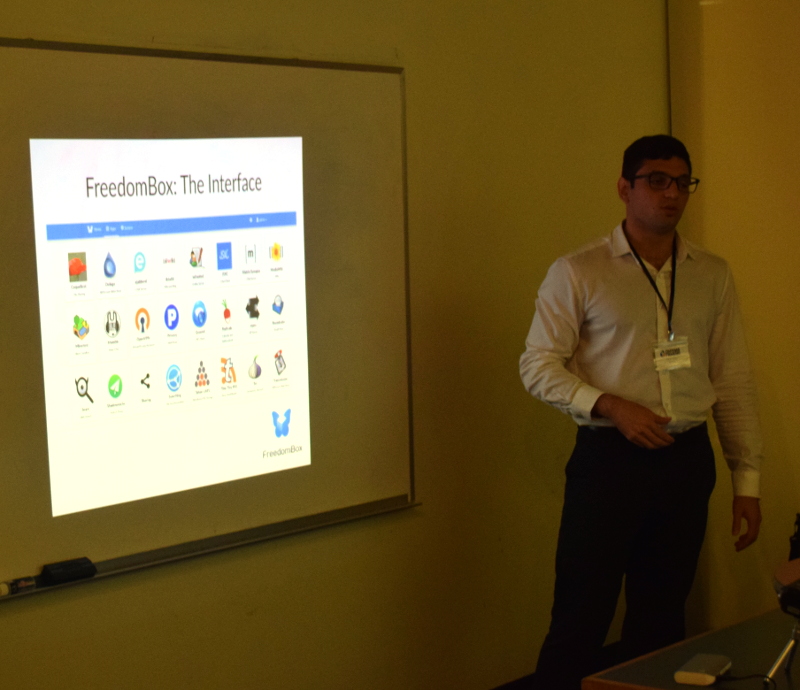
That’s precisely the thinking that got Marc Juul interested in the possibility of bringing a FOSS operating system to e-reader devices. During his talk “Liberate Your E-book Reader with fread.ink!”, he gave examples such as Amazon’s infamous remote deletion of 1984 off of users’ Kindles as a perfect example of the sort of control these companies exert on our personal devices. Marc believes the goal should be to completely replace the operating system on these devices with a free software alternative that still retains the ability to open electronic book formats. Not only would this keep the likes of Amazon or Barnes and Noble out of our reading habits, but turn these cheap readers into more capable devices in the bargain.

Continue reading “HOPE XII: A FOSS Operating System For E-Readers”

HOPE XII: Make Your Own Holograms

Prior to this weekend I had assumed making holograms to be beyond the average hacker’s reach, either in skill or treasure. I was proven wrong by a Club-Mate box full of electronics, and an acrylic jig perched atop an automotive inner tube. At the Hope Conference, Tommy Johnson was sharing his hacker holography in a workshop that let a few lucky attendees make their own holograms on site!

The technique used here depends on interference patterns rather than beam splitting. A diffused laser beam is projected through holographic film onto the subject of the hologram — say a bouquet of flowers like in the video below. Photons from that beam reflect from the bouquet and pass back through the film a second time. Since light is a form of electromagnetic radiation that travels as a wave, anywhere that two peaks (one from the beam the other from the reflected light) align on the film, exposure occurs. With just a 1/2 second exposure the film is ready to be developed, and if everything went right you have created a hologram.

Simple, right? In theory, at least. In practice Tommy’s been doing this for nearly 30 years and has picked up numerous tips along the way. Let’s take a look at the hardware he brought for the workshop.

Continue reading “HOPE XII: Make Your Own Holograms”

HOPE XII: Time Travel With Software Defined Radio

It’s easy to dismiss radio as little more than background noise while we drive.  At worst you might even think it’s just another method for advertisers to peddle their wares. But in reality it’s a snapshot of the culture of a particular time and place; a record of what was in the news, what music was popular, what the weather was like, basically what life was like. If it was important enough to be worth the expense and complexity of broadcasting it on the radio, it’s probably worth keeping for future reference.

But radio is fleeting, a 24/7 stream of content that’s never exactly the same twice. Yet while we obsessively document music and video, nobody’s bothering to record radio. You can easily hop online and watch a TV show that originally aired 50 years ago, but good luck finding a recording of what your local radio station was broadcasting last week. All that information, that rich tapestry of life, is gone and there’s nothing we can do about it.

Or can we? At HOPE XII, Thomas Witherspoon gave a talk called “Creating a Radio Time Machine: Software-Defined Radios and Time-Shifted Recordings”, an overview of the work he’s been doing recording and cataloging the broadcast radio spectrum. He demonstrated how anyone can use low cost SDR hardware to record, and later play back, whole chunks of the AM and shortwave bands. Rather than an audio file containing a single radio station, the method he describes allows you to interactively tune in to different stations and explore the airwaves as if it were live.

Continue reading “HOPE XII: Time Travel With Software Defined Radio”