Automate The Freight: Drones Across The Sea

When you think about which of the many technological advances of the 20th century had the most impact on the global economy, which one would you rank as the most important? Would it be the space program, which gave rise to advances in everything from communications satellites to advanced composite materials? Or would it be the related aerospace industry, which stitched the world together so tightly that you can be almost anywhere on the planet within 24 hours? Or perhaps it’s the Internet, the global platform for buying almost anything from almost anyone.

Those are all important, but for the most economically impactful technology of the 20th century, I’d posit that the lowly shipping container and the containerized cargo industry that grew around it win, hands down.

Continue reading “Automate The Freight: Drones Across The Sea”

Source Parts On TaoBao: An Insider’s Guide

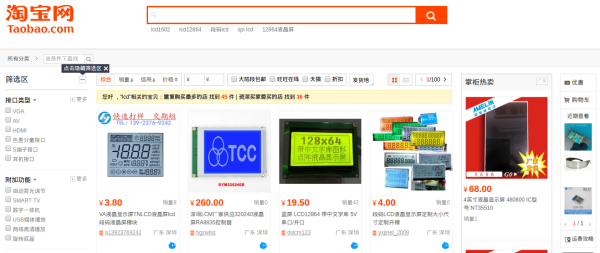
For hardware aficionados and Makers, trips to Shenzhen’s Huaqiangbei have become something of a pilgrimage. While Huaqiangbei is a tremendous and still active resource, increasingly both Chinese and foreign hardware developers do their sourcing for components on TaoBao. The selection is vastly greater and with delivery times rarely over 48 hours and frequently under 24 hours for local purchases it fits in nicely with the high-speed pace of Shenzhen’s hardware ecosystem.

For overseas buyers, while the cost of Taobao is comparable to, or slightly less than AliExpress and Chinese online stores, the selection is again, many, many times the size. Learning how to effectively source parts from Taobao will be both entertaining and empowering.

Continue reading “Source Parts On TaoBao: An Insider’s Guide”

Ask Hackaday: How Should Hackers Handle IP Agreements?

My buddy Harold recently landed a new job at a great technology company. It came at a perfect time for him, having just been laid off from the corporate behemoth where he’d toiled away as an anonymous cog for 19 years. But the day before he was to start, the new company’s HR folks sent him some last-minute documents to sign. One was a broad and vaguely worded non-compete agreement which essentially said he was barred from working in any related industry for a year after leaving the company.

Harold was tempted not to sign, but eventually relented because one needs to put food on the table. Thankfully he’s now thriving at the new company, but his experience got me thinking about all the complications hackers face with the day jobs that so many of us need to maintain. Non-competes and non-disclosures are bad enough, but there’s one agreement that can really foul things up for a hacker: the Intellectual Property Agreement.

Continue reading “Ask Hackaday: How Should Hackers Handle IP Agreements?”

The Tiko Printer: What Happens When You Innovate Too Much

Sometime in the very distant future, the Universe will become the domain of black holes. Energy and entropy will be compressed into minuscule quantum fluctuations. Even in this domain of nothingness, there will still be one unassailable truth: you should not buy a 3D printer on Kickstarter.

We’re no strangers to failed 3D printer crowdfunding campaigns. Around this time last year, backers for the Peachy Printer, an inordinately innovative resin printer, found out they were getting a timeshare in Canada instead of a printer. This was unusual not because a crowdfunding campaign failed, but because we know what actually happened. It’s rare to get the inside story, and the Peachy Printer did not disappoint.

For the last few months, we’ve been watching another crowdfunding campaign on its long walk to the gallows. The Tiko 3D printer is another 3D printer that looks innovative, and at the time of the crowdfunding campaign, the price couldn’t be beat. For just $179 USD, the backers of the Tiko printer would receive a 3D printer. Keep in mind the Tiko launched nearly two years ago, when a bargain-basement printer still cost about $400. Fools and money, or something like that, and the Tiko 3D printer campaign garnered almost three million dollars in pledges.

Now, after almost two years of development, Tiko is closing up shop. In an update posted to the Tiko Kickstarter this week, Tiko announced they are laying off their team and winding down operations. It’s a sad but almost predictable end to a project that could have been cool. Unlike so many other failed crowdfunding campaigns, Tiko has given us a post-mortum on their campaign. This is how the Tiko became a standout success on Kickstarter, how it failed, and is an excellent example of the difference between building one of something and building ten thousand.

Continue reading “The Tiko Printer: What Happens When You Innovate Too Much”

The SmallSat Launcher War

Over the last decade or so the definition of what a ‘small satellite’ is has ballooned beyond the original cubesat design specification to satellites of 50 or 100 kg. Today a ‘smallsat’ is defined far more around the cost, and sometimes the technologies used, than the size and shape of the box that goes into orbit.

There are now more than fifty companies working on launch vehicles dedicated to lifting these small satellites into orbit, and while nobody really expects all of those to survive the next few years, it’s going to be an interesting time in the launcher market. Because I have a sneaking suspicion that Jeff Bezos’ statement that “there’s not that much interesting about cubesats” may well turn out to be the twenty first century’s “nobody needs more than 640kb,” and it’s possible that everybody is wrong about how many of the launcher companies will survive in the long term.

Continue reading “The SmallSat Launcher War”

The Demise Of Pebble As A Platform

Despite owning five, including the original Pebble, I’ve always been somewhat skeptical about smart watches. Even so, the leaked news that Fitbit is buying Pebble for “a small amount” has me sort of depressed about the state of the wearables market. Because Pebble could have been a contender, although perhaps not for the reason you might guess.

Pebble is a pioneer of the wearables market, and launched its first smartwatch back in 2012, two years before the Apple Watch was announced. But after turning down an offer of $740 million by Citizen back in 2015, and despite cash injections from financing rounds and a recent $12.8 million Kickstarter, the company has struggled financially.

An offer of just $70 million earlier this year by Intel reflected Pebble’s reduced prospects, and the rumoured $30 to $40 million price being paid by Fitbit must be a disappointing outcome for a company that was riding high such a short time ago.

Continue reading “The Demise Of Pebble As A Platform”

Life On Contract: How To Fail At Contracting Regardless Of Skill

I believe higher quality learning happens from sharing failure than from sharing stories of success. If you have set your mind to living on contract, I present this cheat sheet of some of the most simple and effective ways to muck it all up that have surprisingly little or nothing to do with your technical skill, knowledge, or even deliverables.

The previous installment of Life on Contract discussed how one might find clients as an engineering contractor or consultant while also taking a bit of time to pull apart the idea of whether life on contract is appropriate as opposed to, for example, bootstrapping a business instead. Assuming you are set on working as a contractor, let’s talk about what happens after you have found a prospective client (or perhaps more likely: after they have found you.)

WARNING: this article features an utter lack of success tips and tricks. Partly because those can be found in any seminar or business self-help book, but mostly because I do not have a foolproof recipe for success, and cheat codes to unlock easy mode still elude me. But I have witnessed (or committed) and reflected on many excellent ways to fail at contracting; or at the very least succeed in not being invited back.

Just because I won’t be sharing success stories doesn’t mean success has no learning value. Got a success story, or a better way to fail? Tell us about it in the comments!

Continue reading “Life On Contract: How To Fail At Contracting Regardless Of Skill”