Mobile phones in schools. If you’re a teacher, school staffer, or a parent, you’ve likely got six hundred opinions about this very topic, and you will have had six hundred arguments about it this week. In Australia, push has come to shove, and several states have banned the use of mobile phones during school hours entirely. Others are contemplating doing the same.
In the state of New South Wales, the current opposition party has made it clear it will implement a ban if elected. Wildly, the party wants to use mobile phone jamming technology to enforce this ban whether students intend to comply or not. Let’s take a look at how jammers work in theory, and explore why using them in schools would be madness in practice.
There are few devices that better exemplify the breakneck pace of modern technical advancement than the mobile phone. In the span of just a decade, we went from flip phones and polyphonic ringtones to full-fledged mobile computers with quad-core processors and gigabytes of memory.
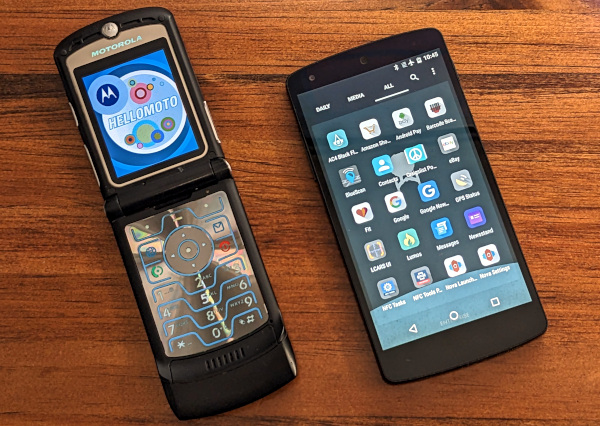
While rapid advancements in computational power are of course nothing new, the evolution of mobile devices is something altogether different. The Razr V3 of 2003 and the Nexus 5 of 2013 are so vastly different that it’s hard to reconcile the fact they were (at least ostensibly) designed to serve the same purpose — with everything from their basic physical layout to the way the user interacts with them having undergone dramatic changes in the intervening years. Even the network technology they use to facilitate voice and data communication are different.
Two phones, a decade apart.
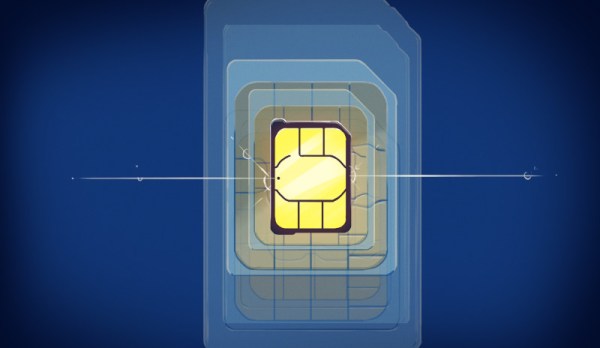
Yet, there’s at least one component they share: the lowly SIM card. In fact, if you don’t mind trimming a bit of unnecessary plastic away, you could pull the SIM out of the Razr and slap it into the Nexus 5 without a problem. It doesn’t matter that the latter phone wasn’t even a twinkling in Google’s eye when the card was made, the nature of the SIM card means compatibility is a given.
Indeed there’s every reason to believe that very same card, now 20 years old, could be installed in any number of phones on the market today. Although, once again, some minor surgery would be required to pare it down to size.
Such is the beauty of the SIM, or Subscriber Identity Module. It allows you to easily transfer your cellular service from one phone to another, with little regard to the age or manufacturer of the device, and generally without even having to inform your carrier of the swap. It’s a simple concept that has served us well for almost as long as cellular telephones have existed, and separates the phone from the phone contract.
So naturally, there’s mounting pressure in the industry to screw it up.
New technology often brings with it a bit of controversy. When considering stem cell therapies, self-driving cars, genetically modified organisms, or nuclear power plants, fears and concerns come to mind as much as, if not more than, excitement and hope for a brighter tomorrow. New technologies force us to evolve perspectives and establish new policies in hopes that we can maximize the benefits and minimize the risks. Artificial Intelligence (AI) is certainly no exception. The stakes, including our very position as Earth’s apex intellect, seem exceedingly weighty. Mathematician Irving Good’s oft-quoted wisdom that the “first ultraintelligent machine is the last invention that man need make” describes a sword that cuts both ways. It is not entirely unreasonable to fear that the last invention we need to make might just be the last invention that we get to make.
Artificial Intelligence and Learning
Artificial intelligence is currently the hottest topic in technology. AI systems are being tasked to write prose, make art, chat, and generate code. Setting aside the horrifying notion of an AI programming or reprogramming itself, what does it mean for an AI to generate code? It should be obvious that an AI is not just a normal program whose code was written to spit out any and all other programs. Such a program would need to have all programs inside itself. Instead, an AI learns from being trained. How it is trained is raising some interesting questions.
Humans learn by reading, studying, and practicing. We learn by training our minds with collected input from the world around us. Similarly, AI and machine learning (ML) models learn through training. They must be provided with examples from which to learn. The examples that we provide to an AI are referred to as the data corpus of the training process. The robot Johnny 5 from “Short Circuit”, like any curious-minded student, needs input, more input, and more input.
When looking at the specifications of smartphones that have been released over the past years, it’s remarkable to see how aspects like CPU cores, clockspeeds and GPU performance have improved during this time, with even new budget smartphones offering a lot of computing power, as well as a smattering of sensors. Perhaps even more remarkable is that of the approximately 1.5 billion smartphones sold each year, many will be discarded again after a mere two years of use. This seems rather wasteful, and a recent paper by Jennifer Switzer and colleagues proposes that a so-called Computational Carbon Intensity (CCI) metric should be used to determine when it makes more sense to recycle a device than to keep using it.
What complicates the decision of when it makes more sense to reuse than recycle is that there are many ways to define when a device is no longer ‘fit for purpose’. It could be argued that the average smartphone is still more than good enough after two years to be continued as a smartphone for another few years at least, or at least until the manufacturer stops supplying updates. Beyond the use as a smartphone, they’re still devices with a screen, WiFi connection and a capable processor, which should make it suitable for a myriad of roles.
Unfortunately, as we have seen with the disaster that was Samsung’s ‘upcycling’ concept a few years ago, or Google’s defunct Project Ara, as promising as the whole idea of ‘reuse, upcycle, recycle’ sounds, establishing an industry standard here is frustratingly complicated. Worse, over the years smartphones have become ever more sealed-up, glued-together devices that complicate the ‘reuse’ narrative.
When the US Air Force shot down some suspected Chinese spy balloons a couple of weeks ago, it was widely reported that one of the targets might have been a much more harmless amateur radio craft. The so-called pico balloon K9YO was a helium-inflated Mylar balloon carrying a tiny solar-powered WSPR beacon, and it abruptly disappeared in the same place and time in which the USAF claimed one of their targets. When we covered the story it garnered a huge number of comments both for and against the balloonists, so perhaps it’s worth returning with the views of a high-altitude-ballooning expert.
[Dave Akerman] has been sending things aloft for a long time now, we think he may have been one of the first to put a Raspberry Pi aloft back in 2012. In his blog post he attempts to answer the frequently asked questions about pico balloons, their legality, whether they should carry a beacon, and what the difference is between these balloons and the latex “weather balloon” type we’re familiar with. It’s worth a read, because not all of us are part of the high-altitude balloon community and thus it’s good to educate oneself.
Generally, when we talk about the production of hydrogen, the discussion is about either electrolysis of water into oxygen and hydrogen, or steam methane reforming (SMR). Although electrolysis is often mentioned – as it can create hydrogen using nothing but water and electricity – SMR is by far the most common source of hydrogen. Much of this is due to the low cost and high efficiency of SMR, but a major disadvantage of SMR is that large amounts of carbon dioxide are released, which offsets some of the benefits of using hydrogen as a fuel in the first place.
Although capturing this CO2 can be considered as a potential solution here, methane pyrolysis is a newer method that promises to offer the same benefits as SMR while also producing hydrogen and carbon, rather than CO2. With the many uses for hydrogen in industrial applications and other fields, such as the manufacturing of fertilizer, a direct replacement for SMR that produces green hydrogen would seem almost too good to be true.
What precisely is this methane pyrolysis, and what can be expect from it the coming years?
It never seems to fail: at the very moment that human society seems to reach a new pinnacle of pettiness, selfishness, violence, and self-absorption, Mother Nature comes along and reminds us all who’s really in charge. The obvious case in point here is the massive earthquakes near the border of Turkey and Syria, the appalling loss of life from which is only now becoming evident, and will certainly climb as survivors trapped since the Monday quakes start to succumb to cold and starvation.
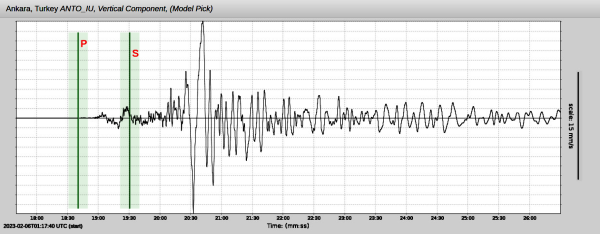
Whatever power over nature we think we can wield pales by comparison with the energy released in this quake alone, which was something like 32 petajoules. How much destruction such a release causes depends on many factors, including the type of quake and its depth, plus the soil conditions at the epicenter. But whatever the local effects on the surface, quakes like these have a tendency to set the entire planet ringing like a bell, with seismic waves transmitted across the world that set the needles of professionally maintained seismometers wiggling.
For as valuable as these seismic networks are, though, there’s a looser, ad hoc network of detection instruments that are capable of picking up quakes as large as these from half a planet away. Some are specifically built to detect Earth changes, while some are instruments that only incidentally respond to the shockwaves traveling through the planet. And we want to know if this quake showed up in the data from anyone’s instruments.