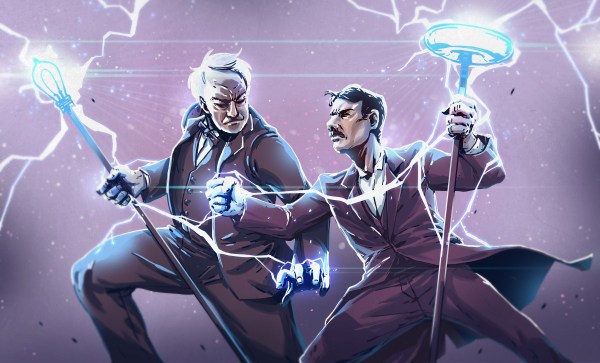
The phrase “Tesla vs. Edison” conjures up images of battling titans, mad scientists, from a bygone age. We can easily picture the two of them facing off, backed by glowing corona with lightning bolts emitting from their hands. The reality is a little different though. Their main point of contention was Tesla’s passion for AC vs. Edison’s drive to create DC power systems to power his lights. Their personalities also differed in many ways, the most relevant one here being their vastly different approaches to research. Here, then, is the story of their rivalry.
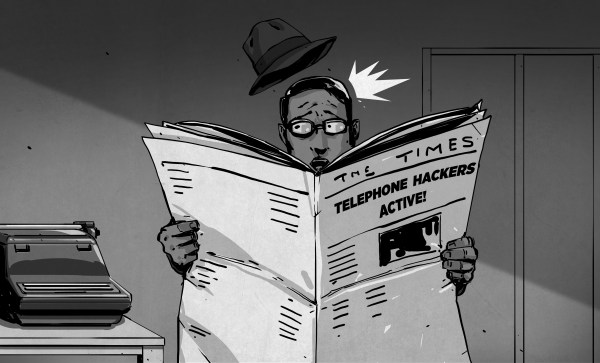
To a casual observer it might seem as though our community is in the news rather a lot at the moment. It’s all about hacks on our TV screens in the soap opera of Washington politics, who hacked this, whether those people over there helped that lot hack the other lot, or even whether that person’s emails could have been hacked on that server. Keeping up with it as an outsider can become a full-time job.
Of course, as we all know even if the mainstream journalists (or should I refer to them colloquially as “hacks”?) don’t, it’s not us they’re talking about. Their hackers are computer criminals, while we are people with some of the hardware and software skills to bend technology to our will, even beyond what its designers might have intended. And that divergence between the way we use the word in a sense of reappropriation and they use it in disapprobation sometimes puts us in an odd position. Explaining to a sober-suited businessman as the director of a hackspace, that no, we’re not *those*hackers can sometimes feel like skating on thin ice.
There was a time when Radio Shack offered an incredible variety of supplies for the electronics hobbyist. In the back of each store, past the displays of Realistic 8-track players, Minimus-7 speakers, Patrolman scanners, and just beyond the battery bin where you could cash in your “Battery of the Month Club” card for a fresh, free 9-volt battery, lay the holy of holies — the parts. Perfboard panels on hinges held pegs with cards of resistors for 49 cents, blister packs of 2N2222 transistors and electrolytic capacitors, and everything else you needed to get your project going. It was a treasure trove to a budding hardware hobbyist.
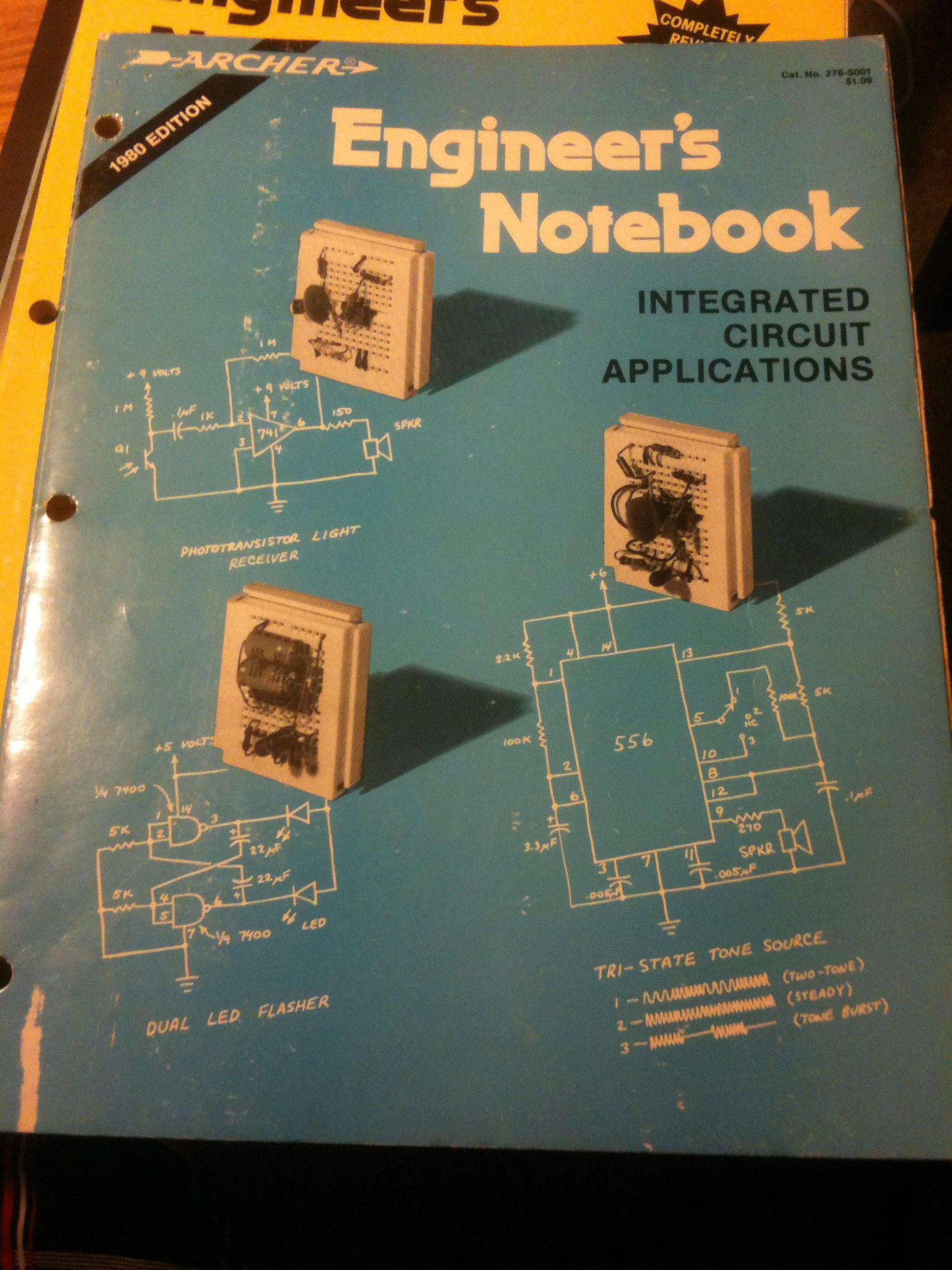
But over on the side, invariably near the parts, was a rack of books for sale, mostly under the Archer brand. 12-year old me only had Christmas and birthday money to spend, and what I could beg from my parents, so I tended to buy books — I figured I needed to learn before I started blowing money on parts. And like many of that vintage, one of the first books I picked up was the Engineer’s Notebook by Forrest M. Mims III.
Wish I could find my original copy from 1979. I just bought this one from Amazon.
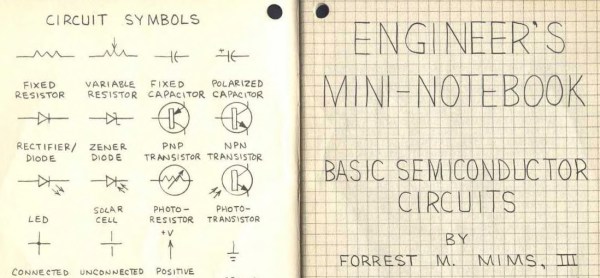
Many years rolled by, and my trusty and shop-worn first edition of Mims’ book, with my marginal notes and more than one soldering iron burn scarring its pulp pages, has long since gone missing. I learned so much from that book, and as I used it to plan my Next Big Project I’d often wonder how the book came about. Those of you that have seen the book and any of its sequels, like the Mini-notebook Series, will no doubt remember the style of the book. Printed on subdued graph paper with simple line drawings and schematics, the accompanying text did not appear to be typeset, but rather hand lettered. Each page was a work of technical beauty that served as an inspiration as I filled my own graph-paper notebooks with page after page of circuits I would find neither the time nor money to build.
I always wondered about those books and how they came about. It was a pretty astute marketing decision by Radio Shack to publish them and feature them so prominently near the parts — sort of makes the string of poor business decisions that led to the greatly diminished “RadioShack” stores of today all the more puzzling. Luckily, Forrest Mims recently did an AMA on reddit, and he answered a lot of questions regarding how these books came about. The full AMA is worth a read, but here’s the short story of those classics of pulp non-fiction.
It is said that “success has many fathers, but failure is an orphan.” Given the world-changing success of radio in the late 19th and early 20th centuries, it’s no wonder that so many scientists, physicists, and engineers have been credited with its invention. The fact that electromagnetic radiation is a natural phenomenon that no one can reasonably claim to have invented sometimes seems lost in the shuffle to claim the prize.
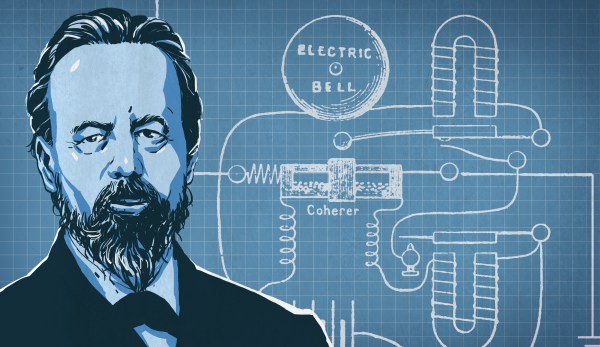
But it was exactly through the study of natural phenomena that one of the earliest pioneers in radio research came to have a reasonable claim to at least be the inventor of the radio receiver, well before anyone had learned how to reliably produce electromagnetic waves. This is the story of how a Russian physicist harnessed the power of lightning and became one of the many fathers of radio.
The late 1950s and early 1960s were a tumultuous time in world history. The Cold War between the East and the West was in full-swing, driving the new fields of nuclear weapons and space exploration and giving the period its dual monikers of “Atomic Age” and “Space Age.”
Changes in these fields often went hand in glove, with developments in one requiring responses in the other. In 1958, the US conducted nuclear tests in the Pacific that effectively destroyed the ionosphere over the test site and shut down high-frequency communications to places like Hawaii and New Zealand. The strategic implications of this were clear, and the US began looking for ways for the military to reduce its reliance on HF communications and ionospheric skip by using space-based assets to communicate at much higher frequencies.
Regular Hackaday readers will be familiar with our convention of putting the name, nickname, or handle of a person in square brackets. We do this to avoid ambiguity as sometimes names and particularly nicknames can take unfamiliar forms that might be confused with other entities referred to in the text. So for example you might see them around [Bart Simpson], or [El Barto]. and occasionally within those brackets you’ll also see a capitalised string of letters and numbers after a name. For example the electronic music pioneer [Bob Moog, K2AMH], which most of you will recognise as an amateur radio callsign.
Every licenced radio amateur is issued one by their country’s radio authority as a unique identifier, think of it as similar to a car licence plate. From within the amateur radio bubble those letters and numbers can convey a significant amount of information about where in the world its user is located, when they received their licence, and even what type of licence they hold, but to outsiders they remain a mysterious and seemingly random string. We’ll now attempt to shed some light on that information, so you too can look at a callsign in a Hackaday piece or anywhere else and have some idea as to its meaning.
Does everyone watch a load of videos on YouTube that are somewhat on the unadmissibly geeky side? In my case I might not care to admit that I have a lot of videos featuring tractors in my timeline. The mighty Russian Kirovets hauling loads through the impossible terrain of the taiga, tiny overloaded 2WD tractors in India pulling wheelies, and JCB Fastracs tearing around the British Fenland. You can take the girl off the farm, but you can’t take the farm out of the girl.
So my recommendations have something of an agricultural flavor. Like the video below the break, a 1917 silent film promoting the Ford Model B tractor. This one was eye-catching because it was a machine I’d not seen before, a rather unusual three-wheeler design with two driving wheels at the front and a single rear steering wheel.
During the early years of the twentieth century the shape of the modern tractor was beginning to evolve, this must have been a late attempt at an alternative. Speaking from the viewpoint of someone who has operated a few tractors in her time it does not look the easiest machine to control, that cloud of exhaust smoke surrounding the driver would not be pleasant, and the operating position hanging over the implement coupling at the rear does not look particularly comfortable or safe.
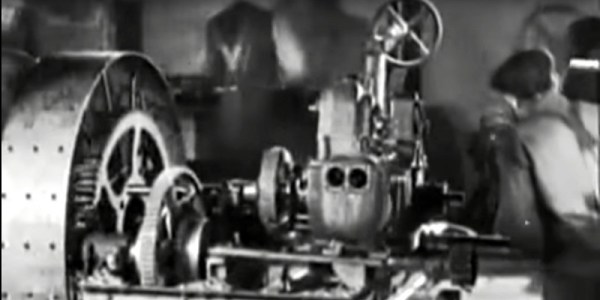
The film has a charming period feel, and tells the tale of a farmer’s son who tires of the drudgery of manual farm labor, and leaves for the city. He finds a job at the tractor factory and eventually becomes a tractor salesman, along the way meeting and marrying the daughter of a satisfied customer. He returns home with his bride, and a shiny new tractor to release his father from ceaseless labor. Along the way we gain a fascinating look at agriculture on the brink of mass mechanization, as well as the inside of a tractor factory of the time with an assembly sequence in which they appear to use no fasteners.
[Image Source: Tractor Industry Fraud on Farm Collector]All of this is very interesting, but the real nugget in the story lies with its manufacturer. This is a Ford Model B tractor. But it’s not a Ford Model B. Confused? So, it seems were the customers. The Ford we all know is the Michigan-based motor company of Henry Ford, who were already very much a big name in 1917. This Ford however comes from the Ford Tractor Co, of South Dakota, an enterprise set up by a shady businessman to cash in on the Ford brand, manufacturing an already outdated and inferior machine backed up by dubious claims of its capabilities.
On the staff was an engineer called Ford who lent his name to the company, but he bore no relation to Henry Ford. The company didn’t last long, collapsing soon after the date of this film, and very few of its products survived. It did have one legacy though, the awful quality of one of its tractors is reputed to have been the impetus behind the founding of the Nebraska Tractor Test Laboratory, the place where if you sell a tractor in the USA, you’ll have to have it tested to ensure it performs as it should. In their museum they house one of the few surviving Ford Model B tractors.
Meanwhile the Ford in Michigan produced their own very successful line of tractors, and their Fordson Model F from the same year is a visible ancestor of today’s machines. But as the video below shows, there’s nothing new about a fake.



![[Image Source: Tractor Industry Fraud on Farm Collector]](https://hackaday.com/wp-content/uploads/2016/11/ford-tractor-company-poster.jpg)