For years now we have been told that self-driving cars will be the Next Big Thing, and we’ve seen some companies — yes, Tesla but others too — touting current and planned features with names like “Autopilot” and “self-driving”. Cutting through the marketing hype to unpacking what that really means is difficult. But there is a standard for describing these capabilities, assigning them as levels from zero to five.
Now we’re greeted with the news that Honda have put a small number of vehicles in the showrooms in Japan that are claimed to be the first commercially available level 3 autonomous cars. That claim is debatable as for example Audi briefly had level 3 capabilities on one of their luxury sedans despite having few places to sell it in which it could be legally used. But the Honda Legend SENSING Elite can justifiably claim to be the only car on the market to the general public with the feature at the moment. It has a battery of sensors to keep track of its driver, its position, and the road conditions surrounding it. The car boasts a “Traffic Jam Pilot” mode, which “enables the automated driving system to drive the vehicle under certain conditions, instead of the driver, such as when the vehicle is in congested traffic on an expressway“.
Sounds impressive, but just what is a level 3 autonomous car, and what are all the other levels?
When you want to read what is being said on a television program, movie, or video you turn on the captions. Looking under the hood to see how this text is delivered is a fascinating story that stared with a technology called Closed Captions, and extended into another called Subtitles (which is arguably the older technology).
I covered the difference between the two, and their backstory, in my previous article on the analog era of closed captions. Today I want to jump into another fascinating chapter of the story: what happened to closed captions as the digital age took over? From peculiar implementations on disc media to esoteric decoding hardware and a baffling quirk of HDMI, it’s a fantastic story.
There were some great questions in the comments section from last time, hopefully I have answered most of these here. Let’s start with some of the off-label uses of closed captioning and Vertical Blanking Interval (VBI) data.
When we think of electric cars, more often than not we’re drawn to the environmental benefits and the smooth quiet commuter drives they’re so ideally suited for. However, EVs can also offer screaming performance, most notably due to their instant-on torque that gives them a big boost over internal combustion vehicles.
In recent years, this has led to a variety of independent and manufacturer-supported efforts taking on some of motorsport’s classic events. Today, we’re looking at a handful of recent entries that have tackled one of the most gruelling events in motorsport – the Pikes Peak International Hillclimb. Continue reading “Electric Vehicles Do Battle On Pikes Peak”→
When it comes to food packaging, there’s no bigger scam than potato chip bags, right? People complain about the air (nitrogen, actually) inside, but it’s there for a reason — nitrogen pushes out oxygen, so the chips live in a state of factory-fresh dormancy until you rip open the bag and release the gas. If you want flat-pack chips, there’s always those uniformly-shaped potato slurry wafers that come in a can. But even those usually manage to have a few broken ones.
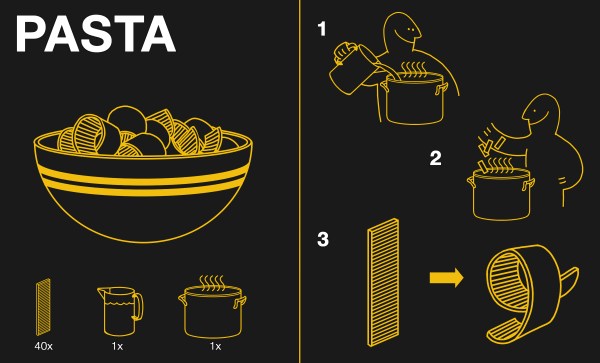
On the other hand, no one complains about the extra space in their box of fusilli — that would be silly. But seriously, successfully shipping fragile foods requires either flat packing or a lot of extra space, especially if that food comes in a myriad of fun 3D shapes like pasta does. Everybody knows that 3D pasta is superior to flat pasta because it holds sauces so much better. The pasta must be kept intact!
The great thing about pasta as a food is that it’s simple to make, and it’s more nutritious than potato chips. Because of these factors, pasta is often served in extreme situations to large groups of people, like soldiers and the involuntarily displaced. But storing large quantities of shapely pasta takes up quite a bit of space. And because of all that necessary air, much of the packaging goes to waste.
T-slot extrusions used to be somewhat mysterious, but today they are quite common thanks to their use in many 3D printers. However, it is one thing to assemble a kit with some extrusions and another thing to design your own creations with the material. If you ever had a Play-Doh Fun Factory as a kid, then you know about extrusions. You push some material out through a die to make a shape. Of course, aluminum extrusions aren’t made from modeling clay, but usually 6105-T5 aluminum. Oddly, there doesn’t seem to be an official standard, but it is so common that there’s usually not much variation between different vendors.
We use extrusions to create frames for 3D printers, laser cutters, and CNC machines. But you can use it anywhere you need a sturdy and versatile frame. There seems to be a lot of people using them, for example, to build custom fixtures inside vans. If you need a custom workbench, a light fixture, or even a picture frame, you can build anything you like using extrusions. Continue reading “Getting Started With Aluminum Extrusions”→
I often think we — or maybe the people who control our money — lack the audacity to take on really big projects. It is hard to imagine laying the transatlantic cable for the first time today, for example. When I want a good example of this effect, I usually say something like: “Can you imagine going to a boardroom of a major company today and saying, ‘We plan to run wire to every house and business in the world and connect them all together.'” Yet that’s what the phone company did. But it turns out, running copper wire everywhere was only one major challenge for the phone company. The other was printing phone directories. In today’s world, it is easy to imagine a computer system that keeps track of all the phone numbers that can spit out a printed version for duplication. But that’s a relatively recent innovation. How did big city phonebooks work before the advent of the computer?
Turns out, the Saturday Evening Post talked about how it all worked in a 1954 article. We aren’t sure there weren’t some computerized records by 1954, but the whole process was still largely manual. By that year, an estimated 60,000,000 directories went out each year in the United States alone. Some of these were small, but the Chicago directory — not including suburban directories — had over 2,100 pages. In New York City, the solution was to print a separate book for each borough. Even then. the Manhattan book was three inches thick and projected to grow to five inches by 1975.
Some friends of mine are designing a new board around the STM32F103 microcontroller, the commodity ARM chip that you’ll find in numerous projects and on plenty of development boards. When the time came to order the parts for the prototype, they were surprised to find that the usual stockholders don’t have any of these chips in stock, and more surprisingly, even the Chinese pin-compatible clones couldn’t be found. The astute among you may by now have guessed that the culprit behind such a commodity part’s curious lack of availability lies in the global semiconductor shortage.
The fall-out from all this drama in the world’s car factories has filtered down through all levels that depend upon semiconductors; as the carmakers bag every scrap of chip fab capacity that they can, so in turn have other chip customers scrambled to keep their own supply lines in place. A quick scan for microcontrollers through distributors like Mouser or Digi-Key finds pages and pages of lines on back-order or out of stock, with those lines still available being largely either for niche applications, unusual package options, or from extremely outdated product lines. The chances of scoring your chosen chip seem remote and most designers would probably baulk at trying to redesign around an ancient 8-bit part from the 1990s, so what’s to be done?
Such things typically involve commercially sensitive information so we understand not all readers will be able to respond, but we’d like to ask the question: how has the semiconductor shortage affected you? We’ve heard tales of unusual choices being made to ship a product with any microcontroller that works, of hugely overpowered chips replacing commodity devices, and even of specialist systems-on-chip being drafted in to fill the gap. In a few years maybe we’ll feature a teardown whose author wonders why a Bluetooth SoC is present without using the radio functions and with a 50R resistor replacing the antenna, and we’ll recognise it as a desperate measure from an engineer caught up in 2021’s chip shortage.
So tell us your tales from the coalface in the comments below. Are you that desperate engineer scouring the distributors’ stock lists for any microcontroller you can find, or has your chosen device remained in production? Whatever your experience we’d like to know what the real state of the semiconductor market is, so over to you!