From Dirt To Space, Backyard Iron Smelting Hackerspace Style

When I went to a hacker camp in the Netherlands in February I was expecting to spend a few days in a comfortable venue with a bunch of friends, drink some beer, see a chiptune gig, and say “Ooh!” a lot at the exciting projects people brought along. I did all of those things, but I also opened the door to something unexpected. The folks from RevSpace in the Hague brought along their portable forge, and before long I found myself working a piece of hot rebar while wearing comically unsuitable clothing. One thing led to another, and I received an invite to come along and see another metalworking project of theirs: to go form ore to ornamental technology all in one weekend.

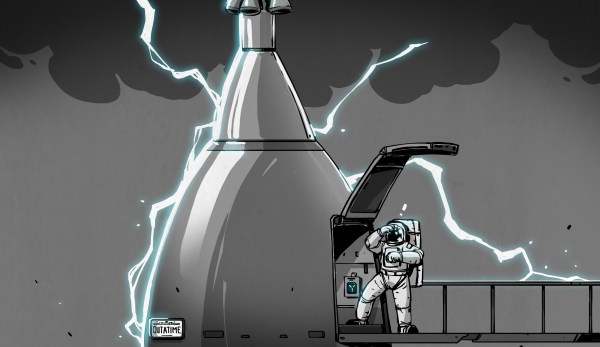
From Dirt To Space is a collaboration between Dutch hackerspaces with a simple aim: to take iron ore and process it into a component that will be launched into space. The full project is to be attempted at the German CCCamp hacker camp in August, but to test the equipment and techniques a trial run was required. Thus I found myself in a Le Shuttle car transporter train in the Channel Tunnel, headed for the Hack42 hackerspace in Arnhem where all the parties involved would convene.

Continue reading “From Dirt To Space, Backyard Iron Smelting Hackerspace Style”

Zork And The Z-Machine: Bringing The Mainframe To 8-bit Home Computers

Computer games have been around about as long as computers have. And though it may be hard to believe, Zork, a text-based adventure game, was the Fortnite of its time. But Zork is more than that. For portability and size reasons, Zork itself is written in Zork Implementation Language (ZIL), makes heavy use of the brand-new concept of object-oriented programming, and runs on a virtual machine. All this back in 1979. They used every trick in the book to pack as much of the Underground Empire into computers that had only 32 kB of RAM. But more even more than a technological tour de force, Zork is an unmissable milestone in the history of computer gaming. But it didn’t spring up out of nowhere.

DEC PDP-10 Flip Chip module

The computer revolution had just taken a fierce hold during the second World War, and showed no sign of subsiding during the 1950s and 1960s. More affordable computer systems were becoming available for purchase by businesses as well as universities. MIT’s Laboratory for Computer Science (LCS) was fortunate to have ties to ARPA, which gave MIT’s LCS and AI labs (formerly part of Project MAC) access to considerable computing resources, mostly in the form of DEC PDP systems.

The result: students at the MIT Dynamic Modeling Group (part of LCS) having access to a PDP-10 KA10 mainframe — heavy iron at the time. Though this PDP-10 was the original 1968 model with discrete transistor Flip Chip modules and wire-wrapping, it had been heavily modified, adding virtual memory and paging support to expand the original 1,152 kB of core memory. Running the MIT-developed Incompatible Timesharing System (ITS) OS, it was a highly capable multi-user system.

Naturally, it got mostly used for playing games.
Continue reading “Zork And The Z-Machine: Bringing The Mainframe To 8-bit Home Computers”

Who Really Has The Largest Aircraft?

We were all glued to our screens for a moment a few weeks ago, watching the Scaled Composites Stratolaunch dual-fuselage space launch platform aircraft make its first flight. The six-engined aircraft represents an impressive technical feat by any standard, and with a wingspan of 385 ft (117 m) and payload weight of 550,000 lb (250 t), is touted as the largest ever flown.

Our own Brian Benchoff took a look at the possibility of hauling more mundane cargo as an alternative (and possibly more popular) use of its lifting capabilities. And in doing so mentioned that “by most measure that matter” this is the largest aircraft ever built. There are several contenders for the title of largest aircraft that depend upon different statistics, so which one really is the largest? Sometimes it’s not as clear as you’d think, but finding out leads us into a fascinating review of some unusual aeronautical engineering.

Continue reading “Who Really Has The Largest Aircraft?”

Everything We Know About SpaceX’s Starlink Network

When it comes to SpaceX, or perhaps more accurately its somewhat eccentric founder and CEO Elon Musk, it can be difficult to separate fact from fiction. For as many incredible successes SpaceX has had, there’s an equal number of projects or ideas which get quietly delayed or shelved entirely once it becomes clear the technical challenges are greater than anticipated. There’s also Elon’s particular brand of humor to contend with; most people assumed his claim that the first Falcon Heavy payload would be his own personal Tesla Roadster was a joke until he Tweeted the first shots of it being installed inside the rocket’s fairing.

So a few years ago when Elon first mentioned Starlink, SpaceX’s plan for providing worldwide high-speed Internet access via a mega-constellation of as many as 12,000 individual satellites, it’s no surprise that many met the claims with a healthy dose of skepticism. The profitability of Starlink was intrinsically linked to SpaceX’s ability to substantially lower the cost of getting to orbit through reusable launch vehicles, a capability the company had yet to successfully demonstrate. It seemed like a classic cart before the horse scenario.

But today, not only has SpaceX begun regularly reusing the latest version of their Falcon 9 rocket, but Starlink satellites will soon be in orbit around the Earth. They’re early prototypes that aren’t as capable as the final production versions, and with only 60 of them on the first launch it’s still a far cry from thousands of satellites which would be required for the system to reach operational status, but there’s no question they’re real.

During a media call on May 15th, Elon Musk let slip more technical information about the Starlink satellites than we’ve ever had before, giving us the first solid details on the satellites themselves, what the company’s goals are, and even a rough idea when the network might become operational.

Continue reading “Everything We Know About SpaceX’s Starlink Network”

That Super Mario Bros. C64 Port Was Too Good For This World

It was foolish to think that the adventure of the Mario Bros. would ever exist outside of the castle walls of the Nintendo Entertainment System. Except for that one time it did. The Hudson Soft company was a close collaborator with Nintendo, and parlayed that favor into being tasked with bringing Super Mario Bros. to platforms beyond the NES. The result of that collaboration would be 1986’s Super Mario Special, a port for the NEC PC-88 line of desktop computers. What ended up on that 5.25″ floppy sounded reminiscent of the Famicom original, but with a grand total of four colors (including black) and not a single scrolling screen in sight; Super Mario Special felt decidedly less than spectacular to play. Those eternally flickering sprites mixed with jarring blank screen transitions would never make it outside of Japan, so for a large swath of the world Mario would remain constrained to a gray plastic cartridge for years to come.

There are no shortage of ways to play Super Mario Bros. these days. Emulation in all of its various official and unofficial forms has taken care of that. Virtually everything with a processor more capable than the NES’s 6502 can play host to the Mushroom Kingdom, however, machines more contemporary with the NES still lacked access to the iconic title.

Enter the 2019 port of Super Mario Bros. for the Commodore 64 by [ZeroPaige]. A culmination of seven years work to port the game onto one of the most prolific computers of the eighties was a clear feat of brilliance and an amazing bit of programming that would have taken 1986 by storm. No pale imitation, this was Mario on the C64. Despite all of the nuance in recreating the jump-and-run model of the original paired with enveloping all eight sound channels of a dual SID chip setup, Nintendo saw fit to stifle the proliferation of this incredible 170 kB of software because they claim it infringes on their copyright.

Continue reading “That Super Mario Bros. C64 Port Was Too Good For This World”

The $50 Ham: Dummy Loads, Part 2

In the last installment of “The $50 Ham” I built a common tool used by amateur radio operators who are doing any kind of tuning or testing of transmitters: a dummy load. That build resulted in “L’il Dummy”, a small dummy load intended for testing typical VHF-UHF handy talkie (HT) transceivers, screwing directly into the antenna jack on the radio.

As mentioned in the comments by some readers, L’il Dummy has little real utility. There’s actually not much call for a dummy load that screws right into an HT, and it was pointed out that a proper dummy load is commercially available on the cheap. I think the latter observation is missing the point of homebrewing specifically and the Hackaday ethos in general, but I will concede the former point. That’s why at the same time I was building L’il Dummy, I was building the bigger, somewhat more capable version described here: Big Dummy.

Continue reading “The $50 Ham: Dummy Loads, Part 2”

Repairing A Catastrophic Failure: The Oroville Dam Update

More than two years ago, the largest dam in the United States experienced a catastrophic failure of its main spillway, the primary means by which operators of the dam prevent the lake from cresting its pen. The spillway failure caused so much erosion that the hydroelectric plant could not operate, further worsening the situation. In a few days, the dam was finally put to its design limitations, and water began flowing down an emergency spillway that had never been used, prompting the evacuation of 188,000 people living in downstream communities.

Since the time that this crisis came to a head, crews have been working around the clock to repair the main and emergency spillways in order to ensure that one of the largest pieces of infrastructure in the wealthiest country in the world does not suffer a complete failure. The dam’s spillways were reopened recently on April 2, in time for this year’s snow melting, and so far everything looks good.

The repair work was a true feat of engineering, and perhaps a logistics miracle as well. The video below goes over a lot of the raw materials inputs that were needed, but the one that stuck out the most was that a dump truck full of roller-compacted concrete was emptied every five minutes over the entire course of the repair — enough to build a sidewalk from the Oroville Dam to Texas. Part of the reason for the use of such an incredible amount of concrete was that it wasn’t just used to repair the main spillway. An enormous “splash pad” for the emergency spillway was also constructed to limit erosion in the event that it must be used again. But the full change goes beyond concrete and rebar. Join me after the break as I try to wrap my mind around the full scope of the Oroville Dam repair.

Continue reading “Repairing A Catastrophic Failure: The Oroville Dam Update”