Check (or cheques) have long been a standard way for moving money from one bank account to another. They’re essentially little more than a codified document that puts the necessary information in a standard format to ease processing by all parties involved in a given transaction.
The check was once a routine, if tedious, way for the average person to pay for things like bills, rent, or even groceries. As their relevance continues to wane in the face of newer technology, though, the Australian government is making a plan to phase them out for good.
When we last brought you word of the SS United States, the future of the storied vessel was unclear. Since 1996, the 990 foot (302 meter) ship — the largest ocean liner ever to be constructed in the United States — had been wasting away at Pier 82 in Philadelphia. While the SS United States Conservancy was formed in 2009 to support the ship financially and attempt to redevelop it into a tourist attraction, their limited funding meant little could be done to restore or even maintain it. In January of 2024, frustrated by the lack of progress, the owners of the pier took the Conservancy to court and began the process of evicting the once-great liner.
SS United States docked at Pier 82 in Philadelphia
It was hoped that a last-minute investor might appear, allowing the Conservancy to move the ship to a new home. But unfortunately, the only offer that came in wasn’t quite what fans of the vessel had in mind: Florida’s Okaloosa County offered $1 million to purchase the ship so they could sink it and turn it into the world’s largest artificial reef.
The Conservancy originally considered it a contingency offer, stating that they would only accept it if no other options to save the ship presented themselves. But by October of 2024, with time running out, they accepted Okaloosa’s offer as a more preferable fate for the United States than being scrapped.
It at least means the ship will remain intact — acting not only as an important refuge for aquatic life, but as a destination for recreational divers for decades to come. The Conservancy has also announced plans to open a museum in Okaloosa, where artifacts from the ship will be on display.
Open any consumer electronics catalog from around the 1980s to the early 2000s and you are overwhelmed by a smörgåsbord of devices, covering any audio-visual and similar entertainment and hobby needs one might have. Depending on the era you can find the camcorders, point-and-shoot film and digital cameras right next to portable music players, cellphones, HiFi sets and tower components, televisions and devices like DVD players and VCRs, all of them in a dizzying amount of brands, shapes and colors that are sure to fit anyone’s needs, desires and budget.
When by the late 2000s cellphones began to absorb more and more of the features of these devices alongside much improved cellular Internet access, these newly minted ‘smartphones’ were hailed as a technological revolution that combined so many consumer electronics into a single device. Unlike the relatively niche feature phones, smartphones absolutely took off.
Fast-forward more than a decade and the same catalogs now feature black rectangles identified respectively as smart phones, smart TVs and tablets, alongside evenly colored geometric shapes that identify as smart speakers and other devices. While previously the onus for this change was laid by this author primarily on the death of industrial design, the elephant in the room would seem to be that consumer electronics are suffering from a terminal disease: subscription services.
Rubber! It starts out as a goopy material harvested from special trees, and is then processed into a resilient, flexible material used for innumerable important purposes. In the vast majority of applications, rubber is prized for its elasticity, which eventually goes away with repeated stress cycles, exposure to heat, and time. When a rubber part starts to show cracks, it’s generally time to replace it.
Researchers at Harvard have now found a way to potentially increase rubber’s ability to withstand cracking. The paper, published in Nature Sustainability, outlines how the material can be treated to provide far greater durability and toughness.
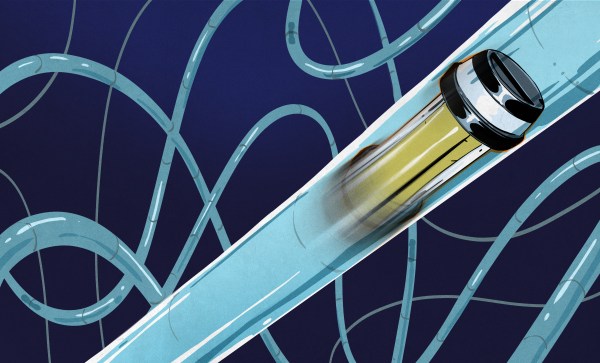
Walk into any pub and order a pint of Guinness, and you’ll witness a mesmerizing ritual. The bartender pulls the tap, fills the glass two-thirds full, then sets it aside to settle before topping it off with that iconic creamy head. But crack open a can of Guinness at home, and something magical happens without any theatrical waiting period. Pour it out, and you get that same cascading foam effect that made the beer famous.
But how is it done? It’s all thanks to a tiny little device that is affectionately known as The Widget.
When do you think the first podcast occurred? Did you guess in the 1890s? That’s not a typo. Telefonhírmondó was possibly the world’s first true “telephone newspaper.” People in Budapest could dial a phone number and listen to what we would think of now as radio content. Surprisingly, the service lasted until 1944, although after 1925, it was rebroadcasting a radio station’s programming.
Tivadar Puskás, the founder of Budapest’s “Telephone Newspaper” (public domain)
The whole thing was the brainchild of Tivadar Puskás, an engineer who had worked with Thomas Edison. At first, the service had about 60 subscribers, but Puskás envisioned the service one day spanning the globe. Of course, he wasn’t wrong. There was a market for worldwide audio programs, but they were not going to travel over phone lines to the customer.
The Hungarian government kept tight control over newspapers in those days. However, as we see in modern times, new media often slips through the cracks. After two weeks of proving the concept out, Puskás asked for formal approval and for a 50-year exclusive franchise for the city of Budapest. They would eventually approve the former, but not the latter.
Unfortunately, a month into the new venture, Puskás died. His brother Albert took over and continued talks with the government. The phone company wanted a piece of the action, as did the government. Before anything was settled, Albert sold the company to István Popper. He finalized the deal, which included rules requiring signed copies of the news reports to be sent to the police three times a day. The affair must have been lucrative. The company would eventually construct its own telephone network independent of the normal phone system. By 1907, they boasted 15,000 subscribers, including notable politicians and businesses, including hotels. Continue reading “The World’s First Podcaster?”→
Hackaday has a long-running series on Mining and Refining, that tracks elements of interest on the human-made road from rocks to riches. What author Dan Maloney doesn’t address in that series is the natural history that comes before the mine. You can’t just plunk down a copper mine or start squeezing oil from any old stone, after all: first, you need ore. Ore has to come from somewhere. In this series, we’re going to get down and dirty into the geology of ore-forming processes to find out from wither come the rocks that hold our elements of interest.
What’s In an Ore?
Though we’re going to be talking about Planetary Science in this series, we should recognize the irony that “ore” is a word without any real scientific meaning. What distinguishes ore from other rock is its utility to human industry: it has elements or compounds, like gems, that we want, and that we think we can get out economically. That changes over time, and one generation’s “rock” can be another generation’s “ore deposits”. For example, these days prospectors are chasing copper in porphyry deposits at concentrations as low as 1000 ppm (0.1%) that simply were not economic in previous decades. The difference? Improvements in mining and refining, as well as a rise in the price of copper. Continue reading “Ore Formation: Introduction And Magmatic Processes”→