It isn’t easy communicating when you have any form of speech impairment. In such cases, a Speech-generating device (SGD) becomes essential to help you talk to the world. When coupled with other ailments that limit body movement, the problem becomes worse. How do you type on a keyboard when you can’t move your hands, and how do you talk when your voice box doesn’t work. Well known Scientist Stephen Hawking has been battling this since 1985. Back then, it took a lot of hardware to build a text entry interface and a text to speech device allowing him to communicate.
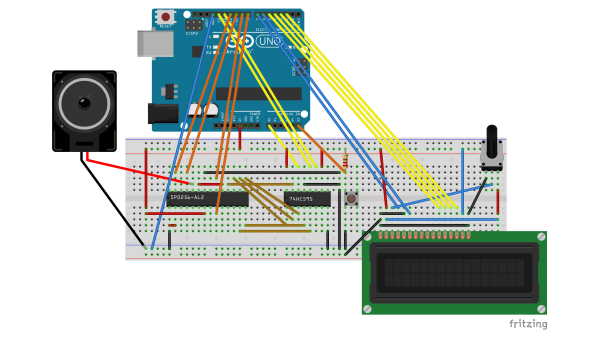
But [Marquis de Geek] did a quick hack using just a few parts to make a Voice Box that sounds like Stephen Hawking. Using an arcade push button to act as a single button keyboard, an Arduino, a 74HC595 shift register, a 2-line LCD, and the SP0256 hooked to an audio amplifier / speaker, he built the stand-alone speech synthesizer which sounds just like the voice box that Stephen Hawking uses. Although Dr. Hawking’s speech hardware is quite complex, [Marquis de Geek]’s hack shows that it’s possible to have similar results using off the shelf parts for a low cost solution.
There aren’t a lot of those SP0256-AL2 chips around. We found just a couple of retailers with small stock levels, so if you want to make one of these voice boxes, better grab those chips while they last. The character entry is not quick, requiring several button presses to get to the character you want to select. But it makes things easier for someone who cannot move their hands or use all fingers. A lot of kids grew up using Speak and Spell, but the hardware inside that box wasn’t the easiest to hack into. For a demo of [Marquis de Geek]’s homemade Hawking voice box, check the video below.