It’s been a while since the last installment in our Know Audio series, in which we investigated distortion as it applies to Hi-Fi audio. Now it’s time to return with part two of our look at distortion, and attempt some real-world distortion measurements on the bench.
Last time, we examined distortion from a theoretical perspective, as the introduction of unwanted harmonics as a result of non-linearities in the signal path. Sometimes that’s a desired result, as with a guitar pedal, but in a Hi-Fi system where the intention is to reproduce as faithfully as possible a piece of music from a recording, the aim is to make any signal path components as linear as possible. When we measure the distortion, usually expressed as THD, for Total Harmonic Distortion, of a piece of equipment we are measuring the ratio of those unwanted harmonics in the output to the frequencies we want, and the resulting figure is commonly expressed in dB, or as a percentage. Continue reading “Know Audio: Distortion Part Two”→
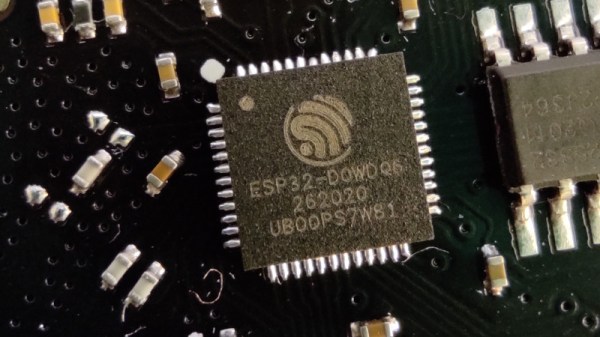
S/PDIF has been around for a long time; it’s still a really great way to send streams of digital audio from device A to device B. [Nathan Ladwig] has got the ESP32 decoding SPDIF quite effectively, using an onboard peripheral outside its traditional remit.
On the ESP32, the Remote Control Transceiver (RMT) peripheral was intended for use with infrared transceivers—think TV remotes and the like. However, this peripheral is actually quite flexible, and can be used for sending and receiving a range of different signals. [Nathan] was able to get it to work with S/PDIF quite effectively. Notably, it has no defined bitrate, which allows it to work with signals of different sample rates quite easily. Instead, it uses biphase mark code to send data. With one or two transitions for each transmitted bit, it’s possible to capture the timing and determine the correct clock from the signal itself.
[Nathan] achieved this feat as part of his work to create an ESP32-based RTP streaming device. The project allows an ESP32 to work as a USB audio device or take an S/PDIF signal as input, and then transmitting that audio stream over RTP to a receiver which delivers the audio at the other end via USB audio or as an SPDIF output. It’s a nifty project that has applications for anyone that regularly finds themselves needing to get digital audio from once place to another. It can also run a simple visualizer, too, with some attached LEDs.
It’s not the first time we’ve seen S/PDIF decoded on a microcontroller; it’s quite achievable if you know what you’re doing. Meanwhile, if you’re cooking up your own digital audio hacks, we’d love to hear about it. Digitally, of course, because we don’t accept analog phone calls here at Hackaday. Video after the break.
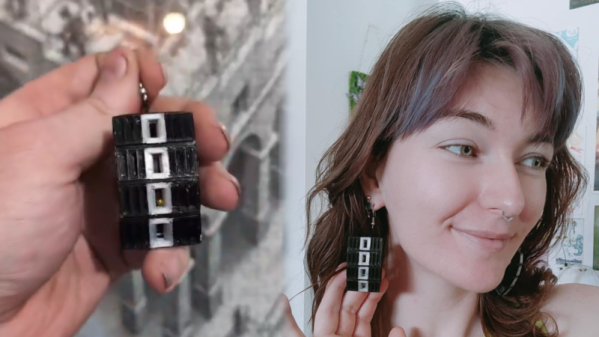
When you think of a Bluetooth speaker, you’re probably picturing a roughly lunchbox-sized device that pumps out some decent volume for annoying fellow beachgoers, hikers, or public transport users. [Matt Frequencies] has developed something in an altogether different form factor—tiny Bluetooth speakers you can dangle from your earlobes! They’re called Earrays, and they’re awesome.
The build started with [Matt] harvesting circuit boards from a pair of off-the-shelf Bluetooth earbuds. These are tiny, and perfect for picking up a digital audio stream from a smartphone or other device, but they don’t have the grunt to drive powerful speakers. Thus, [Matt] hooked them up to a small Adafruit PAM8302A amplifier board, enabling them to drive some larger speaker drivers that you can actually hear from a distance. These were then installed in little 3D printed housings that are like a tiny version of the speaker arrays you might see hanging from the rigging at a major dance festival. Throw on a little earring hook, and you’ve got a pair of wearable Bluetooth speakers that are both functional, fashionable, and very audible!
[Matt] has continued to develop the project, even designing a matching pendant and a charging base to make them practical to use beyond a proof-of concept. Despite the weight of the included electronics, they’re perfectly wearable, as demonstrated by [DJ Kaizo Trap] modelling the hardware in the images seen here.
[Shalma] begins by telling you a little about Joseph Fourier, the French mathematician with an interest in heat propagation who founded the field of harmonic analysis in the early 1800s.
Fourier’s basic insight was that you can represent everything as a sum of very basic oscillations, where the basic oscillations are sine or cosine functions with certain parameters. [Shalma] explains that the biology of our ear can do a similar thing by picking the various notes out from a tune which is heard, but mathematicians and programmers work without the benefit of evolved resonant hairs and bone, they work with math and code.
[Shalma] explains how frequency components can be discovered by trial and error, multiplying candidate frequencies with the original function to see if there are large peaks, indicating the frequency is a component, or if the variations average to zero, indicating the frequency is not a component. [Shalma] tells how even square waves can be modeled with an infinite set of frequencies known as the Fourier series.
Taking a look at higher-dimensional problems [Shalma] mentions how Fourier transforms can be used for graphical compression by dropping the high frequency detail which our eyes can barely perceive anyway. [Shalma] gives us a fascinating look at the 64 graphical building blocks which can be combined to create any possible 8×8 image.
[Shalma] then mentions James Cooley and John Tukey and the development of the Fast Fourier Transform in the 1960s. This mathematical tool has been employed to study the tides, to detect gravitational waves, to develop radar and magnetic resonance imaging, and to support signal processing and data compression. Even quantum mechanics finds use for harmonic analysis, and [Shalma] explains how it relates to the uncertainty principle. The Fourier transform has spread through pure mathematics and into number theory, too.
[Shalma] closes with a quote from Charles Fefferman: “If people didn’t know about the Fourier transform, I don’t know what percent of math would then disappear, but it would be a big percent.”
Immersive audio is the new hotness in the recording world. Once upon a time, mono was good enough. Then someone realized humans have two ears, and everyone wanted stereo. For most of us, that’s where it stopped, but audio connoisseurs kept going into increasingly baroque surround-sound setups — ending in Immersive Audio, audio that is meant to fully reproduce the three-dimensional soundscape of the world around us. [DJJules] is one of those audio connoisseurs, and to share the joy of immersive audio recording with the rest of us, he’s developed Maurice, a compact, low-cost immersive microphone.
Maurice is technically speaking, a symmetrical ORTF3D microphone array. OTRF is not a descriptive acronym; it stands for Office de Radiodiffusion Télévision Française, the fine people who developed this type of microphone for stereo use. The typical stereo ORTF setup requires two cardioid microphones and angles them 110 degrees apart at a distance of 17 cm. Maurice arrays four such pairs, all oriented vertically and facing 90 degrees from one another for fully immersive, 8-channel sound. All of those microphones are thus arrayed to capture sound omnidirectionally, and give good separation between the channels for later reproduction. The mountings are all 3D printed, and [DJJules] kindly provides STLs.
This is the speaker setup you need to get full use of Maurice’s recordings. Now let’s see Paul Allen’s speakers.
Recording eight audio channels simultaneously is not trivial for the uninitiated, but fortunately, [DJJules] includes a how-to in his post. We particularly like his tip to use resistor color coding to identify the XLR cables for different microphone channels. Playback, too, requires special setup and processing. [DJJules] talks about listening on his 7.1.4 stereo setup, which you can find in a companion post. That’s a lot of speakers, as you might imagine.
There are high-end headphones that claim to reproduce an immersive sound field as well, but we can’t help but wonder if you’d miss the “true” experience without head tracking. Even with regular department-store headphones, the demo recordings linked via the Instructable sound great, but that probably just reflects the quality of the individual microphones.
[Scott] acquired this broken trainer on eBay and then set about restoring it. The trainer provides I/O for programming, probing, and debugging an attached CPU. The first problem discovered when opening the case is that the CPU board is missing. The original board was an 80/10 but [Scott] ended up installing a newer 80/10A board he scored for fifty bucks. Later he upgraded to an 80/10B which increased the RAM and added a multimodule slot.
[Scott] has some luck fixing the failed power supply by recapping some of the smaller electrolytic capacitors which were showing high ESR. Once he had the board installed and the power supply functional he was able to input his first assembly program: a Cylon LED program! Making artistic use of the LEDs attached to the parallel port. You can see the results in the video embedded below.
To anyone who remembers Y2K, Sony’s MiniDisc format will probably always feel futuristic. That goes double for Sony’s MZ-RH1, the last MiniDisk recorder ever released, back in 2006. It’s barely larger than the diminutive disks, and its styling is impeccable. There’s a reason they’ve become highly collectible and sell for insane sums on e-Bay.
Unfortunately, they come with a ticking time-bomb of an Achilles heel: the first-generation OLED screens. Failure is not a question of if, but when, and many units have already succumbed. Fortunately enterprising hacker [Sir68k] has come up with replacement screen to keep these two-decade old bits of the future alive.
Replacement screens glowing brightly, and the custom firmware showing track info, something you’d never see on a stock RH1.
Previous revisions required some light surgery to get the twin OLED replacement screens to fit, but as of the latest incarnation (revision F+), it’s now a 100% drop-in replacement for the original Sony part. While it is a drop-in, don’t expect it to be easy. The internals are very densely packed, and fairly delicate — both in the name of miniaturization. You’ll need to break out the micro-screwdrivers for this one, and maybe some magnifiers if your eyes are as old as ours. At least Sony wasn’t gluing cases together back in 2006, and [Sir68k] does provide a very comprehensive repair guide.
He’s even working on new firmware, to make what many considered best MD recorder better than ever. It’s not ready yet, but when it is [Sir68k] promises to open-source the upgrade. The replacement screens are sadly not open source hardware, but they’re a fine hack nonetheless.