COBB Tuning Hit With $2.9 Million Fine Over Emissions Defeat Devices

Recently, the EPA and COBB Tuning have settled after the latter was sued for providing emissions control defeating equipment. As per the EPA’s settlement details document, COBB Tuning have since 2015 provided customers with the means to disable certain emission controls in cars, in addition to selling aftermarket exhaust pipes with insufficient catalytic systems. As part of the settlement, COBB Tuning will have to destroy any remaining device, delete any such features from its custom tuning software and otherwise take measures to fully comply with the Clean Air Act, in addition to paying a $2,914,000 civil fine.

The tuning of cars has come a long way from the 1960s when tweaking the carburetor air-fuel ratios was the way to get more power. These days cars not only have multiple layers of computers and sensor systems that constantly monitor and tweak the car’s systems, they also have a myriad of emission controls, ranging from permissible air-fuel ratios to catalytic converters. It’s little surprise that these systems can significantly impact the raw performance one might extract from a car’s engine, but if the exhaust of nitrogen-oxides and other pollutants is to be kept within legal limits, simply deleting these limits is not a permissible option.

COBB Tuning proclaimed that they weren’t aware of these issues, and that they never marketed these features as ’emission controls defeating’. They were however aware of issues regarding their products, which is why they announced ‘Project Green Speed’ in 2022, which supposedly would have brought COBB into compliance. Now it would seem that the EPA did find fault despite this, and COBB was forced to making adjustments.

Although perhaps not as egregious as modifying diesel trucks to ‘roll coal’, federal law has made it abundantly clear that if you really want to have fun tweaking and tuning your car without pesky environmental laws getting in the way, you could consider switching to electric drivetrains, even if they’re mind-numbingly easy to make performant compared to internal combustion engines.

A Two-Stroke Engine Made From Scratch Using Basic Hardware Store Parts

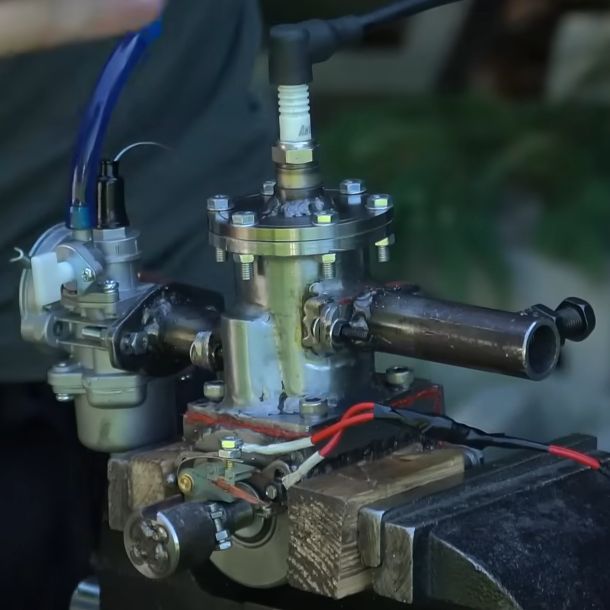
A working DIY two-stroke in all of its glory, with the flywheel removed. (Credit: Camden Bowen)

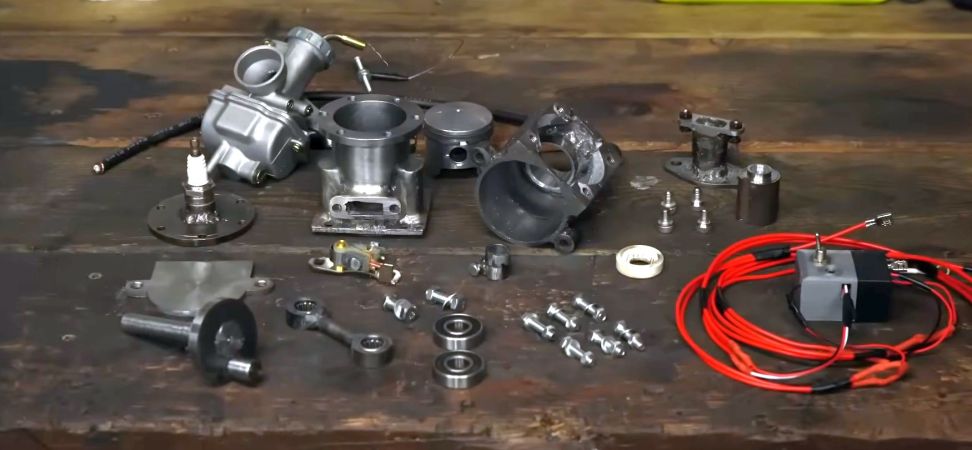
How hard could it to be to build a two-stroke internal combustion engine (ICE) from scratch? This is a challenge that [Camden Bowen] gladly set for himself, while foregoing such obvious wastes of time like first doing an in-depth literature study on the topic. That said, he did do some research and made the design in OnShape CAD before making his way over to the hardware store to make some purchases.

As it turns out, you can indeed build a two-stroke engine from scratch, using little more than some metal piping and other parts from the hardware store. You also need a welder and a lathe, with [Camden] using a Vevor mini-lathe that totally puts the ‘precision’ in ‘chatter’. As building an ICE requires a number of relatively basic parts that have to move with very little friction and with tight tolerances, this posed some challenges, but nothing that some DIY spirit can’t fix.

In the case of the very flexible boring bar on the lathe, improvising with some sturdy metal stock welded to a short boring bar resolved that, and precision was achieved. Together with an angle grinder, [Camden] was then able to manufacture the crank case, the cylinder and crank shaft and all the other pieces that make up an ICE. For the carburetor he used a unit off Amazon, which turned out to have the wrong throat size at 19 mm, but a 13 mm version worked. Ultimately, the first ICE constructed this way got destroyed mostly by running it dry and having the starter fluid acting as a solvent, but a full rebuild fixed all the issues.

This second attempt actually ran just fine the first time around, with oil in the crank case so that the poor engine wasn’t running dry any more. With a 40:1 fuel/oil mixture the little engine idles and runs as well as a two-stroke can, belching blue smoke and making a ruckus. This answers the question of whether you can build a two-stroke ICE with basic machining skills and tools, but of course the question that’s now on everyone’s lips is whether a four-stroke one would be nearly as ‘easy’. We wait with bated breath.

Continue reading “A Two-Stroke Engine Made From Scratch Using Basic Hardware Store Parts”

Making EV Motors, And Breaking Up With Rare Earth Elements

Rare earth elements are used to produce magnets with very high strength that also strongly resist demagnetization, their performance is key to modern motors such as those in electric vehicles (EVs). The stronger the magnets, the lighter and more efficient a motor can be. So what exactly does it take to break up with rare earths?

Rare earth elements (REEs) are actually abundant in the Earth’s crust, technically speaking. The problem is they are found in very low concentrations, and inconveniently mixed with other elements when found. Huge amounts of ore are required to extract useful quantities, which requires substantial industrial processing. The processes involved are ecologically harmful and result in large amounts of toxic waste.

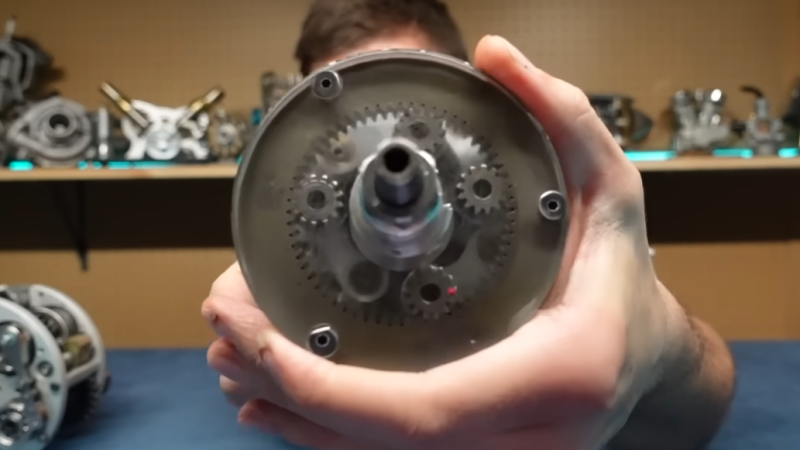
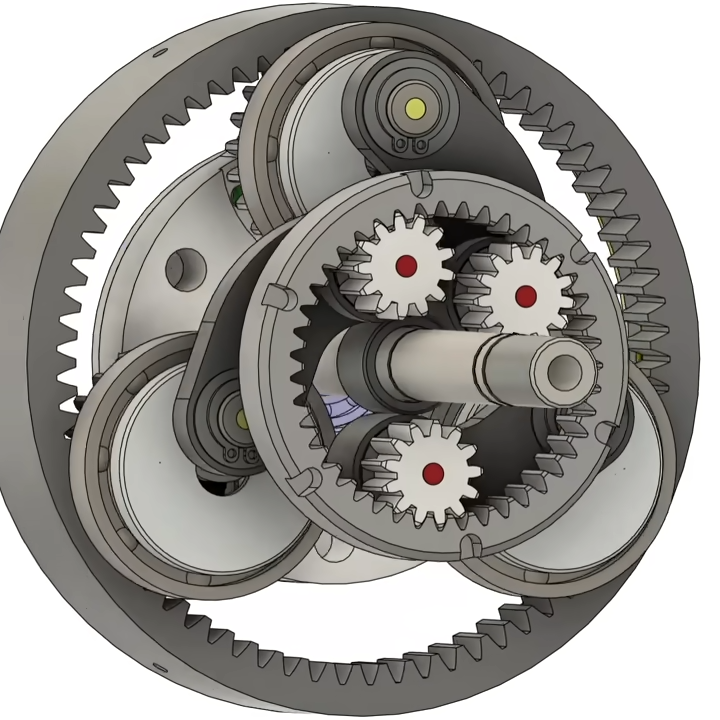
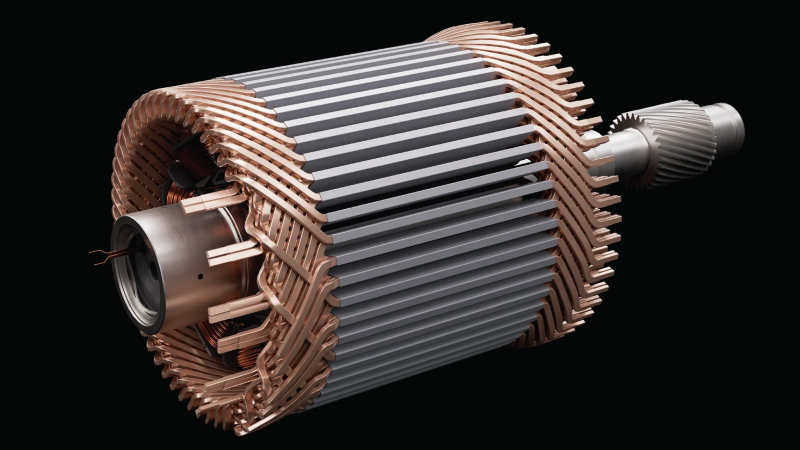
Moving away from rare earth magnets in EV motors would bring a lot of benefits, but poses challenges. There are two basic approaches: optimize a motor for non-rare-earth magnets (such as iron nitrides), or do away with permanent magnets entirely in favor of electromagnets (pictured above). There are significant engineering challenges to both approaches, and it’s difficult to say which will be best in the end. But research and prototypes are making it increasingly clear that effective REE-free motors are perfectly feasible. Breaking up with REEs and their toxic heritage would be much easier when their main benefit — technological performance — gets taken off the table as a unique advantage.

Building A Hydraulic Loader For A Lawn Tractor

Lawn tractors are a great way to mow a large yard or small paddock. They save you the effort of pushing a mower around and they’re fun to drive, to boot. However, they can be even more fun with the addition of some extra hardware. The hydraulic loader build from [Workshop from Scratch] demonstrates exactly how.

The build is based around a John Deere LX188 lawn tractor, which runs a 17 horsepower Kawasaki engine and features a hydrostatic transmission. It’s a perfectly fine way to mow a lawn. In this case, though, it’s given new abilities with the addition of a real working loader. It’s fabricated from raw steel from the arms right down to the bucket. It’s all run from a hydraulic pump, which is mounted to the engine via an electromagnetic clutch. The clutch can be engaged when it’s desired to use the hydraulics to actuate the loader.

As you might expect, the humble lawn tractor isn’t built for this kind of work. Thus, to support the extra equipment, the mower was also given some frame reinforcements and a wider track for stability.

If you’re trying to give your neighbours mower envy, this is how you do it. Or, you could go another route entirely. Video after the break.
Continue reading “Building A Hydraulic Loader For A Lawn Tractor”

3D Printed Axial Compressor Is On A Mission To Inflate Balloons

[Let’s Print] has been fascinated with creating a 3D printed axial compressor that can do meaningful work, and his latest iteration mixes FDM and SLA printed parts to successfully inflate (and pop) a latex glove, so that’s progress!

Originally, the unit couldn’t manage even that until he modified the number and type of fan blades on the compressor stages. There were other design challenges as well. For example, one regular issue was a coupling between the motor and the rest of the unit breaking repeatedly. At the speeds the compressor runs at, weak points tend to surface fairly quickly. That’s not stopping [Let’s Print], however. He plans to explore other compressor designs in his quest for an effective unit.

Attaching motor shafts to 3D printed devices can be tricky, and in the past we’ve seen a clever solution that is worth keeping in mind: half of a spider coupling (or jaw coupling) can be an economical and effective way to attach 3D printed things to a shaft.

While blowing up a regular party balloon is still asking too much of [Let’s Print]’s compressor as it stands, it certainly inflates (and pops) a latex glove like nobody’s business.

Continue reading “3D Printed Axial Compressor Is On A Mission To Inflate Balloons”

Unbricking Trains, Uncovering Shady Behavior

The first clue was that a number of locomotives started malfunctioning with exactly 1,000,000 km on the odometer. And when the company with the contract for servicing them couldn’t figure out why, they typed “Polish hackers” into a search engine, and found our heroes [Redford], [q3k], and [MrTick]. What follows is a story of industrial skullduggery, CAN bus sniffing, obscure reverse engineering, and heavy rolling stock, and a fantastically entertaining talk.

Cutting straight to the punchline, the manufacturer of the engines in question apparently also makes a lot of money on the service contracts, and included logic bombs in the firmware that would ensure that revenue stream while thwarting independent repair shops. They also included “cheat codes” that simply unlocked the conditions, which the Polish hackers uncovered as well. Perhaps the most blatant evidence of malfeasance, though, was that there were actually checks in some versions of the firmware that geofenced out the competitors’ repair shops.

We shouldn’t spoil too much more of the talk, and there’s active investigation and legal action pending, but the smoking guns are incredibly smoky. The theme of this year’s Chaos Communication Congress is “Unlocked”, and you couldn’t ask for a better demonstration of why it’s absolutely in the public interest that hackers gotta hack. Of course, [Daniel Lange] and [Felix Domke]’s reverse engineering of the VW Dieselgate ECU shenanigans, another all-time favorite, also comes to mind.

Machining A Reciprocating Solenoid Engine

The reciprocating engine has been all the rage for at least three centuries. The first widely adopted engine of this type was the steam engine with a piston translating linear motion into rotational motion, but the much more common version today is found in the internal combustion engine. Heat engines aren’t the only ways of performing this translation, though. While there are few practical reasons for building them, solenoid engines can still do this job as well and, like this design from [Maciej Nowak Projects], are worth building just for the aesthetics alone.

The solenoid engine is built almost completely from metal stock shaped in a machine shop, including the solenoids themselves. The build starts by making them out of aluminum rod and then winding them with the help of a drill. The next step is making the frame to hold the solenoids and the bearings for the crankshaft. To handle engine timing a custom brass shutter mechanism was made to allow a set of infrared emitter/detector pairs to send signals that control each of the solenoids. With this in place on the crankshaft and the connecting rods attached the engine is ready to run.

Even though this solenoid engine is more of a project made for its own sake, solenoid engines are quite capable of doing useful work like this engine fitted into a small car. We’ve seen some other impressive solenoid engine builds as well like this V8 from [Emiel] that was the final iteration of a series of builds from him that progressively added more solenoid pistons to an original design.

Continue reading “Machining A Reciprocating Solenoid Engine”