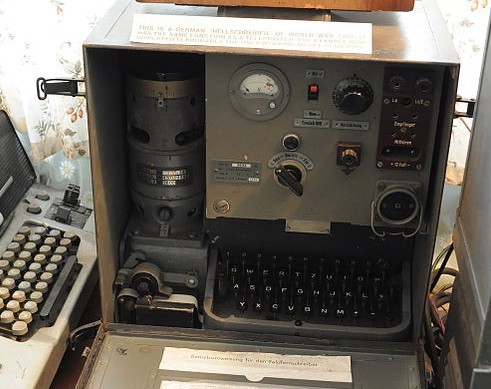
Despite the title, there’s no religious content in this post. The Hell in question is the German inventor [Rudolph Hell]. Although he had an impressive career, what most people remember him for is the Hellschreiber–a device I often mention when I’m trying to illustrate engineering elegance. What’s a Hellschreiber? And why is it elegant?
The first question is easy to answer: the Hellschreiber is almost like a teletype machine. It sends printed messages over the radio, but it works differently than conventional teletype. That’s where the elegance comes into play. To understand how, though, you need a little background.
Measuring the body’s electrical signals is a neat trick… if you can get your equipment dialed in enough to establish dependable measurements. The technique is called Surface ElectroMyography (SEMG) though you’ll hear many call this ECG. They’re essentially the same technology; the Electro CardioGraph instruments monitor the activity of the heart while SEMG Instruments monitor electrical signals used to control other muscles. Both types of hardware amount to an instrumentation type amplifier and some form of I/O or display.
This topic has been in my back pocket for many months now. Back in May we Hackaday’ites descended on New York City for the Disrupt NY Hackathon event. We arrived a day or so early so that we might better peruse the Korean BBQ joints and check out the other electronics that NY has to offer. On Saturday we gathered around, each shouting out the size of his or her t-shirt preference as we covered up our black Hackaday logo tees with maroon maroon ones (sporting the Hackaday logo of course) for a 24-hour craze of hardware hacking.
There were two individuals at our tables who were both hacking away on hardware to measure the electrical field produced by the body’s muscles in some form or another. The electrical signals measured from the skin are small, and need careful consideration to measure the signal despite the noise. This is a fun experiment that lets you work with both Instrumentation Amplifiers and OpAmps to achieve a usable signal from the movement of your body.
Over the last few weeks we’ve waded through the debate of Drone restrictions as the FAA announced, solicited comments, and finally put in place a registration system for Unmanned Aerial Systems (UAS). Having now had a week to look at the regulation, and longer to consider the philosophy behind it, I don’t think this is a bad thing. I think the FAA’s move is an early effort to get people to pay attention to what they’re doing.
The broad picture looks to me like a company trying to get users to actually read an End User Licensing Agreement. I’m going to put the blame for this firmly on Apple. They are the poster children for the unreadable EULA. Every time there is an update, you’re asked to read the document on your smartphone. You scroll down a bit and think it’s not that long, until you discover that it’s actually 47 pages. Nobody reads this, and years of indoctrination have made the click-through of accepting an EULA into a pop-culture reference. In fact, this entire paragraph has been moot. I’d bet 99 out of 103 readers knew the reference before I started the explanation.
So, we have a population of tech adopters who have been cultivated to forego reading any kind of rules that go with a product. Then we have technological advancement and business interests that have brought UAS to the feet of the general public both with low costs, wide availability, and pop-culture appeal. What could possibly go wrong? Let’s jump into that, then cover some of the other issues people are concerned about, like the public availability of personal info on the drone registry.
It has been over 2 years since we last mentioned the Weightless SIG and their claims of an IoT open standard chip with a 10 year battery life and 10km wireless range, all at a jaw dropping price of $2 per chip. There was a planned production run of the 3rd gen chips which I would suspect went to beta testers or didn’t make it into production since we didn’t hear anything else, for years.
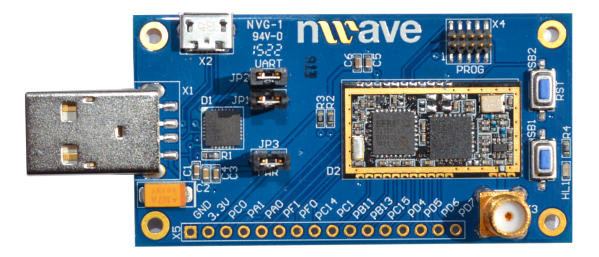
Recently, a company called nwave began producing dev-kits using the Weightless Technology which you can see in the banner image up top. Although the hardware exists it is a very small run and only available to members of the development team. If you happen to have been on the Weightless mailing list when the Weightless-N SDK was announced there was an offer to get a “free” development board to the first 100 development members. I use bunny ears on free because in order to become a member of the developer team you have to pay a yearly fee of £900. Don’t abrasively “pffffft” just yet, if you happened to be one first 100 there was an offer for developers that came up with a product and submitted it back for certification to get their £900 refunded to them. It’s not the best deal going, but the incentive to follow through with a product is an interesting take.
According to this post on the official V8 Javascript blog, the pseudo-random number generator (PRNG) that V8 Javascript uses in Math.random() is horribly flawed and getting replaced with something a lot better. V8 is Google’s fast Javascript engine that they developed for Chrome, and it’s used in Node.js and basically everywhere. The fact that nobody has noticed something like this for the last six years is a little bit worrisome, but it’s been caught and fixed and it’s all going to be better soon.
In this article, I’ll take you on a trip through the math of randomness, through to pseudo-randomness, and then loop back around and cover the history of the bad PRNG and its replacements. If you’ve been waiting for an excuse to get into PRNGs, you can use this bizarre fail and its fix as your excuse.
But first, some words of wisdom:
Any one who considers arithmetical methods of producing random digits is, of course, in a state of sin. For, as has been pointed out several times, there is no such thing as a random number — there are only methods to produce random numbers, and a strict arithmetic procedure of course is not such a method. John von Neumann
John von Neumann was a very smart man — that goes without saying. But in two sentences, he conveys something tremendously deep and tremendously important about random variables and their mathematical definition. Indeed, when you really understand these two sentences, you’ll understand more about randomness than most everyone you’ll meet.
November marked our inaugural Hackaday Superconference, something we’ve been wanting to do for a very long time. Hackaday already has a massive and vibrant online community, but until now, we haven’t asked people to come together for a hardware conference that spans a full weekend. The Supercon is Hackaday incarnate, and hundreds of very cool people showed up for a few dozen talks, amazing workshops, and a lot more.
Over the past month, we’ve been putting together a compilation of everything that happened at the first Hackaday Superconference. This includes videos of all the talks, relevant asides, and posts for everything that happened over a two-day conference. Even if you couldn’t make it out to our first con, this great material that should be shared by all.
Below is a YouTube playlist of all the talks. If you’re looking for eight hours to kill over the holiday weekend, well, there you have it. After the break is the complete conference indexed by day and speaker, with links to the talk and accompanying Hackaday post.
We’d like to thank everyone who came out to the first Hackaday Supercon, with a huge shout-out to the speakers, workshop organizers, and volunteers. It couldn’t have happened without the full support of the Hackaday community. That’s good, because we’re going to be doing this again next year.
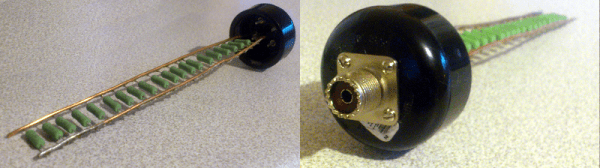
If you work on RF circuits–even if you aren’t a ham radio operator–you ought to have a dummy load. A dummy load is a non-radiative “antenna” with known impedance that you can use to test your RF circuit without radiating. For radio work, you usually just need a 50-ohm resistor that is non-inductive (at least at the frequencies you are interested in) and that can dissipate the amount of power you’ll expect it to handle (at least for a short time). [VO1PWF] wanted a dummy load and built his own. The Cantenna (not the Pringle’s kind; see right) was a famous dummy load design when Heathkit was in business. It was a single carbon rod immersed in a paint can full transformer oil (which we now know was full of dangerous PCBs; and we don’t mean printed circuit boards). [VO1PWF’s] design is a little more practical, using some resistors in parallel (20 1K resistors), a plastic pipe housing, and mineral oil to keep it all cool.
The reason for the parallel resistors is to maximize the power handling capability. The resistors are 3W units, so the dummy load–in theory–can handle 60 watts. Often, high power resistors are wire wound and thus have a good bit of parasitic inductance that makes the dummy load reactive (not a good thing since that makes the load impedance vary by frequency). They do make non-inductive wire wound resistors, but these aren’t truly non-inductive. The wire winds in two different directions, so the inductance tends to cancel out. We wouldn’t trust them to be a pure resistance in a high-power dummy load design.


 The first question is easy to answer: the Hellschreiber is almost like a teletype machine. It sends printed messages over the radio, but it works differently than conventional teletype. That’s where the elegance comes into play. To understand how, though, you need a little background.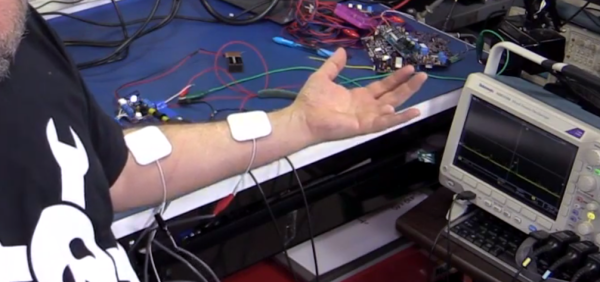






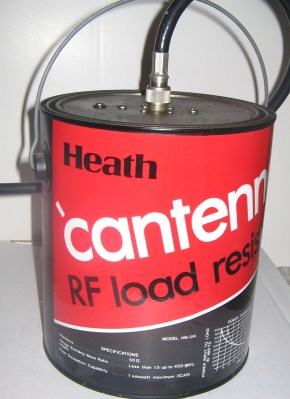 The Cantenna (not the Pringle’s kind; see right) was a famous dummy load design when Heathkit was in business. It was a single carbon rod immersed in a paint can full transformer oil (which we now know was full of








