Logic Noise: Taming The Wild Shift Register

One of the best things about DIY synth building is that you can create devices that just don’t exist in the commercial marketplace. In this session, we’ll build a looper / sequencer the likes of which you may have never seen. And it’s groovy. Today we’ll also get back a little closer to the soul of the series. In this session, nothing is analog — this is pure Logic Noise.

The shift register is the centerpiece chip this session, and a great device in its own right. We’ve got a lot of ground to cover, so watch the teaser video and then let’s get going.

Continue reading “Logic Noise: Taming The Wild Shift Register”

Weekend Proves Hardware Wins Hackathons

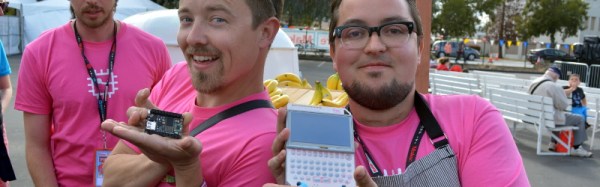
Teams hacking on hardware won big this weekend in New York. There were ten teams that answered Hackaday’s call as we hosted the first ever hardware hackathon at the Tech Crunch Disrupt NYC. These teams were thrown into the mix with all of the software hackers TC was hosting and rose to the top. Eight out of our ten teams won!

As we suspected, having something physical to show off is a huge bonus compared to those showing apps and webpages alone. Recipe for awesome: Mix in the huge talent pool brought by the hardware hackers participating, then season with a dash of experience from mentors like [Kenji Larson], [Johngineer], [Bil Herd], [Chris Gammell], and many more.

Out of over 100 teams, first runner-up went to PicoRico, which built a data collection system for the suspension of a mountain bike. The Twillio prize went to Stove Top Sensor for Paranoid, Stubburn Older Parents which adds cellphone and web connectivity to the stove, letting you check if you remembered to turn off the burns. The charismatic duo of fifteen-year-olds [Kristopher] and [Ilan] stole the show with their demonstration of Follow Plants which gives your produce a social media presence which you can then follow.

We recorded video and got the gritty details from everyone building hardware during the 20-hour frenzy. We’ll be sharing those stories throughout the week so make sure to check back!

Vintage Computer Festival Europa 16.0: The Hackaday Report

The 16th annual Vintage Computer Festival Europa (VCFe) is still ongoing this weekend in Munich, and of course Hackaday had to swing by. If you’re anywhere in Germany, you’ve still got until Sunday at 16:30 to check it out.

DSCF7896The theme for this year’s festival is “The East is Red Colorful” and that means vintage computers from the other side of the Iron Curtain. Here in (West) Germany, that naturally means a good representation of computers from the former Democratic Republic of Germany (DDR), but Czechoslovakia, Yugoslavia, and of course Russia were also in the house. There was far too much going on to cover it all, but here’s a few of the projects and computers that caught our eye.

Continue reading “Vintage Computer Festival Europa 16.0: The Hackaday Report”

Excruciating Quest Turns Chromebook Pixel IPS Into Exquisite Extra Monitor

[Shen] wanted an extra monitor at his desk, but not just any monitor. He wanted something particularly special and unquestionably refined. Like any super-power-possessing engineer he set out to scratch his hacking itch and was sucked into a multi-year extravaganza. For the love of everything hardware we’re glad this one came in on the weekend. If we had spent all that time drooling during a weekday we’d be so far behind.

The final product is a desktop monitor on an articulated arm. It features a Chromebook Pixel’s IPS display in a custom-crafted case everything. The journey started out with two different LCD units, the first from a Dell L502x replacement display using a generic LVDS board. The results were meh; washed out colors and obvious pixellation, with display adjustments that left [Shen] with a grimace on his mug. Installment two was an iPad Retina display. This iteration required spinning his own boards (resulting in [Shen’s] discovery of OSH Park). Alas, 9.7″ was too small coupled with short-cable-requirements making this version a no-go.

chromebook-pixel-ips-driver-boardAnd so we arrive at the meat and potatoes of this one. [Shen] identified the IPS LCD display on Google’s first Chromebook Pixel laptop as the object of his desire. The hack takes him through sourcing custom display cables, spinning rev after rev of his own board, and following Alice down the rabbit hole of mechanical design. Nothing marginal is good enough for [Shen], we discovered this with his project to get real audio out of a computer. He grinds away at the driver board, the case design, the control presentation, and everything else in the project until perfection was reached. This work of art will stand the test of time as a life fixture and not just an unappreciated workhorse.

This one is not to me missed. Head over to [Shen’s] project entry on Hackaday.io (don’t forget to give him a skull for this) and his blog linked at the top. We need to celebrate not only the people who can pull off such amazing work. But also the ones who do such a great job of sharing the story both for our enjoyment, and to inspire us.

Italian Law Changed By The Hackaday Prize

A recent change in Italian law was spurred by the Hackaday Prize. The old law restricted non-Italian companies from hosting contests in the country. With the update Italian citizens are now welcome to compete for the 2015 Hackaday Prize which will award $500,000 in prizes.

We’ve heard very few complaints about the Hackaday Prize. When we do, it’s almost always because there are some countries excluded from participation. We’ve tried very hard to include as much of the globe as possible, some countries simply must be excluded due to local laws regarding contests. The folks from Make in Italy saw last year’s offer of a Trip into Space or $196,418 and set out to get the local laws changed (translated). Happily they succeeded!

The Make in Italy Foundation was started to encourage and support FabLabs in Italy. After seeing two major Hacker and Maker oriented contests — The 2014 Hackaday Prize and the Intel Make it Wearable contest — exclude Italian citizens from entering. Their two prong approach sought out legal counsel and started a petition on Change.org signed by about 1.8k supporters.

We’ve been holding off on the announcement as we needed our own legal opinion on the change (we’re not great at understanding Italian legal PDFs without some help). But today we have removed Italy from the list of excluded countries. Submit your entry today just by writing down your idea of a build which will solve a problem faced by a large number of people. Build something that matters and you could win a Trip into Space, $100,000 for the ‘Best Product’, or hundreds of other prizes. But we’re not waiting until the end, over the next 17 weeks we’ll be giving out $50k in prizes to hundreds of entries.

[Thanks Alessandro]


The 2015 Hackaday Prize is sponsored by:

3D Printed Metal Assembly

New 3D Printing Techniques At AMUG 2015

Sometimes there’s a lot of perks to working for a cutting edge tech company while also being a writer here at Hackaday. This week I had the opportunity to attend AMUG 2015 — the Additive Manufacturing User Group conference in Jacksonville, Florida.

I saw companies big and small, checked out the newest techniques like metal printing and mold making, and met a ton of interesting people. Join me after the break for the rundown and a video summary of my experience.

Continue reading “New 3D Printing Techniques At AMUG 2015”

Extreme Vectrex Multicart Plays Bad Apple

[Sprite_TM] had a Vectrex console that he wanted to play with. Alas, his makeshift multicart had fallen into disrepair. Rolling up his hacking sleeves, he set about making a new one, a better one. His PCB design included his microcontroller of choice: the ST STM32F411, a 32-bit 100Mhz ARM Cortex M4, along with a 16MB SPI flash chip. [Sprite_TM] wanted to make programming games onto the multicart simple. Using the libopencm3 firmware library for the STM in conjunction with Elm-Chans FatFS, the multicart could be plugged into a computer’s USB port and have any game data dragged and dropped onto it like a USB stick. The PCB then connects directly into the Vectrex’s cartridge port. The first cartridge file is a basic menu that lists all of the game ROMs stored in the flash memory. When the user selects the game the STM loads that ROM file which the menu software then boots.

After loading his entire Vectrex ROM library onto the multicart, [Sprite_TM] realized he had far too much space left over – so he decided to add some extras. His first choice was Bad Apple (YouTube link), a music video made by fans of the Touhou Project game series. The video features black and white silhouettes of the many game characters in a shadow art style. Since its debut, Bad Apple has been ported from everything from the Sega Genesis (YouTube link) to laser scanners (YouTube link). It was time for the Vectrex to join the list.

After ripping the video from YouTube, [Sprite_TM] used MPlayer to save each frame as a PNG along with a wave file of the music. Next, he ran Potrace on the PNG files to get vector versions. Using a custom PHP script, the resulting JSON file was post-processed into relative vectors the Vectrex uses. Digital audio was possible by having the Vectrex’s 8-bit DA-converter perform double duty both for the video circuit and the audio. However, the volume must be turned to the max in order to hear the music. Incidentally, the DAC can only output audio in this scenario when vectors are not being drawn, so the event timing needed to be adjusted. The video and audio data was re-parsed after a modified version of VecX was used to get the timing events synchronized before transferring Bad Apple onto the multicart.

You can see the Vectrex version of Bad Apple after the break, along with a 3D-engine based on Doom levels. The engine is written in C and makes use of the Z-buffer, creating the effect of solid 3D-objects in front of each other.  There are no weapons or enemies to dispatch here, but the effect is impressive nonetheless.

Continue reading “Extreme Vectrex Multicart Plays Bad Apple”