This Week In Security: Iran’s ITG18, ProcMon For Linux, And Garbage Collection Fail

Even top-tier security professionals make catastrophic mistakes, and this time it was the operators at Iran’s ITG18. We’re once again talking about the strange shadowy world of state sponsored hacking. This story comes from the IBM X-Force Incident Response Intelligence Services (IRIS). I suspect a Deadpool fan must work at IBM, but that’s beside the point.

A server suspected to be used by ITG18 was incorrectly configured, and when data and training videos were stored there, that data was publicly accessible. Among the captured data was records of compromised accounts belonging to US and Greek military personnel.

The training videos also contained a few interesting tidbits. If a targeted account used two factor authentication, the attacker was to make a note and give up on gaining access to that account. If a Google account was breached, the practice was to start with Google Takeout, the service from Google that allows downloading all the data Google has collected related to that account. Yoiks. Continue reading “This Week In Security: Iran’s ITG18, ProcMon For Linux, And Garbage Collection Fail”


Jan Czochralski And The Silicon Revolution

If you were to travel back in time to the turn of the previous century and try to convince the average person that the grains of sand on just about any beach would be the basis of an industry worth hundreds of billions of dollars within 100 years, they’d probably have thought you were crazy. Aside from being coarse, rough, and irritating, sand is everywhere, and convincing anyone of its value would be a hard sell, unless your interlocutor was a real estate visionary with an appreciation of the future value of seaside property and a lot of patience.

Fast forward to our time, and we all know the value of the material that comes from common quartz sand: silicon, specifically the ultra-purified crystals of silicon that end up as the wafers we depend on to build the circuitry of life. The trip from beach to chip foundry is a long and non-obvious one which would not have been possible without the insights of an undistinguished Polish student and one-time druggist who discovered the process that made the Information Age possible: Jan Czochralski.

Continue reading “Jan Czochralski And The Silicon Revolution”

The WISE In NEOWISE: How A Hibernating Satellite Awoke To Discover The Comet

Over the last few weeks the media has been full of talk about NEOWISE, one of the brightest and most spectacular comets to ever pass through our solar system that you can still see if you hurry. While the excitement over this interstellar traveler is more than justified, it’s also an excellent opportunity to celebrate the Wide-field Infrared Survey Explorer (WISE) space telescope it was named after. The discovery of this particular comet is just the latest triumph in the orbiting observatory’s incredible mission of discovery that’s spanned over a decade, with no signs of slowing down anytime soon.

In fact, WISE has been operational for so long now that its mission has evolved beyond its original scope. When it was launched in December 2009 from California’s Vandenberg Air Force Base, its primary mission was scheduled to be completed in less than a year. But like many NASA spacecraft that came before it, WISE achieved its original design goals and found itself ready for a new challenge. Though not before it spent almost three years in hibernation mode as the agency decided what to do with it.

Continue reading “The WISE In NEOWISE: How A Hibernating Satellite Awoke To Discover The Comet”

Beyond Printf(): Better Logging Practices For Faster Debugging

All of us who do some programming know that logging is a time-tested way to output messages about the internal state of our code. With varying degrees of adjustable granularity, these messages allow us to keep track of not only the state of the application, but also its overall health. When things do end up going FUBAR, these log messages are usually the first thing we look at as a software equivalent of a Flight Data Recorder in an airplane.

Spending some time and care in not only designing the logging system, but also in deciding what should be logged and at what level, can make our future self appreciate life a lot more. We’re all familiar with the practice of ‘printf-debugging’, where logging is added as part of the usual post-crash autopsy as one tries to figure out what exactly went wrong. It’s one way of doing it, and eventually it works, but we can do much better.

People are lazy, and you’re only going to stick to good logging practices if they are at least as easy if not easier than sprinkling printf() statement throughout the code. Yet at the same time we want to be able to handle things like log levels and newlines without too much extra typing. The most successful logging libraries are built with this

Continue reading “Beyond Printf(): Better Logging Practices For Faster Debugging”

Window In The Skies: Why Everyone Is Going To Mars This Month

Mars may not be the kind of place to raise your kids, but chances are that one day [Elton John]’s famous lyrics will be wrong about there being no one there to raise them. For now, however, we have probes, orbiters, and landers. Mars missions are going strong this year, with three nations about to launch their rockets towards the Red Planet: the United States sending their Perseverance rover, China’s Tianwen-1 mission, and the United Arab Emirates sending their Hope orbiter.

As all of this is planned to happen still within the month of July, it almost gives the impression of a new era of wild space races where everyone tries to be first. Sure, some egos will certainly be boosted here, but the reason for this increased run within such a short time frame has a simple explanation: Mars will be right around the corner later this year — relatively speaking — providing an ideal opportunity to travel there right now.

In fact, this year is as good as it gets for quite a while. The next time the circumstances will be (almost) as favorable as this year is going to be in 2033, so it’s understandable that space agencies are eager to not miss out on this chance. Not that Mars missions couldn’t be accomplished in the next 13 years — after all, several endeavors are already in the wings for 2022, including the delayed Rosalind Franklin rover launch. It’s just that the circumstances won’t be as ideal.

But what exactly does that mean, and why is that? What makes July 2020 so special? And what’s everyone doing up there anyway? Well, let’s find out!

Continue reading “Window In The Skies: Why Everyone Is Going To Mars This Month”

There’s An Engineer In Germany I’d Like A Word With; Tale Of A Crumbling Volkswagen Lock

In common with quite a few in the hardware hacking community, I have a fondness for older vehicles. My “modern” ride is an older vehicle by today’s standards, a Volkswagen Polo 6N made in the late 1990s. It’s by my estimation a Good Car, having transported me reliably back and forth across the UK and Europe for several years.

Last week though, it let me down. Outside the church in a neighbouring village the driver’s door lock failed, leaving me with my igniton key stuck in the door, and a mildly embarrassing phone call to my dad to bring the Torx driver required to remove the assembly and release it. I am evidently not 1337 enough, I don’t carry a full set of Torx bits with me everywhere I go. The passenger side lock has never worked properly while I’ve had the car, and this is evidently my cue to sort it all out.

Continue reading “There’s An Engineer In Germany I’d Like A Word With; Tale Of A Crumbling Volkswagen Lock”

Clacker Hacker: Hot Rod Switch Mods

Whether you’re a programmer, gamer, writer, or data entry specialist, the keyboard is an extension of your nervous system. It’s not so much a tool as it is a medium for flow — for being in the zone. So I think it’s only natural that you should care deeply about your keyboard — how it looks, how it sounds, and above all, how it feels to finger-punch those helmeted little switches all the live-long day. That’s my excuse, anyway.

It might surprise you that mechanical keyboard switches can be modified in a number of ways. Depending on what you want from your keyboarding experience, you can make switches feel lighter or less scratchy, quiet them down, or tighten up any wobble in the housing. Why would you want to do this? Because customization is fun. Because electromechanical things are awesome, and because it’s fun to take switches apart and put them back together again. Because it’s literally hacking and this is Hackaday.

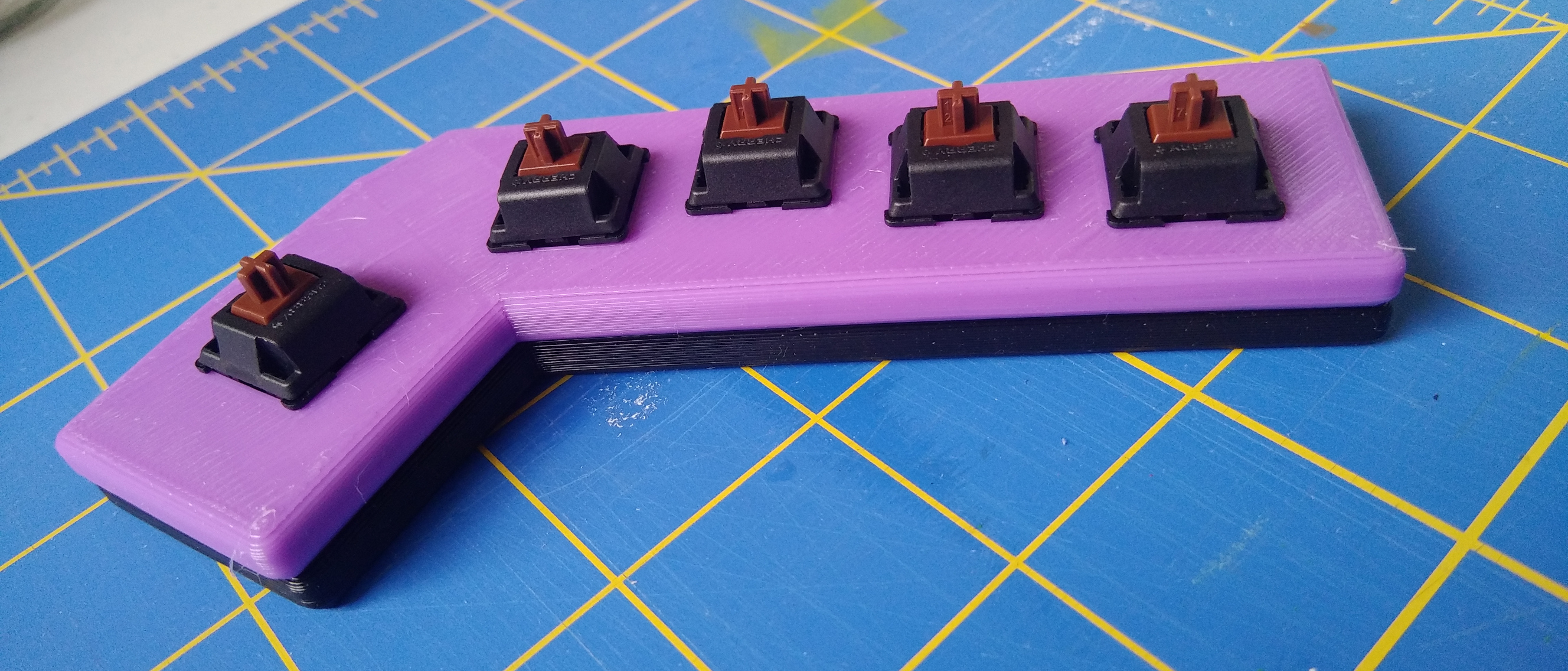
This is a pair of plates from a macro keeb I’m making that will sit directly in front of my trackball.

I got into switch modding because I wanted to put Cherry clears in my dactyl, but worried that they would take too much force to actuate and wear my fingers out. So I bought some really light (39g) springs and was really looking forward to swapping them into the clears, but they just don’t work. Like, physically. Slider goes down, slider gets stuck. It will come back up, but only if I hit it again and smear my finger to the side a bit at the same time. Those springs must be too weak to return clear sliders.

I took this as a sign that I should suck it up and use browns instead. After all, no one else has to know what my sliders look like. While I was opening switches, I tried out one of these super-light springs in a brown, thinking maybe they wouldn’t have to go to waste. Not only did the lighter spring work in the brown, it felt pretty nice. It’s hard to imagine how a whole keeb would feel based on a single switch, but if you can gather a handful and snap them into a plate to riffle your fingers over them, well, it’s probably close enough to a full keyboard to get a good feel for whatever mod you’re doing.

Continue reading “Clacker Hacker: Hot Rod Switch Mods”