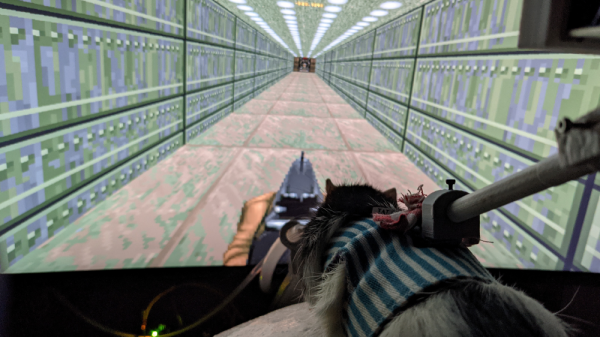
Rat playing DOOM

Rats Learn To Play DOOM In This Automated VR Arena

When we run an article with “DOOM” in the title, it’s typically another example of getting the venerable game running on some minimalist platform. This DOOM-based VR rig for rats, though, is less about hacking DOOM, and more about hacking the rats.

What started as a side project for [Viktor Tóth] has evolved into quite a complex apparatus. At the center of the rig is an omnidirectional treadmill comprised of a polystyrene ball about the size of a bowling ball. The ball is free to rotate, with sensors detecting rotation in two axes — it’s basically a big electromechanical mouse upside down. The rat rides at the top of the ball, wearing a harness to keep it from slipping off. A large curved monitor sits right in front of the rat to display the virtual environment, which is a custom DOOM map.

With the VR rig built, [Viktor] worked on automating the training. A treat dispenser provides the proper motivation, while powered drive wheels engage with the ball to nudge the rat if it gets stuck in the virtual world. [Viktor] says he has trained three rats — [Romero], [Carmack], and [Tom] — to walk down a straight hallway using this automated method. As for the meat of the game — shooting monsters — [Viktor] has that covered too, with a sensor that detects when a rat rears up on its hind legs to register a shot.

Total training time to get the rats to the point seen in the video was about six weeks, and [Viktor] reports the whole thing cost him about $2000. That’s a lot of time and money, but the results are pretty interesting. If you’re more interested in minimalist DOOM builds, we understand — check out DOOM on a lightbulb, or a thermostat, or even a GPS.

Continue reading “Rats Learn To Play DOOM In This Automated VR Arena”
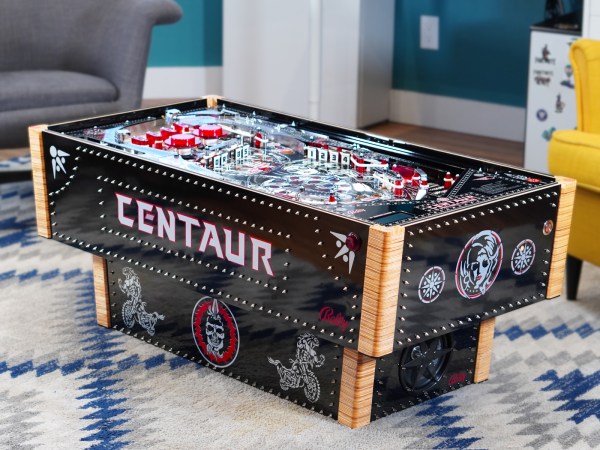
A 1981 Centaur pinball table rebuilt into a coffee table.

Clear Off The Coffee Table, It’s Pinball Time

Like many of us, [BuildXYZ] has always wanted to own a pinball machine, but doesn’t have the space to justify buying such a big and heavy toy. But where there’s a will, there’s a way. [BuildXYZ] figured that if they could build a pinball machine into a coffee table form factor, they’d be at least halfway to justification.

[BuildXYZ] didn’t choose just any pin. After doing a bunch of research, they settled on 1981’s Bally Centaur because it’s an early solid-state machine, and it’s one of the best. It has no secondary playfield levels to deal with, making it much easier to do this project.

Where do we even start to describe this beautiful labor of love? There are too many details to list, but know that it seems to be equal amounts of restoration work and custom work that brought this table together. The build video after the break is definitely worth your time, and you’ll gain a much better appreciation of the amount of time that went into this, from the custom score decoder chip built on an FPGA to the 3D printed replacement drop targets and new acrylic bits to replace the yellowing ones from the playfield.

Continue reading “Clear Off The Coffee Table, It’s Pinball Time”

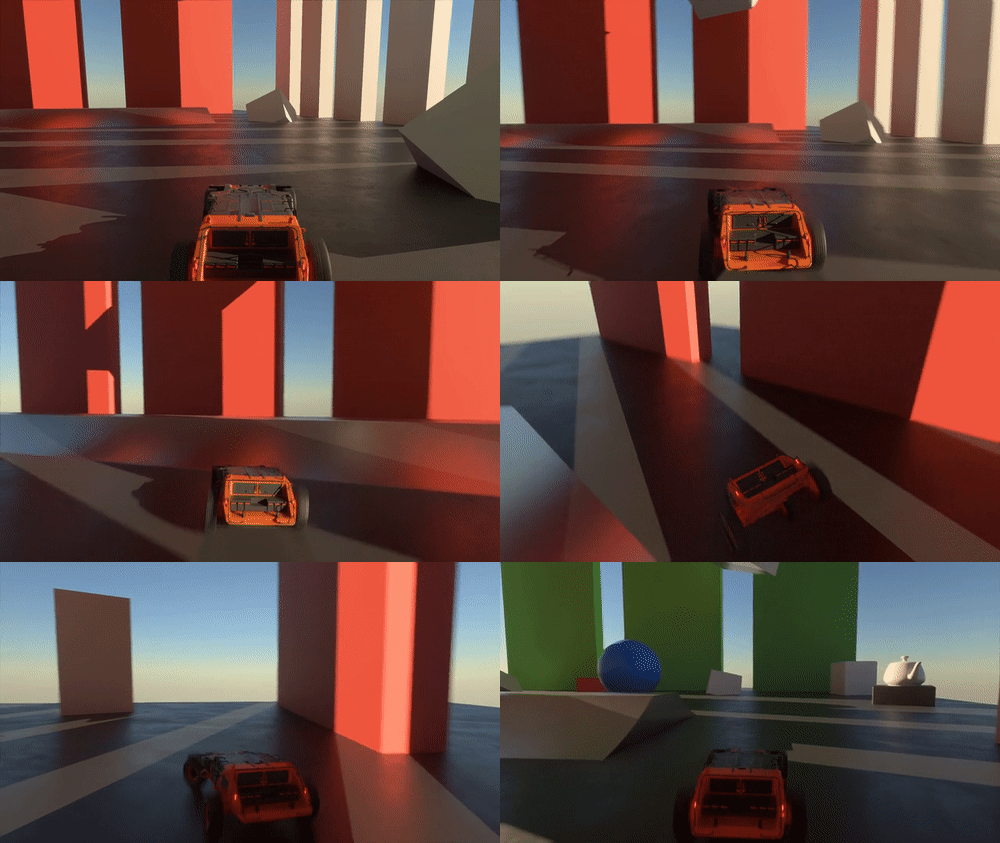
The ray tracer racer

Whipping Together A Little Ray Tracer Racer

When you hear raytracing, you might think of complex dark algorithms that to stare too long at their source code invites the beginning of madness. And you’re technically not far off from the truth, but [h3r2tic] put a small open-source ray tracing game demo up on GitHub. The actual rust code powering the game is relatively short (just four files), with the longest file being the physics file. But, of course, there is a small mountain of code under this sample in the form of libraries.

Kajiya, physx-rs, and dolly are the three libraries that make this little demo possible. Kajiya, in particular, is what makes raytracing possible as it uses the newer RTX features (so only more recent Nvidia and AMD cards are supported) and Vulkan bindings. But, of course, it isn’t wholly ray-traced as we are still several years out from proper real-time raytracing. Nevertheless, the blend between raytracing and traditional rasterization looks incredible. The most important thing about this simple tiny sample isn’t the game itself but what it stands for. It shows how easy it is to create a sample like this. Even just five years, creating a demo like this required massive effort and expertise.

Visually, it is stunning to look at. While the reflections are most apparent, the takeaway from this is the ease that real-time global illumination brings. A quick look through the code shows that there are very few lights in the scene, despite looking well lit with soft shadows. Traditional video games spend a significant amount of development time lighting a scene, placing additional lights, and tweaking them to make up for all the shortcuts that lighting has to take in a rasterized environment. As more and more games are built with raytracing in mind rather than tacked on at the end, we can ditch the small crumbling mountain of hacks that we are forced to use in games today and just rely on the rays to accurately light a scene.

If using a library for your raytracing seems too easy, perhaps you’d like to take on the challenge of raytracing in excel. Video after the break.

Continue reading “Whipping Together A Little Ray Tracer Racer”

The Legend Of Zelda: Decompiled

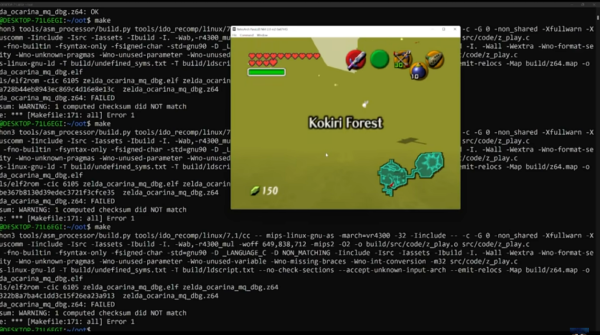
Keeping source code to programs closed is something that is generally frowned upon here for plenty of reasons. Closed source code is less secure and less customizable, but unfortunately we won’t be able to convince everyone of the merits of open source code any time soon. On the other hand, it is possible to decompile some of those programs whose source remains behind locked doors in an attempt to better understand that code, and one of the more impressive examples of that of late is this project which has fully decompiled Ocarina of Time.

To get started with the code for this project, one simply needs to clone the Git repository and then use a certain set of software tools (depending on the user’s operating system) to compile the ROM from the source code. From there, though, the world is your rupee-filled jar. Like we’ve seen from other decompiled games, any number of enhancements to the original game can be made including increasing the frame rate, improving the graphics, or otherwise adding flourishes that wouldn’t otherwise be there.

The creators of this project do point out that this is still a work-in-progress as only one of the 18 versions have been completed, but the fact that the source code they have been able to decompile builds a fully-working game when recompiled speaks to how far along it’s come. We’ve seen similar processes used for other games before that also help to illustrate how much improvement is possible when re-writing old games from their source code.

Continue reading “The Legend Of Zelda: Decompiled”

The Dreamcast Legacy

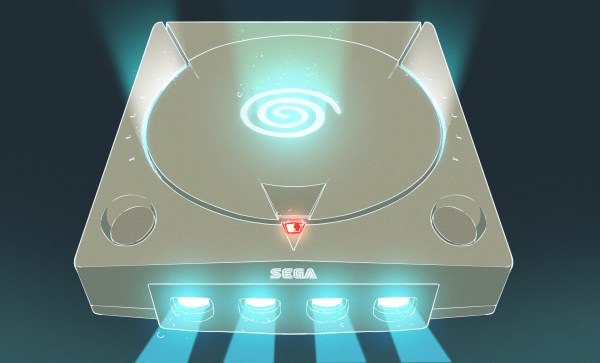
The Dreamcast is a bit of an odd beast. Coming on the heels of the unpopular Sega Saturn, the Dreamcast was meant to be a simple console built with off-the-shelf parts and released in late 1998. The Nintendo 64 was already tough competition (1996). Ultimately, the Dreamcast fell out of the public eye in the early 2000s as the Playstation 2, Xbox, and Gamecube were all released with incredible fanfare just a few years later. In some sense, Sega’s last console is a footnote in gaming history.

But despite not achieving the success that Sega hoped for, the Dreamcast has formed a small cult following, because as we know, nothing builds a cult-like following like an untimely demise. Since its release, it has gained a reputation for being ahead of its time. It was the first console to include a modem for network play and an easy storage solution for transferring game data between consoles via the VMUs that docked in the controllers. It had innovative and classic games such as Crazy TaxiJet Set RadioPhantasy Star Online, and Shenmue. Microsoft even released a version of Windows CE with DirectX allowing developers to port PC games to the console quickly.

We see our fair share of console hacks here on Hackaday, but what is the ultimate legacy of the Dreamcast? How did it come to be? What happened to it, and why did so much of Sega’s hopes ride on it? Continue reading “The Dreamcast Legacy”

Assistive Tech And Video Games

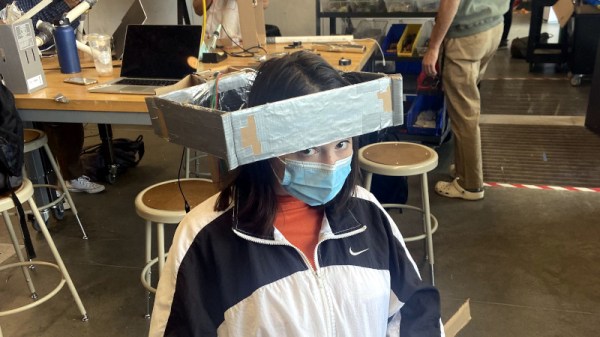
Assistive technologies have a pretty big presence here on Hackaday, and this hack is nothing short of interesting. [kerchoo_22] is working on a hands-free video game controller as a final project for her engineering class and we think it’s worth sharing.

The basic premise of the circuit is pretty simple. She DIY’d a few contact switches using conductive plates made of cardboard, duct tape, and aluminum foil. The output of the switch is read by analog input pins on an Arduino Leonardo. When the switches are off, the analog input pins are pulled HIGH using 1 MegaOhm resistors. But when the user hits their head on one of the four conductive pads, the switch is engaged, and the analog input pins are shorted to ground.

The Arduino Leonardo, having a native USB port, is able to directly emulate a keyboard. Each conductive pad is mapped to a different key press corresponding to different functions within the game. Left, right, shoot, etc. And there you have it, gameplay without using hands or a controller!

Now, it seems as though [kerchoo_22] put an appropriate amount of cushion on the head pads, so there probably isn’t much danger of a concussion. Either way, you can never be too careful.

My Major Is Gaming…

Times have changed. You can now take a university class in writing games. In fact, YOU can now take a university class about writing games because [Dave Churchill] of Memorial University has put all 22 of his lectures up for your enjoyment. [Dr. Churchill] isn’t planning on releasing the assignment files, but you can still get a lot from watching the videos. Apparently, the classes were also live streamed on Twitch.

The games build on SFML so the resulting games can be portable. The library abstracts input, graphics, sound, and networking.

Continue reading “My Major Is Gaming…”