Turn-by-turn Smart Glasses Give You Direction

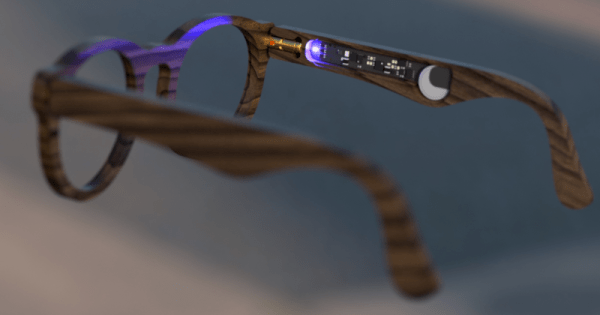
[SamsonMarch] designs electronic products by day and — apparently — does it in his spare time, too. His latest is a pair of really cool shades that give him turn-by-turn directions as he walks around town. Unlike some smart glasses, these get around the difficult problem of building a heads-up display by using a very simple interface based on colored LEDs visible to your peripheral vision in the temples of the frames.

The glasses themselves look great; designed in Fusion 360 and cut out of wood, no one would give them a second glance. [Sam] says you could 3D print them, too, but we think the wood looks best even if the stock is a cheap bamboo cutting board. He also cut the lenses out of acrylic.

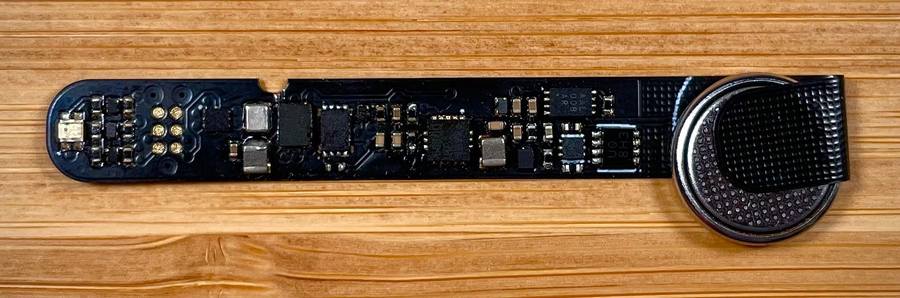
The slots in the temples are where the action is, though. An iPhone app takes input and talks to Apple services to get directions. A lot of thought went into making the app work even though the phone keeps trying to put it to sleep. Each PCB hosts an RGB LED for indicating left/right turn and destination. They talk to the app using BLE and include accelerometers which put the boards — powered by coin cells — into sleep mode when no movement is detected.

Overall a fun and good looking project. There are even covers to hide the boards during normal use. The files you need to reproduce it are on GitHub. Usually, when we see smart glasses, they have some sort of screen which is harder to do. Of course, it is impossible to avoid comparisons to Google Glass.

Continue reading “Turn-by-turn Smart Glasses Give You Direction”

Hello From The NearSpace

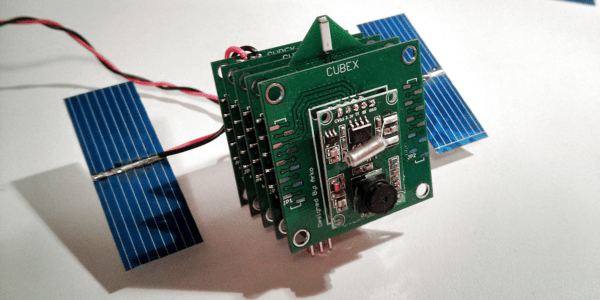
A key challenge for any system headed up into the upper-atmosphere region sometimes called near space is communicating back down to the ground. The sensors and cameras onboard many high altitude balloons and satellites aren’t useful if the data they collect can’t be retrieved. Often times, custom antennas or beacons are added to help. Looking at the cost and difficulty of the problem, [arko] and [upaut] teamed up to try and make a turn-key solution for any near-space enthusiast by building CUBEX, a wonderful little module with sensors and clever radio that can be easily reused and repurposed.

CUBEX is meant as a payload for a high-altitude balloon with a camera, GPS, small battery, solar cell, and the accompanying power management circuits. The clever bit comes in the radio back down. By using the 434.460 Mhz band, it can broadcast around a hundred miles at 10mW. The only hardware to receive is a radio listener (a cheap RTL USB stick works nicely). Pictures and GPS coordinates stream down at 300 baud.

Their launch was quite successful and while they didn’t catch a solar eclipse, their balloon reached an impressive 33698m (110,560ft) while taking pictures. Even though it did eventually splashdown in the Pacific Ocean, they were able to enjoy a plethora of gorgeous photos thanks to their easy and cost-effective data link.

Continue reading “Hello From The NearSpace”

Under The Sea GPS Uses Sound

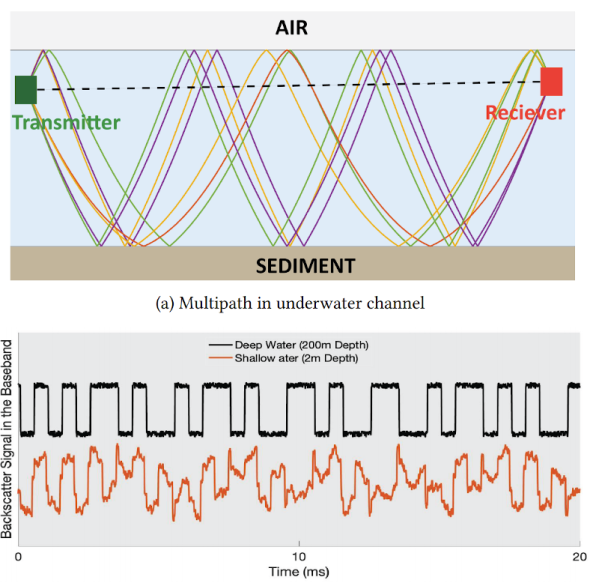
If you’ve ever tried to use GPS indoors, you know that the signals aren’t easy to acquire in any sort of structure. Now imagine trying to get a satellite fix underwater. Researchers at MIT have a new technique, underwater backscatter localization or UBL, that promises to provide a low-power localization system tailored for the subsea environment.

Like other existing solutions, UBL uses sound waves, but it avoids some of the common problems with using sonic beacons in that environment. A typical system has a fixed beacon constrained by the availability of power or battery-operated beacons that require replacement or recharging. Since the beacon acts as a transponder — it receives a signal and then replies — it requires either constant power or time to wake up from the external stimulus and that time typically varies with the environment. That variable startup time interferes with computing the round-trip time of the signal, which is crucial for estimating position.

Continue reading “Under The Sea GPS Uses Sound”

Tracking Your Run Over The Long Haul

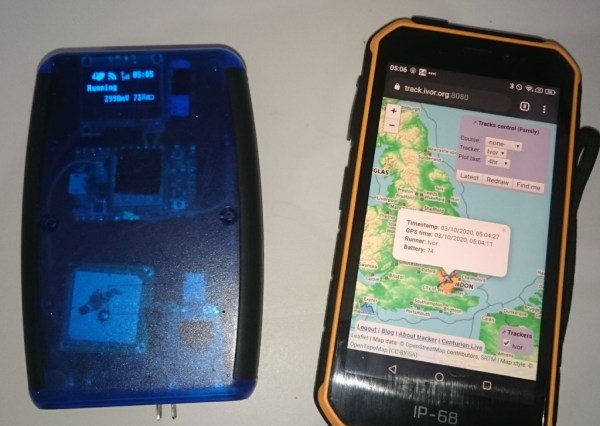
The rise of smartphone and smartwatch fitness tracking has been an absolute boon for anyone interested in tracking their runs. However, it all falls short when you need a custom feature and start getting into serious long distance running, as most smartphone batteries simply won’t last. While there are devices out there for the ultra-running enthusiast, [Ivor Hewitt] decided he wasn’t willing to pay a monthly subscription for the pricy trackers or deal with the hassle of the generic cheap versions, and decided to roll his own.

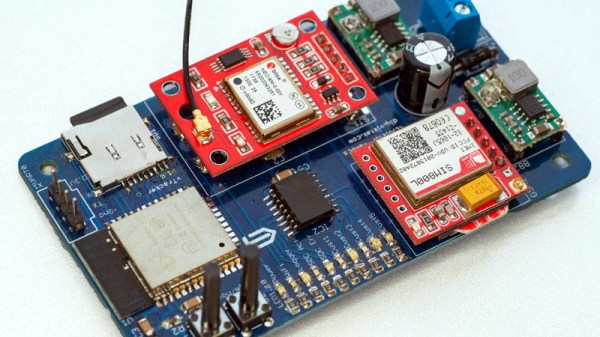
The key pieces of this project are the A9G GPS module and the RDA8955 GRS/GPRS module. They’re both incredibly small and power efficient, perfect for a project that needs to be worn on your person with a long battery life. As an added bonus, the RDA8955 also includes a SoC that’s user-programmable. After battling the lackluster documentation and tooling, [Ivor] managed to get some software running on his new system. A power bug on the A9G GPS module was potentially show stopping, but thanks to some help by folks in the community, it was diagnosed and solved.

Further additions included adding a proper charging circuit (TP4056) and a beefy 2600 mAh battery scavenged from a Sony smartphone, giving the compact system around 38 hours of active battery life. An OLED screen was added to show upcoming aid stations and overall system status, driven by a custom display library. A snazzy translucent case makes the whole device slim and easy to carry. Now at the end of a long race or training session, [Ivor] has a wealth of tracked points that has already been uploaded to his own tracking website and a fully charged phone.

Next time you’re looking for a small compact GPS tracker or cellular logger take a look at this project’s code on GitHub or the A9G and RDA8955 modules.

Thanks [Ivor] for sending this one in!

Mobile Transmitter Gets Internal GPS And Bluetooth

While [Selim Olcer] was relatively happy with his Kenwood TM-D710a radio, he didn’t like the fact that it needed a bulky external GPS “backpack” for APRS location data. So he decided to crack open the head unit and see if he couldn’t integrate his own GPS hardware (machine translation). Not only did he succeed, but he even threw in Bluetooth compatibility for good measure.

With the repair manual circuit diagrams in hand, it was no problem to find the GPS RX and TX lines that were being broken out to the external connector. Unfortunately, the radio’s electronics are all 5 volts and the GPS module [Selim] wanted to use was only 3.3 V. So he came up with a small PCB that included not only the voltage regulator to power the GPS module, but also some voltage-dividers to level shift those signals.

Since the Kenwood TM-D710a was already designed to accept a GPS upgrade module, he just needed to change some configuration options in the radio’s menus for it to see the new hardware. Technically the project was done at this point, but since there was still room in the case and he had a GPS module spitting out NMEA sentences, [Selim] tacked on a common Bluetooth serial module so he could see the position information on his smartphone. With an application like APRSdroid, he now has a nice moving map display using the position pulled from the radio’s GPS.

With this modification done it looks like the head unit is ready to go, but that’s only the beginning for a mobile rig. Now we want to see how he integrates the whole thing into the car.

Draw On Your Lawn With This Autonomous Mower And RTK-GPS

The rise of open source hardware has seen a wide variety of laborious tasks become successfully automated, saving us humans a great deal of hassle.  Suffice to say, some chores are easier to automate than others. Take the classic case of a harmless autonomous vacuum cleaner that can be pretty dumb, bumping around the place to detect the perimeter as it traverses the room blindly with a pre-programmed sweeping pattern.

Now in principle, this idea could be extended to mowing your lawn. But would you really want a high speed rotating blade running rampant as it aimlessly ventures outside the perimeter of your lawn? The Sunray update to the Ardumower autonomous lawn mower project has solved this problem without invoking the need to lay down an actual perimeter wire. As standard consumer grade GPS is simply not accurate enough, so the solution involves implementing your very own RTK-GPS hardware and an accompanying base station, introducing centimeter-level accuracy to your mowing jobs.

RTK-GPS, also known as Carrier Phase Enhanced GPS, improves the accuracy of standard GPS by measuring the error in the signal using a reference receiver whose position is known accurately. This information is then relayed to the Ardumower board over a radio link, so that it could tweak its position accordingly. Do you need the ability to carve emojis into your lawn? No. But you could have it anyway. If that’s not enough to kick off the autonomous lawnmower revolution, we don’t know what is.

Continue reading “Draw On Your Lawn With This Autonomous Mower And RTK-GPS”

How To Choose The Right GPS Module For Your Project

You’ve built a brand new project, and it’s a wonderful little thing that’s out and about in the world. The only problem is, you need to know its location to a decent degree of accuracy. Thankfully, GPS is a thing! With an off-the-shelf module, it’s possible to get all the location data you could possibly need. But how do you go about it, and what parts are the right ones for your application? For the answers to these questions, read on! Continue reading “How To Choose The Right GPS Module For Your Project”