Great Beginnings For Vintage Computing In Seattle; VCF PNW

The pitch to my wife was simple: “Feel like spending the weekend in Seattle?” That’s how I ended up at the inaugural Vintage Computer Festival Pacific Northwest last weekend, and I’m glad we made the five-hour drive into The Big City to check it out. Hackaday is a VCF sponsor, after all, so it seemed like a great excuse to make the trip. That it ended up being two consecutive days of great Seattle weather was only icing on the cake of being able to spend time with fellow retro computer aficionados and their dearest bits of old hardware, in a great museum dedicated to keeping computer history alive and accessible.

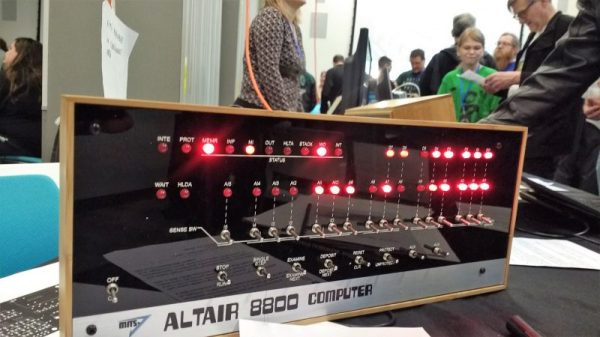
The fact that Seattle, home of Microsoft, Amazon, and dozens of other tech companies, has until now been left out of the loop in favor of VCF East in New Jersey and VCF West in Mountain View seems strange, but judging by the reception, VCF PNW is here to stay and poised to grow. There were 20 exhibitors for this go around, showing off everything from reanimated PDP-11 and Altair 8800 control panels to TRS-80s from Model 1 through to the CoCo. Almost every class of reasonably transportable retro hardware was represented, as well as some that pushed the portability envelope, like a working PDP-8 and a huge Symbolics 3640 LISP workstation.

Continue reading “Great Beginnings For Vintage Computing In Seattle; VCF PNW”

Retrotechtacular: AM Radios, Core Memory, And Color TV, What Was Hot In Chips In ’73

As part of writing tech stories such as those we feature here at Hackaday, there is a huge amount of research to be done.  We trawl through pages and pages of obscure blogs, videos, and data sheets. Sometimes we turn up resources interesting enough that we file them away, convinced that they contain the nucleus of another story at some point in the future.

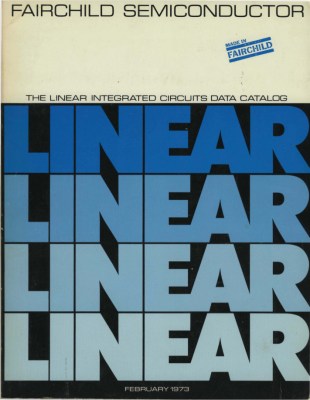
Today’s topic of entertainment is just such a resource, courtesy of the Internet Archive. It’s not a video as we’d often provide you in a Retrotechtacular piece, instead it’s the February 1973 edition of the Fairchild Semiconductor Linear Integrated Circuits Catalog. Books like this one that could be had from company sales representatives were highly prized in the days before universal Internet access to data sheets, and the ink-on-paper datasheets within it provide a fascinating snapshot of the integrated electronics industry as it was 45 years ago.

The first obvious difference between then and now is one of scale, this is a single volume containing Fairchild’s entire range. At 548 pages it wouldn’t have been a slim volume by any means, but given that Fairchild were at the time one of the big players in the field it is unimaginable that the entire range of a 2018 equivalent manufacturer could be contained in the same way. Given that the integrated circuit was at the time an invention barely 15 years old, we are looking at an industry still in relative infancy.

The catalog has a series of sections with familiar headings: Operational amplifiers, comparators, voltage regulators, computer/interface, consumer, and transistor/diode arrays with analog switches. Any modern catalog will have similar headings, and there are even a few devices you will find have survived the decades. The μA741 op-amp (page 64) from its original manufacturer has not yet become a commodity product here, and it sits alongside familiar devices such as the μA7800 series (page 201) or μA723 (page 194) regulators.

Continue reading “Retrotechtacular: AM Radios, Core Memory, And Color TV, What Was Hot In Chips In ’73”

Create A Discord Webhook With Python For Your Bot

Discord is an IRC-like chat platform that all the young cool kids are hanging out on. Originally intended as a way to communicate during online games, Discord has grown to the point that there are servers out there for nearly any topic imaginable. One of the reasons for this phenomenal growth is how easy it is to create and moderate your own Discord server: just hit the “+” icon on the website or in the mobile application, and away you go.

As a long-time IRC guy, I was initially unimpressed with Discord. It seemed like the same kind of stuff we’ve had for decades, but with an admittedly slick UI. After having used it for a few months now and joining servers dedicated to everything from gaming to rocket science, I can’t say that my initial impression of Discord is inaccurate: it’s definitely just a modern IRC. But I’ve also come to the realization that I’m OK with that.

But this isn’t a review of Discord or an invitation to join the server I’ve setup for my Battlefield platoon. In this article we’re going to look at how easy it is to create a simple “bot” that you can plug into a Discord server and do useful work with. Since anyone can create a persistent Discord server for free, it’s an interesting platform to use for IoT monitoring and logging by simply sending messages into the server.

Continue reading “Create A Discord Webhook With Python For Your Bot”

Friday Hack Chat: Making A Makerspace

How do you make a makerspace? Over the last decade, there have been plenty of talks and tutorials handing out pointers. No day of the week will be good for a meeting, so the meetings are always on Tuesdays. The bike shed will be painted orange, no exceptions. Are you going to be a for-profit, or not-for-profit? Are we a makerspace or a hackerspace? Jerry, stop being clever. Pantone 021 U.

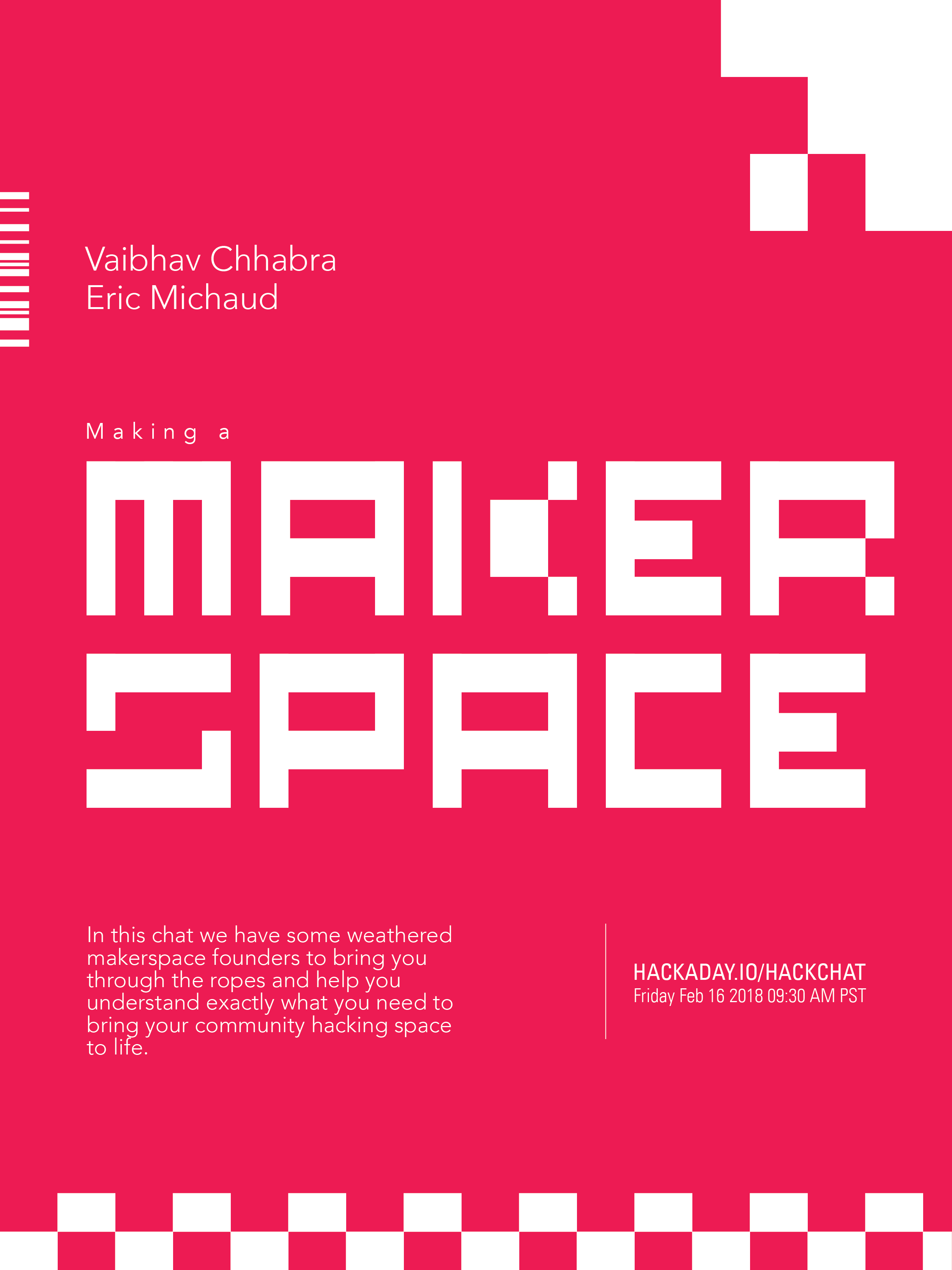
For this week’s Hack chat, we’re going to be talking all about making a makerspace. These are community hubs where people come together and share resources to bring their inventions to life. It’s not as simple as it may seem. You need insurance, you need a building, you need a landlord who’s cool, and there are a thousand and one things that can go wrong. Who best to steer you through the storm of opening a Hackerspace? Who can you solicit advice from?

Our guests for this week’s Hack Chat are Vaibhav Chhabra, a mech E from Boston University. He spent two years working on an eye diagnostic device, is an instructor at MIT REDX health care innovation lab, and is a founder of the incredible Makers Asylum. Eric Michaud is a Hacker, runner, and author, currently working on Rift Recon, Shellcon, and hackerspaces.org. He has written tutorials on Adafruit, and was a founding member of HacDC before he took off to Chicago and started PS:One.

Topics for this week’s Hack Chat include what it takes to open a makerspace, how you can fund it, organizational structure concerning for-profit, not-for-profit, and the thing that the members are most concerned about: what equipment is most crucial for a successful makerspace. You are, of course, encouraged to add your own questions to the Hack Chat; to do that, just leave a comment on the Hack Chat event page.

join-hack-chat

Our Hack Chats are live community events on the Hackaday.io Hack Chat group messaging. This Hack Chat is going down Friday, February 16th at 09:30am Pacific time. This is different than our usual time slot. Want to know what time this is happening in your neck of the woods? Here, look at the neat time zone converter thingy

Click that speech bubble to the right, and you’ll be taken directly to the Hack Chat group on Hackaday.io.

You don’t have to wait until Friday; join whenever you want and you can see what the community is talking about.

Mechanisms: Bearings

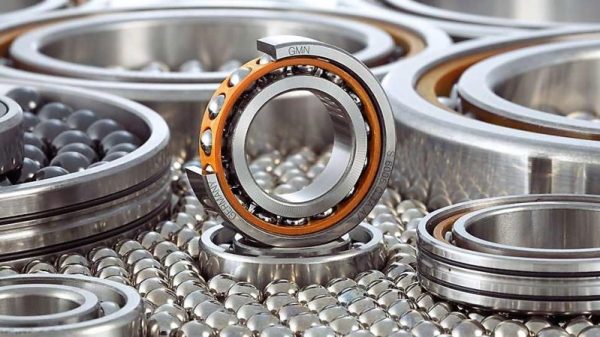
They lie at the heart of every fidget spinner and in every motor that runs our lives, from the steppers in a 3D printer to the hundreds in every car engine. They can be as simple as a lubricated bushing or as complicated as the roller bearing in a car axle. Bearings are at work every day for us, directing forces and reducing friction, and understanding them is important to getting stuff done with rotating mechanisms.

Continue reading “Mechanisms: Bearings”

OpenSCAD: Tieing It Together With Hull()

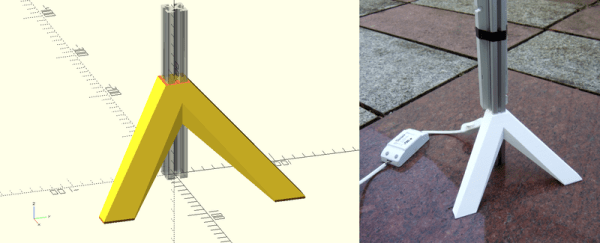
What’s your favorite OpenSCAD command? Perhaps it’s intersection() or difference()? Or are you a polygon() and extrude() modeler? For me, the most useful, and maybe most often overlooked, function is hull(). Hull() does just what it says on the can — creates a convex hull around the objects that are passed to it as children — but that turns out to be invaluable.

Hull() solves a number of newbie problems: making things round and connecting things together. And with a little ingenuity, hull() can provide a nearly complete modelling strategy all on its own. If you use OpenSCAD and your creations end up with hard edges, or you spend too much time figuring out angles, or if you just want to experience another way to get the job done, read on!

Continue reading “OpenSCAD: Tieing It Together With Hull()”

Mary Somerville: The First Scientist

Science, as a concept, is relatively new. Benjamin Franklin wasn’t a scientist probing the mysteries of amber and wool and electricity and ‘air baths’; he was a natural philosopher. Antonie van Leeuwenhoek was simply a man with a proclivity towards creating new and novel instruments. Robert Hooke was a naturalist and polymath, and Newton was simply a ‘man of science’. None of these men were ever called ‘scientists’ in their time; the term hadn’t even been coined yet.

The word ‘scientist’ wouldn’t come into vogue until the 1830s. The word itself was created by William Whewell, reviewing The Connexion of the Physical Sciences by Mary Somerville. The term used at the time, ‘a man of science’, didn’t apply to Mrs. Somerville, and, truth be told, the men of science of the day each filled a particular niche; Faraday was interested in electricity, Darwin was a naturalist. Mary Somerville was a woman and an interdisciplinarian, and the word ‘scientist’ was created for her.

Continue reading “Mary Somerville: The First Scientist”