Uncertainty – The Key To Quantum Weirdness

All these fifty years of conscious brooding have brought me no nearer to the answer to the question, ‘What are light quanta?’ Nowadays every Tom, Dick and Harry thinks he knows it, but he is mistaken.

                       Albert Einstein, 1954

As 1926 was coming to a close, the physics world lauded Erwin Schrodinger and his wave mechanics. Schrodinger’s purely mathematical tool was being used to probe the internal structure of the atom and to provide predictable experimental outcomes. However, some deep questions still remained – primarily with the idea of discontinuous movements of the electron within a hydrogen atom. Niels Bohr, champion of and chief spokesperson for quantum theory, had developed a model of the atom that explained spectral lines. This model required an electron to move to a higher energy level when absorbing a photon, and releasing a photon when it moved to a lower energy level. The point of contention is how the electron was moving. This quantum jumping, as Bohr called it was said to be instantaneous. And this did not sit well with classical minded physicists, including Schrodinger.

Continue reading “Uncertainty – The Key To Quantum Weirdness”

Hackaday Prize: 20 Projects That Make Us All Citizen Scientists

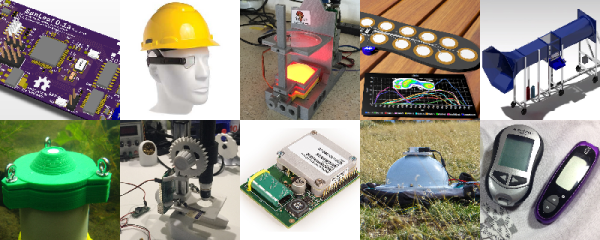
We live in a time of unparalleled access to technology and this has the power to make life better for everyone. Today we are excited to announce twenty spectacular builds that use access to technology to move scientific exploration within the reach of all. These are the winners of the Citizen Scientist challenge of the 2016 Hackaday Prize. Themes tackled in this round include blood glucose monitoring, insole sensing for analyzing your footfalls, lab equipment like automated microscopy, sensors to measure the world around us, and more.

The winners for the Citizen Scientist portion of the Hackaday Prize are, in no particular order:


The Hackaday Prize is the greatest hardware competition on earth. We want to see the next great Open Hardware project benefit everyone. We’re working toward that by recognizing people who build, make, and design the coolest and most useful devices around.

These twenty projects just won $1000 and will now move on to the final phase of The Hackaday Prize, to be judged by our fourteen celebrity judges. Awesome! Now get to work: there’s a lot the hackers behind these projects need to do before the final judging in October where they’ll compete for the grand prize of $150,000 and four other top prizes.

AutomationIf your project didn’t make the cut, there’s still an opportunity for you to build the next great piece of hardware for The Hackaday Prize. The Automation Challenge is currently under way. It encourages everyone to build devices that make your life easier.

Automate your life; build a device that makes your breakfast, a robot to mow your lawn, or software that does your taxes. Build a device that automatically tracks laundry detergent, automates washing the dishes, or a robot that obeys every command.

Like the Design Your Concept, Anything Goes, and Citizen Science rounds of The Hackaday Prize, the top twenty projects will each win $1000, and move on to the Hackaday Prize finals for a chance to win $150,000 and a residency at the Supplyframe DesignLab in Pasadena.

If you don’t have a project up on Hackaday.io, you can start one right now and submit it to The Hackaday Prize. If you’re already working on the next great piece of hardware design, add it to the Automation challenge using the dropdown menu on the sidebar of your project page.

Hackaday Links: July 17, 2016

There’s going to be a new Nintendo console for Christmas! It’s the NES Classic Edition. It looks like a minified NES, with weird connectors that look like the connector for the Wii Nunchuck. There are no other details.

A site called “Motherboard” reports assembling a computer is too hard and a ‘nerve-wrecking [sic]’ process. Tip of the stovepipe to the Totalbiscuit.

When I was in elementary school, the playground had a twenty foot tall metal slide that faced South. During my time there, at least three of my classmates fell off it, and I distinctly remember the school nurse’s aid running past me on the playground with a wheelchair. There wasn’t soft mulch or the weird rubber granules under this slide – just hard, compacted dirt. This slide was awesome, even if it was torn down when I was in third grade. [Brandon Hart]’s kid’s won’t look back fondly on their youth with experiences like these; he built a water-cooled slide in his backyard. He’s getting an 80°F ΔT with a trip to Ace Hardware, probably $20 in fittings, and a drill. Neat.

This is probably better suited for an ‘Ask Hackaday’ column, but [Arsenijs] has run into a bit of a problem with his Raspberry Pi Project. He’s trying to use a planarized kernel module to obfuscate the SPI bus, but he can’t do that because of a oblivated drumble pin. He could, of course, deenumerate several of the GISP modules, but this would cause a buffer underflow and eventually wreck the entire cloudstack. I told him he should use Corrosion, but he seems dead set on his Hokey implementation. If anyone has any ideas, get the glamphs and put it on the grumbo.

The Owon SDS7102 oscilloscope is a small, cheap, two-channel scope that is impressive for its price but noisier than you would expect. This scope has been thoroughly reverse engineered, and now Linux is running on this scope. This Linux scope has a working VGA display, USB host, USB device, Flash, and working Ethernet. The entire analog front end has been reversed engineered, and somehow this is now the most open oscilloscope you can buy.

The ESP32 is Espressif’s followup to their very popular ESP8266 WiFi module. The ESP32 will be much more powerful and include Bluetooth when it’s released in August. Until then, [Pighixxx] has the complete pinout for the ESP32.

Hacklet 116 – Audio Projects

If the first circuit a hacker builds is an LED blinker, the second one has to be a noisemaker of some sort. From simple buzzers to the fabled Atari punk console, and guitar effects to digitizing circuits, hackers, makers and engineers have been building incredible audio projects for decades. This week the Hacklet covers some of the best audio projects on Hackaday.io!

vumeterWe start with [K.C. Lee] and Automatic audio source switching. Two audio sources, one amplifier and speaker system; this is the problem [K.C. Lee] is facing. He listens to audio from his computer and TV, but doesn’t need to have both connected at the same time. Currently he’s using a DPDT switch to change inputs. Rather than manually flip the switch, [K.C. Lee] created this project to automatically swap sources for him. He’s using an STM32F030F4 ARM processor as the brains of the operation. The ADCs on the microcontroller monitor both sources and pick the currently active one. With all that processing power, and a Nokia LCD as an output, it would be a crime to not add some cool features. The source switcher also displays a spectrum analyzer, a VU meter, date, and time. It even will attenuate loud sources like webpages that start blasting audio.
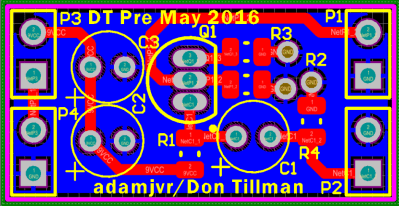
 

muzzNext up is [Adam Vadala-Roth] with Audio Blox: Experiments in Analog Audio Design. [Adam] has 32 projects and counting up on Hackaday.io. His interests cover everything from LEDs to 3D printing to solar to hydroponics. Audio Blox is a project he uses as his engineer’s notebook for analog audio projects. It is a great way to view a hacker figuring out what works and what doesn’t. His current project is a 4 board modular version of the Big Muff Pi guitar pedal. He’s broken this classic guitar effect down to an input board, a clipping board, a tone control, and an output stage. His PCB layouts, schematics, and explanations are always a treat to view and read!
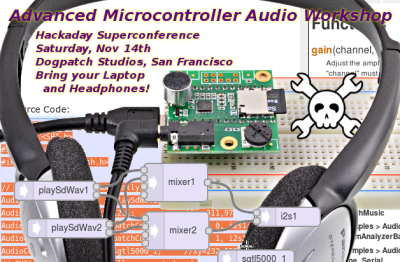
pauldioNext we have [Paul Stoffregen] with Teensy Audio Library. For those not in the know, [Paul] is the creator of the Teensy family of boards, which started as an Arduino on steroids, and has morphed into something even more powerful. This project documents the audio library [Paul] created for the Freescale/NXP ARM processor which powers the Teensy 3.1. Multiple audio files playing at once, delays, and effects, are just a few things this library can do. If you’re new to the audio library, definitely check out [Paul’s] companion project
Microcontroller Audio Workshop & HaD Supercon 2015. This project is an online version of the workshop [Paul] ran at the 2015 Hackaday Supercon in San Francisco.
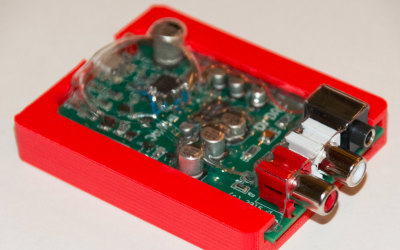
drdacFinally we have [drewrisinger] with DrDAC USB Audio DAC. DrDac is a high quality DAC board which provides a USB powered audio output for any PC. Computers these days are built down to a price. This means that lower quality audio components are often used. Couple this with the fact that computers are an electrically noisy place, and you get less than stellar audio. Good enough for the masses, but not quite up to par if you want to listen to studio quality audio. DrDAC houses a PCM2706 audio DAC and quality support components in a 3D printed case. DrDAC was inspired by [cobaltmute’s] pupDAC.

If you want to see more audio projects and hacks, check out our new audio projects list. See a project I might have missed? Don’t be shy, just drop me a message on Hackaday.io. That’s it for this week’s Hacklet, As always, see you next week. Same hack time, same hack channel, bringing you the best of Hackaday.io!


Retrotechtacular: The US Air Force Has The Biggest Fleet

When it comes to the superlatives of aviation, there are aircraft larger than the C-5 Galaxy. [Howard Hughes]’s Spruce Goose has the largest wingspan, and the Soviet and now Ukranian Antonov AN-225 Mriya has the largest cargo capacity. When it flies in the next year or so, Scaled Composites Stratolaunch – a twin-hulled beast of a plane designed to haul rockets up to 30,000 feet – will be the aircraft with the largest wingspan and the greatest cargo capacity.

These superlatives, while completely accurate, fail to realize these huge planes are one of a kind. There is no plan to build a second Stratolaunch, and the second airframe for the AN-225 is rusting away in a field. If you want to find a fleet of enormous aircraft, there’s only one contender: the C5 Galaxy, the largest plane in the US Air Force inventory.

This video, from the USAF Archives circa 1968, goes over the design, construction, and operation of the C5 Galaxy. It covers the program beginnings, the shortcomings of earlier aircraft, and – of course – completely disregards the initial problems of the C5.

Continue reading “Retrotechtacular: The US Air Force Has The Biggest Fleet”

Code Craft – Embedding C++: Multitasking

We’re quite used to multitasking computer systems today. Our desktops run email, a couple of browsers in different workspaces, a word processor, and a few other applications, apparently all at once. Looking behind the scenes using a system monitor or task manager program reveals a multitude of other programs running in support of our activities. Of course, any given CPU is running a maximum of one program at a time. Multitasking is simply the practice of switching between active processes fast enough to give the illusion of simultaneity.

The roots of multiasking go way back. In the early days, when computers cost tons of money, the thought of an idle system was anathema. Teletype IO was slow compared to the processor, and leaving the processor waiting idle for a card reader to slurp in the next card was outrageous. The gurus of the time worked to fill that idle time with productive work. That eventually led to systems that would run multiple programs at one time, and eventually to more finely grained multitasking within a program.

Modern multitasking depends on support from the underlying API of an operating system. Each OS uses its own techniques, making it difficult to write portable code. The C++ 2011 standard increased the portability of the language by adding concurrency routines to the Standard Template Library (STL). These routines use the API of the OS. For instance, the Linux version uses the POSIX threading library, pthread. The result is a minimal, but useful, capability for building upon in later standards. The C++ 2017 standard development activities include work on parallelism and concurrency.

In this article, I’ll work through some of the facilities for and pitfalls in writing threaded code in C++.

Continue reading “Code Craft – Embedding C++: Multitasking”

Ask Hackaday: Does Apple Know Jack About Headphones?

If you’ve watched the tech news these last few months, you probably have noticed the rumors that Apple is expected to dump the headphone jack on the upcoming iPhone 7. They’re not alone either. On the Android side, Motorola has announced the Moto Z will not have a jack. Chinese manufacturer LeEco has introduced several new phones sans phone jack. So what does this mean for all of us?

This isn’t the first time a cell phone company has tried to design out the headphone jack. Anyone remember HTC’s extUSB, which was used on the Android G1? Nokia tried it with their POP Port. Sony Ericsson’s attempt was the FastPort. Samsung tried a dizzying array of multi-pin connectors. HP/Palm used a magnetic adapter on their Veer. Apple themselves tried to reinvent the headphone jack by recessing it in the original iPhone, breaking compatibility with most of the offerings on the market. All of these manufacturers eventually went with the tried and true ⅛” headphone jack. Many of these connectors were switched over during an odd time in history where Bluetooth was overtaking wired “hands-free kits”, and phones were gaining the ability to play mp3 files.

Continue reading “Ask Hackaday: Does Apple Know Jack About Headphones?”