AirAsia Crash Analysis: Who Or What Failed?

Just a few days after Christmas last year AirAsia Flight 8051 traveling to Singapore tragically plummeted into the sea. Indonesia completed its investigation of the crash and just released the final report. Media coverage, especially in Asia is big. The stories are headlined by pilot error but,as technologists, there are lessons to be learned deeper in the report.

The Airbus A320 is a fly-by-wire system meaning there are no mechanical linkages between the pilots and the control surfaces. Everything is electronic and most of a flight is under automatic control. Unfortunately, this also means pilots don’t spend much time actually flying a plane, possibly less than a minute, according to one report.

Here’s the scenario laid out by the Indonesian report: A rudder travel limit computer system alarmed four times. The pilots cleared the alarms following normal procedures. After the fifth alarm, the plane rolled beyond 45 degrees, climbed rapidly, stalled, and fell.

Continue reading “AirAsia Crash Analysis: Who Or What Failed?”

Retrocomputing On A Chip

New electrical components enable us to reconstruct old wiring more efficiently. Especially, the accessible and cheap FPGA kits which offer the possibility to put together wiring of many old computers as an “on-a-chip” solution.

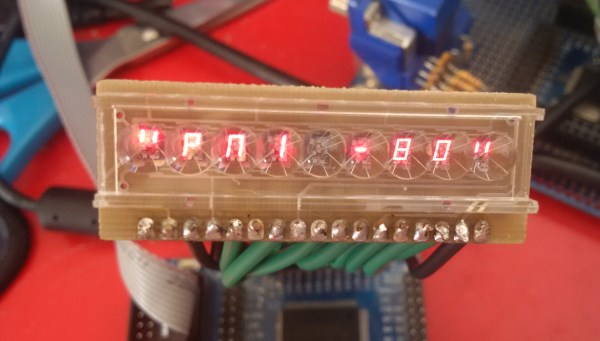
When I managed to get a hold of an old bubble LED display and a pretty mechanical matrix keyboard, I decided to build a replica of an old single board computer. Logical options seemed to be to build either KIM-1 or Heathkit ET-3400. Replicas of KIM-1 already exist, even for Arduino, so my task would be reduced to connect the keyboard and display. But then I told myself that I would use the fact that my bubble display has 9 positions as an excuse to build the legendary Czechoslovak Single Board Computer PMI-80 which used the same display. My replica is an FPGA, or rather an FPGA emulator of this very computer.

Continue reading “Retrocomputing On A Chip”

Pi Zero HackChat With Lady Ada

This Thursday, December 3rd, join us for a Live HackChat about the Raspberry Pi Zero with special guest [Limor Fried]. You may know [Limor] as [Lady Ada], the founder of Adafruit Industries. Adafruit has been on the forefront of the Pi Zero release. The $5 single board computer was announced one week ago by the Raspberry Pi Foundation.

Join in the chat to discuss the Raspberry Pi Zero. Limor has done a lot of work with the board already, including hacking analog audio back into the form factor. This is a great opportunity to ask questions, talk about your own plans for the hardware, and to find collaborators for future projects.

Pi Zero HackChat starts Thursday at 5pm PST (here’s a timezone cheat sheet if you need it). Participating in this live chat is very simple. Those who are already part of the Hacker Channel can simply click on the Team Messaging button. If you’re not part of the channel, just go to the hacker Channel page, scroll to the bottom of the “TEAM” list in the left sidebar and click “Request to join this project”.

HackChat takes place in the Hacker Channel every few weeks and is a friendly place to talk about engineering and the projects you’re working on.

Hackaday Dictionary: Bluetooth Low Energy

Bluetooth is one of the mainstays of the mobile gadget world, allowing mobile devices to communicate easily over short distances. It’s how your wireless headset talks to your cell phone without the complexity and power requirements of WIFi. In particular, the Bluetooth Low Energy (BLE) component is interesting for those who build portable gadgets, because it requires a very small amount of power. Continue reading “Hackaday Dictionary: Bluetooth Low Energy”

A Short History Of AI, And Why It’s Heading In The Wrong Direction

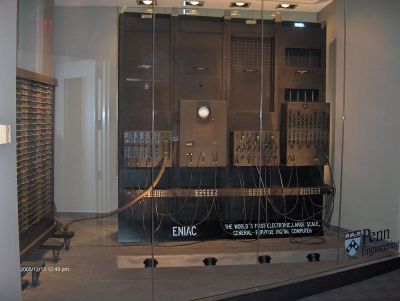
Sir Winston Churchill often spoke of World War 2 as the “Wizard War”. Both the Allies and Axis powers were in a race to gain the electronic advantage over each other on the battlefield. Many technologies were born during this time – one of them being the ability to decipher coded messages. The devices that were able to achieve this feat were the precursors to the modern computer. In 1946, the US Military developed the ENIAC, or Electronic Numerical Integrator And Computer. Using over 17,000 vacuum tubes, the ENIAC was a few orders of magnitude faster than all previous electro-mechanical computers. The part that excited many scientists, however, was that it was programmable. It was the notion of a programmable computer that would give rise to the ai_05idea of artificial intelligence (AI).

As time marched forward, computers became smaller and faster. The invention of the transistor semiconductor gave rise to the microprocessor, which accelerated the development of computer programming. AI began to pick up steam, and pundits began to make grand claims of how computer intelligence would soon surpass our own. Programs like ELIZA and Blocks World fascinated the public and certainly gave the perception that when computers became faster, as they surely would in the future, they would be able to think like humans do.

But it soon became clear that this would not be the case. While these and many other AI programs were good at what they did, neither they, or their algorithms were adaptable. They were ‘smart’ at their particular task, and could even be considered intelligent judging from their behavior, but they had no understanding of the task, and didn’t hold a candle to the intellectual capabilities of even a typical lab rat, let alone a human.

Continue reading “A Short History Of AI, And Why It’s Heading In The Wrong Direction”

The Grid Dip Meter: Forgotten Instrument

It used to be a major rite of passage for a hardware hacker to acquire an oscilloscope. Until recently, new instruments were rarely in normal people’s budgets, so you probably made do with a used scope. Now, there are lots of inexpensive options, especially if you include low-end PC scopes and “scope meters.” Digital meters are also now inexpensive (often free at some major stores), along with signal generators, frequency counters, and even logic analyzers.

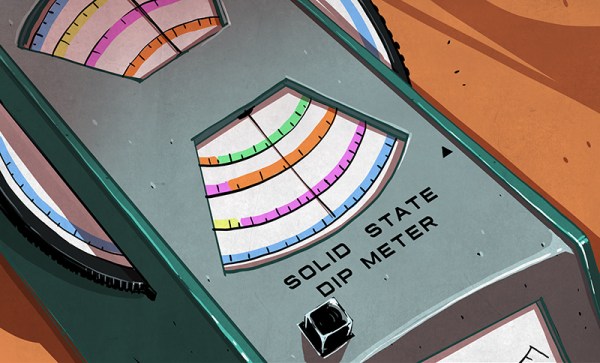
But there is one piece of test equipment you don’t see as often as you used to and its a shame, because it is a very versatile piece of kit. Admittedly, if you aren’t doing wireless work, it might not be high on your wish list, but if you do anything with RF, it is not only a versatile tool, but a good value, too. What’s it called? That depends. Historically, they went by the name “Grid Dip Oscillator” or GDO. Sometimes you’d hear it called a “Grid Dip Meter” instead. However, modern versions don’t have tubes (and, thus, no grid) so sometimes you hear them now called dip meters or maybe just dippers.

Continue reading “The Grid Dip Meter: Forgotten Instrument”

Hackaday Links: November 29, 2015

The Raspberry Pi Zero was announced this week, so you know what that means: someone is going to destroy a Game Boy Micro. If you’re interested in putting the Zero in a tiny handheld of your own design, here are the dimensions, courtesy of [Bert].

[Ahmed] – the kid with the clock – and his family are suing his school district and city for $15 Million. The family is also seeking written apologies from the city’s mayor and police chief.

There are a lot — a lot — of ‘intro to FPGA’ boards out there, and the huge variety is an example of how the ‘educational FPGA’ is a hard nut to crack. Here’s the latest one from a Kickstarter. It uses an ICE40, so an open source toolchain is available, and at only $50, it’s cheap enough to start digging around with LUTs and gates.

Over on Hackaday.io, [Joseph] is building a YAG laser. This laser will require a parabolic mirror with the YAG rod at the focus. There’s an interesting way to make one of these: cut out some acrylic and beat a copper pipe against a form. A little polish and nickel plating and you have a custom mirror for a laser.

You know those machines with wooden gears, tracks, and dozens of ball bearings? Cool, huh? Tiny magnetic balls exist, and the obvious extension to this line of thought is amazing.

[David Windestål] is awesome. Completely and totally awesome. Usually, he’s behind the controls of an RC plane or tricopter, but this time he’s behind a slo-mo camera, an RC heli, and a watermelon. That’s a 550-sized heli with carbon fiber blades spinning at 2500 RPM, shot at 1000 FPS.

How do you label your cables? Apparently, you can use a label printer with heat shrink tubing. Nothing else, even: just put heat shrink through a label maker.