Retrotechtacular: Robots, Robots Everywhere, With Kitschy Pronunciation

One of the great things about the human intellect is that we have the ability to build machines of varying complexity to do our bidding. As a major proponent of technology, the Chevrolet automobile corporation once dreamed of a future where the American housewife’s most mundane tasks are handled with the push of a button—one that sets a robot butler into action.

Chevy shows us what this future might look like in this short film, which they presented at the 1940 World’s Fair. A housewife’s faithful ‘robot’, pronounced throughout the picture as ‘robe-it’, has gone on the fritz. Naturally, she calls for a repairman. We see from the console controller that Roll-Oh the Robe-it can take care of all kinds of housewifely duties: he can answer the door and the phone, wash dishes, clean house, make beds, fetch hats, get dinner, and fix the furnace (and only the furnace). And that SCRAM! function? That’s never explained. We like to think it has to do with getting kids off the lawn, or could be used in conjunction with ‘get door’ to chase away would-be burglars. We get a glimpse of this when Roll-Oh answers the door and scares the daylights out of a young [Gary Sinise*] delivering flowers in a cop uniform.

Roll-Oh’s upper limbs have several Swiss Army knife-like implements in them. He uses a sharp one to cut the ribbon off of the flower box. Upon seeing the flowers, he gives them a gentle misting with his sprayer attachment. Dropped petals are no problem for Roll-Oh. He promptly vacuums them up from the thin industrial sound stage carpet with his big metal feet. Roll-Oh is then tasked with getting dinner. This amounts to him painstakingly opening a couple of cans and lighting candles with the torch hidden in his face.

While Roll-Oh the large ductwork butler is only a dream, Chevy wants you to know that smaller robe-its are all around us already. They’re regulating the heat in our stoves, browning our bread without burning it, and brewing our coffee in cool double-globe glass percolators. These tiny servants are capable of performing other tasks, like shutting off machinery when humans are too close, or sensing heat and engaging fire suppression systems. There is brief mention of something called the Petomat, an automatic dog feeding system which is essentially a bowl of food hidden in a latched box. The latch opens rather violently when the alarm clock connected to it goes off.

Robe-its are also performing more serious tasks, like keeping airplanes level and headed in the right direction. Of course, they’re also abundant in Chevrolet automobiles. A small one in the carburetor administers the proper mix of “gasoline calories and fresh air vitamins” to the engine. It’s rare to get to this level of technical detail, you know. Others watch over the spark, the intake manifold, and the voltage regulation. Up in the cab, friendly robe-its will happily traverse the AM dial at the push of a pre-set.

*Probably not actually [Gary Sinise].

Continue reading “Retrotechtacular: Robots, Robots Everywhere, With Kitschy Pronunciation”

DEF CON Vs IoT: On Hackability And Security

Ahh DEF CON! One group of hackers shows off how they’ve broken into all sorts of cool devices and other hackers (ahem… “security professionals”) lament the fact that the first group were able to do so. For every joyous “we rooted the Nest thermostat, now we can have fun” there’s a doom-mongering “the security of network-connected IoT devices is totally broken!”.

And like Dr. Jekyll and Mr. Hyde, these two sides of the hacker persona can coexist within the same individual. At Hackaday, we’re totally paranoid security conscious, but we also like to tinker with stuff. We believe that openness and security are best friends forever. If you can open it, you can see if it’s well-made inside, at least in principle. How do we reconcile this with the security professional’s demand for devices that only accept signed binary firmware updates so that they can’t be tampered with?

We’ve got no answers, but we’ve got plenty of questions. Read on, and let us know what you think.

Continue reading “DEF CON Vs IoT: On Hackability And Security”

Hackaday Prize Entry: Vertical Aeroponics

For his Hackaday Prize entry, [MIPS ARMSTRONG] is working on an open-source terrarium that will be one of the fastest way to grow foodstuffs or other edible greens. He’s calling it Project EDEN, and it’s shaping up to be one of the most advanced homebrew horticultural devices ever made.

There are a few things that make this indoor greenhouse unique. The most obvious is the incredible number of LEDs used as grow lights. [MIPS] is using 900 Watts worth of Royal Blue and Deep Red LEDs. To water these plants, [MIPS] is taking a cue from NASA and building a High Pressure Aeroponics system – a device that shoots droplets of water only 50 microns in diameter directly onto the roots of the plants.

One of the more interesting aspects of EDEN is the CO2 system. The bulk of plant biomass – like humans – comes from carbon, and plants get their carbon from the atmosphere. Studies have shown that increasing the concentration of CO2 in a grow chamber can increase plant growth. There is a limit before CO2 becomes toxic to plants, so [MIPS] will have to keep a close eye on the CO2 levels with gas sensors.

With high-pressure watering, a CO2 system, and an amazing array of LEDs, this is one of the most advanced homebrew horticulture projects on the planet. It’s also a great fit for this year’s Hackaday prize theme of ‘build something that matters’, and we can’t wait to see [MIPS]’s future developments of his awesome aeroponic terrarium.

The 2015 Hackaday Prize is sponsored by:

Hacking A KVM: Teach A Keyboard Switch To Spy

When it comes to large systems, there are a lot more computers than there are people maintaining them. That’s not a big deal since you can simply use a KVM to connect one Keyboard/Video/Mouse terminal up to all of them, switching between each box simply and seamlessly. The side effect is that now the KVM has just as much access to all of those systems as the human who caresses the keyboard. [Yaniv Balmas] and [Lior Oppenheim] spent some time reverse engineering the firmware for one of these devices and demonstrated how shady firmware can pwn these systems, even when some of the systems themselves are air-gapped from the Internet. This was their first DEF CON talk and they did a great job of explaining what it took to hack these devices.

Continue reading “Hacking A KVM: Teach A Keyboard Switch To Spy”

Hacklet 69 – Morse Code Projects

With over 160 years of history under its belt, Morse code is by far the oldest digital signaling system known to man. Originally developed for telegraph systems, [Samuel Morse’s] code has been sent over wires, via radio, and even with flashes of light. Hackers, makers and engineers have been working with Morse code throughout history. For many years, simple code keys and practice oscillators were the “hello world” of hobby electronics. In fact, a company which started out selling a Morse key has gone on to become one of the largest electronic component distributors in the world. The company still bears the name of that project: Digi-Key. This week’s Hacklet is all about some of the best Morse code projects on Hackaday.io!

key1We start with [voxnulla] and Morse key HID + ugly hack. [voxnulla] found an old key at his favorite thrift store. It was dusty, greasy, and for some reason had been painted hospital green. Once the paint and grime were removed, and the original wooden plate restored, the key actually looked pretty good. [Voxnulla] then decided to turn it into a USB Human Interface Device (HID), emulating the keyboard of his computer. An Arduino converts Morse code characters tapped at the key into keystrokes over USB. As [voxnulla] knows, when butterflies aren’t available, real programmers drive vim with a Morse key!

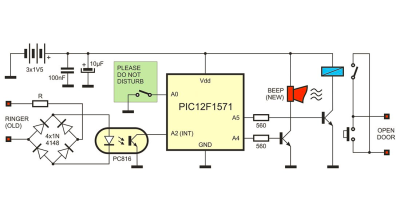
code2Next up is [Voja Antonic] with Daddy, I don’t have the key. If you didn’t read [Voja’s] article about Hacking the Digital and Social System, check it out! Many apartments have an intercom system where you have to “buzz” someone in, activating a solenoid lock in the door. [Voja] inserted a Microchip PIC12 series microcontroller between the speaker and the unlock button. All a user has to do is tap out the right Morse code password on the call button in the lobby. If the code is accepted, the PIC unlocks the door, and you’re in!


morseterminal[kodera2t] took things into the digital age with Stand-alone Tiny Morse code encoder/decoder. This project grew out of his general purpose Portable tiny IoT device project. [kodera2t] rolled his own Arduino-compatible board for this project. The tiny ATmega1284 powered computer allows him to encode and decode Morse code. A smartphone-sized keyboard and a lilliputian OLED display serve as the user interface, while rotary encoder allows for variable code speed. You can even “tap” Morse out on one of the tactile buttons!


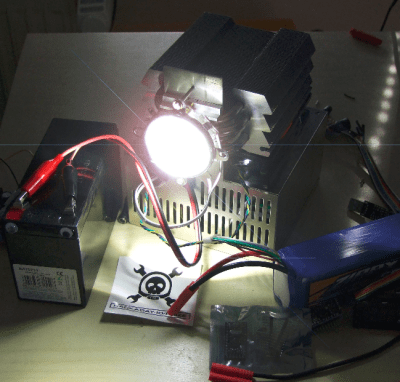
morselightFinally, we have [Yannick (Gigawipf)] with Portable (morsing) 100W led flashlight. 100 watt LEDs have gotten quite cheap these days, and they’re perfect when you absolutely, positively have to blind everyone around you. These LEDs can also be switched on and off quickly, which makes them perfect for Morse code. In years past, mechanical shutters had to be used to perform the same feat. [Yannick] used a 5000mAh 5S Zippy Li-Po to supply electrons to this hungry beast, while a 600 Watt constant current boost converter keeps that power under control. An Arduino running Morse code converter software controls the boost convert and LED.  [Yannick] uses his computer to send a message over the Arduino’s serial link, and the light does the rest, flashing out the message for all to see.

If you want more Morse goodness, check out our brand new Morse code project list! My Morse is a bit rusty, so if I wasn’t able to copy your transmission and missed your project, don’t hesitate to drop me a message on Hackaday.io. That’s it for this week’s Hacklet. As always, see you next week. Same hack time, same hack channel, bringing you the best of Hackaday.io!

DEF CON Uber Badge So Hot It’s Radioactive

I went to the Opening Ceremonies of DEF CON 23 this morning to get more information on the badge challenge and I was not disappointed. The talk covered the Uber badge, which is hot in a literally radioactive sense. This badge, which is also known as the black badge, is reserved for people who are first to solve one of the official DEF CON challenges. It grants lifetime free admission and opens just about any door when listed on your resume.

Lichtenberg Figures

The triangle of acrylic itself is adorned with Lichtenberg Figures. This is a bolt of lightning on the badge. By building up extremely high voltages, the discharge leaves a unique pattern. In this case it was a 5 million volt, 150 kW particle accelerator that made the figures.

There is a medallion affixed to this triangular base-plate which is obviously part of the puzzle everyone is trying to solve this weekend. What is less clear is how the radioactive isotopes of this badge play into this challenge.

Whoa, oh, oh, oh, I’m Radioactive, Radioactive

Trinitie Photo by Shaddack -  CC BY 3.0
Trinitie Photo by Shaddack – CC BY 3.0

[LoST] took inspiration from [Richard Feynman] to a new level with this badge. [Feynman] was involved with “The Gadget” experiment which I know better as Trinity, the first detonation of a nuclear weapon. This badge contains isotopes from that detonation.

Trinitite (get it, from the Trinity explosion?) is a green glassy substance generated from a Plutonium-based bomb explosion. [LoST] made a point of explaining that the samples of Trinitite in this badge create a unique radioactive signature that not only traces back to this explosion, but actually indicates a precise distance form the epicenter of the explosion.

Also embedded in the badge are glass spheres doped with 3% Uranium 238. Tritium, used in exit signs, is a third source of radioactivity on the badge. This is joined by another marker that is a combination of Uraninite, Pitchblende, Carnotite, Gummit, and Yellowcake.

Interesting story, Tritium is highly regulated in this country but it is hypothetically possible to import it from Europe by a seller who ships it sealed inside packets of coffee. Hypothetically.

The opening ceremonies talk concluded with some inspirational remarks from [Dark Tangent]. Pictures of that as well as a few of [L0ST’s] slides are found below. If you’re working on the badge challenge, join in on the collaborative Badge deciphering we’ve started on Hackaday.io. If you’re at DEF CON, make sure to show up for breakfast with us on Sunday.

Continue reading “DEF CON Uber Badge So Hot It’s Radioactive”

Logic Noise: 4046 Voltage-Controlled Oscillator, Part One

In this session of Logic Noise, we’ll be playing around with the voltage-controlled oscillator from a 4046 phase-locked loop chip, and using it to make “musical” pitches. It’s a lot of bang for the buck, and sets us on the path toward much more interesting circuits in the future. So watch the intro video right after the break, and we’ll dig straight in.

Continue reading “Logic Noise: 4046 Voltage-Controlled Oscillator, Part One”