Smart Watch Hack Lets You Use Your 3.5mm Headphones With An IPhone 7

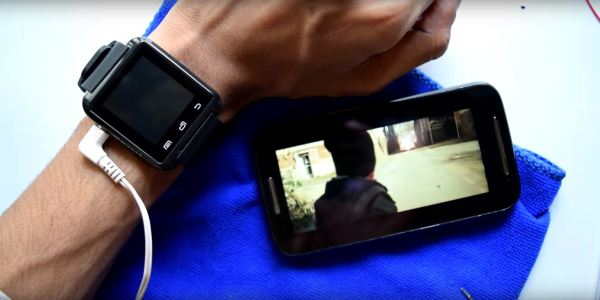
As you may have heard, the iPhone 7 is ditching the 3.5 mm headphone jack in the name of progress and courage. Whatever your take on that, it leaves the end user out in the cold if — for instance — their preferred headphones still use the old format. Here to save you from an untimely upgrade is YouTuber [Kedar Nimbalkar], who has modified a Bluetooth Smartwatch to incorporate a 3.5 mm jack to allow continued use your current headphones.

After opening up the smartwatch [Nimbalkar] removes the speaker, solders in a 3.5 mm headphone jack and clips out an opening in the watch’s case that maintains the watch’s sleek exterior.

Continue reading “Smart Watch Hack Lets You Use Your 3.5mm Headphones With An IPhone 7”

How To Drill A Curved Hole

Next time you’re renovating and need to run some cables around corners in you walls, save yourself some frustration by building [izzy swan]’s corner drilling rig. It’s something akin to a custom tunnel boring machine but on a small scale.

drill-a-curved-holeStarting with a piece of steel, [izzy] traced and cut out a 90 degree curve with an attached arm that will allow it to rotate from a central block. He then grabs a random drill bit and attaches it to a flex shaft which is secured to the leading point of the steel curve. To complete the handy setup the entire rig is bolted to a block that will clamp over the corner stock.

As it stands, it takes some elbow grease to get the drill through, but it’s not a purpose built setup. On a second demonstration, the flex shaft breaks, but the idea is there. Now, [izzy] advises that this is most easily accomplished when re-framing walls with no drywall obstructing your drill, but the concept for this rig could nonetheless prove handy for welding, grinding, and so forth along any angled curve.

If instead you want to push your carpentry skills to their limits, build a wooden Vespa.

Continue reading “How To Drill A Curved Hole”

Arcade Button Pressing Game

When every month brings out a fresh console blockbuster game that breaks new boundaries of cinematic immersion in its gameplay, it’s easy to forget that sometimes the simplest of game interfaces can be rewarding.

Hele Norges Knapp” (“All of Norway’s Button”), is a good example. As you might expect, it’s a button, a large arcade-style one, and the gameplay is simple. Press the button as many times as you can in 30 seconds. It’s a project from Norwegian Creations, and it was produced as a promotion that toured the country for one of Norway’s debit card payment systems.

The blog post and video is frustratingly light on hardware or software details, and their is nothing about it in their GitHub presence. But they tell us that at its heart is a Teensy 3.2 with an audio board, driving the big 7-segment displays for the scoreboard and the WS2801 LED lighting.

The button itself is Adafruit’s 100mm Massive Arcade Button, and given that it was pressed over a million times by eager Norwegians it would seem this project has proved its robustness.

The video below the break has details of construction and of the game in action, and there is another far more corporate promotional video on Facebook featuring a host of Bright Young People honing their button action in a sun-kissed Norway that looks almost tropical. The game itself does look as though it could be an amusing diversion in the same vein as those fairground strength tests.

Continue reading “Arcade Button Pressing Game”

Hackaday Prize Entry: Mouse Controlled Microscope

You might imagine that all one should need to operate a microscope would be a good set of eyes. Unfortunately if you are an amputee that may not be the case. Veterinary lab work for example requires control of focus, as well as the ability to move the sample in both X and Y directions, and these are not tasks that can easily be performed simultaneously with only a single hand.

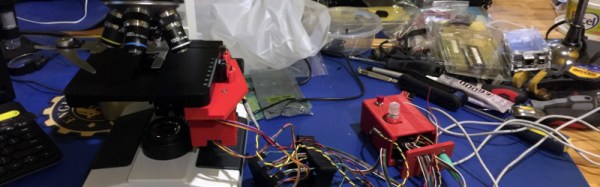
[ksk]’s solution to this problem is to use geared stepper motors and an Arduino Mega to allow the manual functions of the microscope to be controlled from a computer mouse or trackball. The motors are mounted on the microscope controls with a custom 3D-printed housing. A rotary selector on the control box containing the Arduino allows the user to select a slow or fast mode for fine or coarse adjustment.

It’s fair to say that this project is still a work in progress, we’re featuring it in our series of posts looking at Hackaday Prize entries. However judging by the progress reported so far it’s clear that this is a project with significant potential, and we can see the finished product could be of use to anyone operating the microscope.

We’ve featured one or two mouse controlled projects over the years, though not controlling microscopes. Here’s one mouse controlled robot arm, and we’ve covered another arm with a 3D mouse.

Vacuum Exposure Unit Gives Better PCB Etching Results

PCB etching seems to be a subject that sharply divides our community into those who are experts in it and etch themselves every PCB they use, and those who have significant quantities of ferric chloride stained clothing in their past and for whom the advent of cheap commercial PCB manufacture and CNC milled PCB prototyping have been the best thing since sliced bread.

Your likely success when etching your own boards is most dependent on the quality of your preparation and your equipment. If you began your PCB career with etch-resist transfers and a permanent marker with a Tupperware tub of etchant, then later progressed to laser toner or photographic masking and a bubble etcher, you’ll understand this.

[Jana Marie Hemsing] has drawn our attention to this very nicely built PCB etching suite (Translation, German original) at the Warpzone hackerspace (Translation, German original) in Münster, Germany. The foil pattern is printed on transparency and exposed to UV light over a photoresist coated board with a vacuum pump arrangement to ensure as good a contact as possible to the board for the sharpest result. They have two exposers, one for single sided and the other for double-sided boards, both are very well-built from what looks like plywood.

The attention to detail continues with a home-made magnetic stirrer and heated bubble etching tank Their etchant of choice is sodium persulphate, so there are none of those brown ferric chloride stains.

PCB etching is nothing new, indeed we have covered the subject extensively over the years. But we think you’ll agree, if you’re going to etch your own PCBs you should have as good a set-up as you can, and Warpzone’s PCB suite is rather well put together. Those of us in spaces with lesser facilities should be getting ideas from it.

Portable Workbench Crams An Entire Workspace Into One Box

Making on the go is sometimes required in today’s busy lives, and if you find yourself traveling — say, off to university like [ZSNRA] — then a convenient solution is required. To that end, a portable electronics workbench was built in the shape of a relatively nondescript plywood box.

Plywood and foam-core are the main materials used in building this maker’s bug-out box, with two fir runners along the bottom so the case is not resting on the hinges. Inside, [ZSNRA] has packed a staggering amount of hardware which results in an 11kg suitcase.

Power StackHere goes — deep breath now: wires, solder, resistors, transistors, capacitors, diodes, clips, switches, logic chips, non-logic chips, an Arduino, ATmegas, fuses, pliers, wire strippers and cutters, angle cutters, tweezers, a 66-piece screwdriver set, a desoldering pump, 12 needle files, a hacksaw blade, a multi meter, oscilloscope, power source, four outlets built into the case(!), steel wool, a third hand, a soldering station, two handbooks, and a breadboard.

Whew.


The work surface is an ESD mat on the inside of the case’s front face that is comfortable enough to work with, though we are surprised that it doesn’t also fold out somehow to create an even larger work-space.

For an elegant — if slightly less mobile — workbench solution, check out The Tempel. Now if you’re looking for ideas on how and what to carry we still think [Kenji Larsen] has the ultimate hacking kit.

[Thanks for the tip, Zaphod! via /r/electronics]

The USB Killer Now Has Commercial Competition

With a proliferation of USB Flash disk drives has come a very straightforward attack vector for a miscreant intent on spreading malware onto an organisation’s computer network. Simply drop a few infected drives in the parking lot, and wait for an unsuspecting staff member to pick one up and plug it into their computer. The drives are so familiar that to a non-tech-savvy user they appear harmless, there is no conscious decision over whether to trust them or not.

A diabolical variant on the exploit was [Dark Purple]’s USB Killer. Outwardly similar to a USB Flash drive, it contains an inverter that generates several hundred volts from the USB’s 5 volts, and repeatedly discharges it into the data lines of whatever it is plugged into. Computers whose designers have not incorporated some form of protection do not last long when subjected to its shocking ministrations.

Now the original has a commercial competitor, in the form of Hong Kong-based usbkill.com. It’s a bit cheaper than the original, but that it has appeared at all suggests that there is an expanding market for this type of device and that you may be more likely to encounter one in the future. They are also selling a test shield, an isolated USB port add-on that allows the device to be powered up without damaging its host.

From the hardware engineer’s point of view these devices present a special challenge. We are used to protecting USB ports from high voltage electrostatic discharges with TVS diode arrays, but those events have an extremely high impedance and the components are not designed to continuously handle low-impedance high voltages. It’s likely that these USB killers will result in greater sales of protection thermistors and more substantially specified Zener diodes in the world of USB interface designers.

We covered the original USB Killer prototype when it appeared, then its second version, and finally its crowdfunding campaign. This will probably not be the last we’ve heard of these devices and they will inevitably become cheaper, so take care what you pick up in that parking lot.

[via Extremetech]