Open Sound Control Of Kitchen Lights

Controlling the Internet of Things is all about passing information around. Realistically, it doesn’t matter what is used, be it MQTT, HTTP, serial data, whatever, and it doesn’t really matter what data is sent as long as the sender and receiver agree on what the data means. MIDI could be used to pass information back and forth, for example and while MIDI is good for some things, Open Sound Control is a more modern alternative and one area where OSC excels over MIDI is Internet connectivity. [Matt] used OSC to control the lighting he installed in his kitchen.

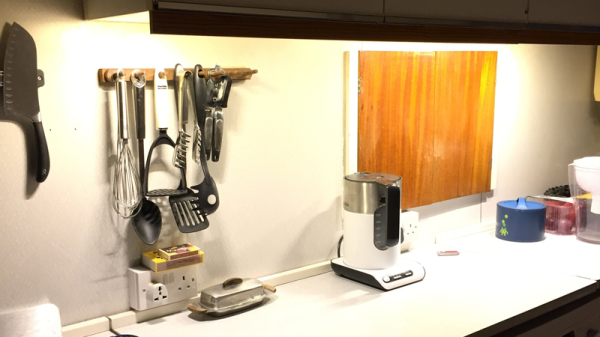
kitchen_controller
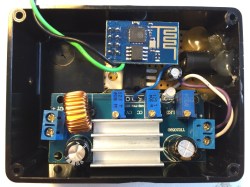
ESP8622-1 and Buck Converter

[Matt] had moved in to a new house and wanted some under-cupboard lighting for his kitchen. He got a few cheap warm white LED lights from the Internet and went about wiring them together. For the controller, an ESP8266-1 was used as well as a 12 volt constant-current buck converter. The software runs on the Sming framework, rather than the Arduino framework, and listens for incoming OSC messages. When it receives a command on a specific channel, a callback function turns the lights on and off.  [Matt] also added a switch on the outside of the control box to manually turn the lights on and off.

OSC might not be the right choice for this project, and even [Matt] doesn’t know why he used it, but [Matt] got it working and uses an app on his phone to control it. If he wanted to, he could have used Ableton or another controller to control the lights. (He hasn’t wanted to yet.) OSC is an interesting alternative to MIDI and can also be used with an Arduino without an ethernet shield, or with RFID tags.

What Makes The Perfect Hardware Badge

There are only a handful of people who can say they’ve built several successful electronic badges for conferences. Voja Antonic is not just on that list, he’s among the leaders in the field. There are a lot of pressures in this type of design challenge: aesthetics, functionality, and of course manufacturability. If you want to know how to make an exposed-PCB product that will be loved by the user, you need to study Voja’s work on the 2016 Hackaday SuperConference Badge. The badge is completely open, with all the design files, firmware, and a manual on the badge project page.

Between travelling from Belgrade to Pasadena and guiding production of 300 badges across the finish line before the conference deadline Voja took ill. He made it to the conference but without a voice he asked me to give his badge design talk for him. You can check that talk out below but let’s touch briefly on why Voja’s design is so spectacular.

Continue reading “What Makes The Perfect Hardware Badge” →

CES2017: Astrophotography In The Eyepiece

If you’ve never set up a telescope in your back yard, you’ve never been truly disappointed. The Hubble can take some great shots of Saturn, nebulae, and other astronomical phenomena, but even an expensive backyard scope produces only smudges. To do astronomy properly, you’ll spend your time huddled over a camera and a computer, stacking images to produce something that almost lives up to your expectations.

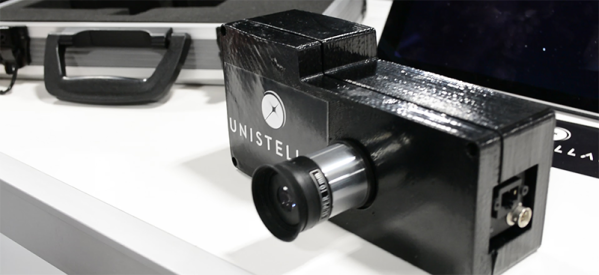
At CES, Unistellar introduced a device designed to fit over the eyepiece of a telescope to do all of this for you.

According to the guys at Unistellar, this box contains a small Linux computer, camera, GPS, and an LCD. Once the telescope is set up, the module takes a few pictures of the telescope’s field of view, stacks the images, and overlays the result in the eyepiece. Think of this as ‘live’ astrophotography.

In addition to making Jupiter look less like a Great Red Smudge, the Unistellar module adds augmented reality; it knows where the telescope is pointing and will add a label if you’re looking at any astronomical objects of note.

While I wasn’t able to take a look inside this extremely cool device, the Unistellar guys said they’ll be launching a crowdfunding campaign in the near future.

Visualization Of A Phased Array Antenna System

Phased array antenna systems are at the cusp of ubiquity. We now see Multiple-Input Multiple-Output (MIMO) antenna systems on WiFi routers. Soon phased array weather radar systems will help to predict the weather and keep air travel safe, and phased array base stations will be the backbone of 5G which is the next generation of wireless data communication.  But what is a phased array antenna system?  How do they work?  With the help of 1024 LEDs we’ll show you.

Continue reading “Visualization Of A Phased Array Antenna System” →

Hacked Television Uses No Power In Standby Mode

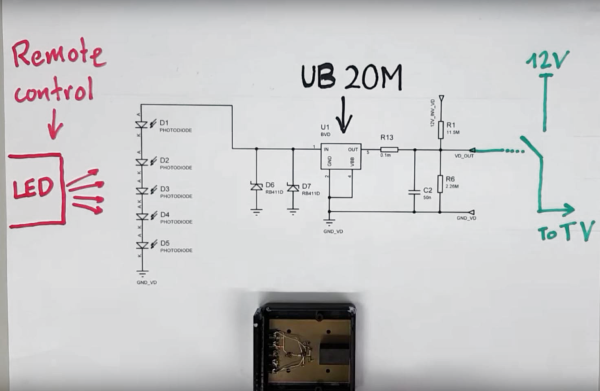
How much effort do you put into conserving energy throughout your daily routine? Diligence in keeping lights and appliances turned off are great steps, but those selfsame appliances likely still draw power when not in use. Seeing the potential to reduce energy wasted by TVs in standby mode, the [Electrical Energy Management Lab] team out of the University of Bristol have designed a television that uses no power in standby mode.

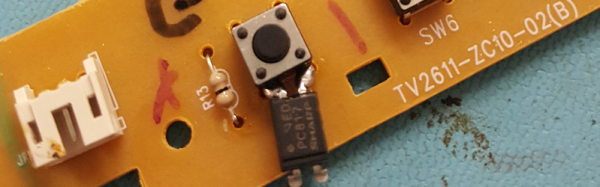
The feat is accomplished through the use of a chip designed to activate at currents as low as 20 picoamps.  It, and a series of five photodiodes, is mounted in a receiver which attaches to the TV. The receiver picks up the slight infrared pulse from the remote, inducing a slight current in the receiving photodiodes, providing enough power to the chip which in turn flips the switch to turn on the TV. A filter prevents ambient light from activating the receiver, and while the display appears to take a few seconds longer to turn on than an unmodified TV, that seems a fair trade off if you aren’t turning it on and off every few minutes.

Continue reading “Hacked Television Uses No Power In Standby Mode” →

The Cyborg Artist – Tattoo Machine Arm Prosthesis

[JC Sheitan Tenet] lost his right arm when he was 10 years old. As most of us, he was right-handed, so the challenges he had to face by not having an arm become even harder.

Have you ever tried to perform mundane tasks with your non-dominant hand? If you’re right-handed, have you ever tried to feed yourself with your left? Or if you’re left-handed, how well can you write with your right? For some people, using both hands comes naturally, but if you’re anything like me, your non-dominant hand is just about useless.

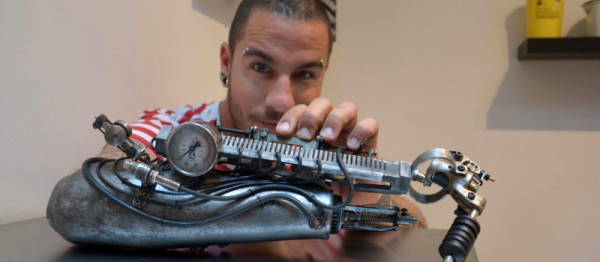
The thing is, he wanted to be a tattoo artist. And he wasn’t giving up. Even facing the added difficulty of not finding a tattoo artist that wanted to take him as an apprentice, he did not gave up. So he became a tattoo artist, using only his left arm. That is, until some months ago, when he met [Jean-Louis Gonzal], a bio-mechanical artist with an engineer background, at a tattoo convention. After seeing [Gonzal] work, he just asked if it was possible to modify a prosthesis and attach a tattoo machine to it.

The Cyborg Artist is born. The tattoo machine in the prosthesis can move 360 degrees for a wide range of movements. [JC Sheitan Tenet] uses it to help with colours, shadows and abstract forms in general. It’s a bad-ass steam punk prosthesis and it’s not just for show, he actually works with it (although not exclusively) . This, it seems, is only the beginning, since the first version of prototype worked so well, the second version is already being planned by [JC] and [Gonzal]. We can’t wait to see what they’ll come up with, maybe a mix between current version and a tattoo robotic arm or a brain controlled needle?

Check it out in the video:

Continue reading “The Cyborg Artist – Tattoo Machine Arm Prosthesis” →

Humidity Sensor Shootout

If you want to measure humidity (and temperature, and maybe even barometric pressure) in a device that you’re building, have a look at this comprehensive test of seven different options. We’re going to summarize the results here, but you’ll really want to read up on the testing methodology — it’s great science hacking. Did you know about using saturated salt solutions to produce constant humidity levels for calibration? We didn’t.

The eBay hacker favorite, the so-called DHT22 module, doesn’t fare all that well, with one of six that [Robert] tested being basically horrible, and three of them breaking within two years of use. The one that works well, however, is pretty good. Feeling lucky?

The Bosch BME280 looks great. It costs a bit more as a bare part, and a few times more than that when it is mounted on a friendly module, but it seems to be very reliable. And you get a barometer thrown in for the extra work. Indeed, it performed so well that Hackaday contributor [Nava Whiteford] put the part under a scanning electron microscope to figure out what’s going on.

The other sensors were fine, with the HTU21D and SHT71 being standouts for their ultra-fast response. For the full details, go click on that link at the top. Having just installed a sextet of DHT22s in our house last year, we’re left with that sinking feeling that we may have gotten what we paid for, which wasn’t much. At least they’re all still running.

Thanks to [Dodutils] and [mac012345] via comments in another thread.