A Simple And Educational Brushless Motor

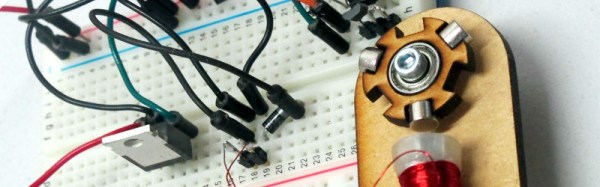
Sometimes there is no substitute for a real working model to tinker with when it comes to understanding how something works. Take a brushless motor for example. You may know how they work in principle, but what factors affect their operation and how do those factors interact? Inspired by some recent Hackaday posts on brushless motors, [Matt Venn] has built a simple breadboard motor designed for the curious to investigate these devices.

The rotor and motor bodies are laser-cut ply, and the rotor is designed to support multiple magnet configurations. There is only one solenoid, the position of which relative to the magnets on the rotor can be adjusted. The whole assembly is mounted on the edge of a breadboard, and can be rotated relative to the breadboard to vary the phase angle at which the drive circuit’s Hall-effect sensor is activated by the magnet. The drive circuit in turn can have its gain and time constants adjusted to study their effects on the motor’s running.

[Matt] has made all the design files available in his GitHub repository, and has recorded a comprehensive description of the motor’s operation in the YouTube video below the break. Continue reading “A Simple And Educational Brushless Motor”

IntelliServo

Servos are extremely versatile actuators used in a large number of applications which need controlled mechanical movement. The usual way of driving them is by using a PWM output from a micro-controller. But if you’re building a robot or a drone which requires a large number of servos, then it makes sense to add smarts directly to the servo.

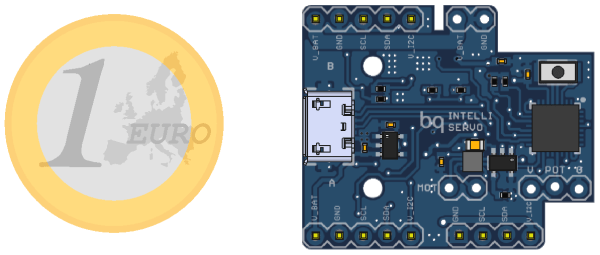
[Alvaro Ferrán Cifuentes] did just that by building IntelliServo – an add on board which makes regular servos smart by giving them enhanced capabilities as found in high-end versions. His approach is different compared to other takes on this theme. The IntelliServo is designed to replace the electronics in any regular servo and is not limited to any particular make or type. Once upgraded, it’s possible to read the servos position, temperature and current consumption. This allows interesting uses, such as controlling one servo by moving another one, or detecting collision or stalling by monitoring the servo current. Multiple servos can be daisy-chained and controlled over I²C from a micro-controller, or over USB directly from a computer. Each board features an LPC11U24 32-bit Cortex-M0 micro-controller, a DRV8837 motor driver, a TMP36 temperature sensor and a PCA9508 I²C repeater.

The project is open source and the Github repository contains the board design, Arduino library and examples, servo firmware and mechanical parts as well as use instructions. It’s a modular design which allows using either an external controller or running it directly via the on-board micro-USB socket. Check out the videos after the break to see the IntelliServo in action.

Continue reading “IntelliServo”

[Sprite_tm] Gives Near Death VFD A Better Second Life

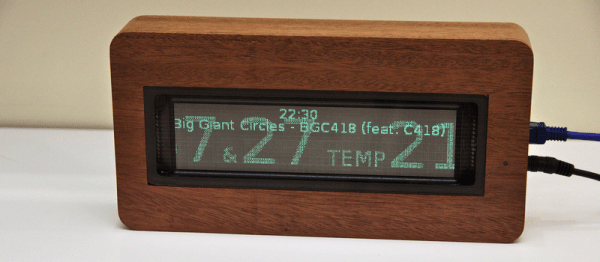
[Sprite_tm] picked up some used VFD displays for cheap, and wanted to make his own custom temperature and air-quality display. He did that, of course, but turned it into a colossal experiment in re-design to boot. What started out as a $6 used VFD becomes priceless with the addition of hours of high-powered hacking mojo.

You see, the phosphor screen had burnt-in spots where the old display was left static for too long. A normal person would either live with it or buy new displays. [Sprite_tm] ripped off the old display driver and drives the row and column shift registers using the DMA module on a Raspberry Pi2, coding up his own fast PWM/BCM hybrid scheme that can do greyscale.

He mapped out the individual pixels using a camera and post processing in The Gimp to establish the degradation of burnt-in pixels. He then re-wrote a previous custom driver project to compensate for the pixels’ inherent brightness in firmware. After all that work, he wrapped the whole thing up in a nice wooden frame.

There’s a lot to read, so just go hit up his website. High points include the shift-register-based driver transplant, the bit-angle modulation that was needed to get the necessary bit-depth for the grayscale, and the PHP script that does the photograph-based brightness correction.

Picking a favorite [Sprite_tm] hack is like picking a favorite ice-cream flavor: they’re all good. But his investigation into hard-drive controller chips still makes our head spin just a little bit. If you missed his talks about the Tamagotchi Singularity from the Hackaday SuperCon make sure you drop what you’re doing and watch it now.

Teslaphoresis: Tesla Coil Causes Self-Assembly In Carbon Nanotubes

teslaphoresis_strings_1

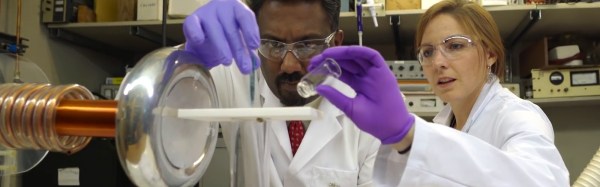
This significant discovery in nanotechnology could also be the first practical use of a Tesla coil in modern times that goes beyond fun and education. A self-funded research team at Rice University has found that unordered heaps of carbon nanotubes will self-assemble into conductive wires when exposed to the electric field of a strong Tesla coil. The related paper by lead author and graduate student [Lindsey R. Bornhoeft], introduces the phenomenon as “Teslaphoresis”. Continue reading “Teslaphoresis: Tesla Coil Causes Self-Assembly In Carbon Nanotubes”

ESP8266 Based Irrigation Controller

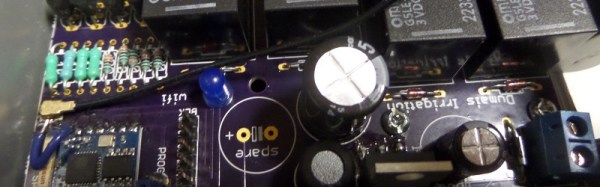
If you just want to prevent your garden from slowly turning into a desert, have a look at the available off-the-shelf home automation solutions, pick one, lean back and let moisture monitoring and automated irrigation take over. If you want to get into electronics, learn PCB design and experience the personal victory that comes with all that, do what [Patrick] did, and build your own ESP8266 based irrigation controller. It’s also a lot of fun!

[Patrick] already had a strong software background and maintains his own open source home automation system, so building his own physical hardware to extend its functionality was a logical step. In particular, [Patrick] wanted to add four wirelessly controlled valves to the system.

Continue reading “ESP8266 Based Irrigation Controller”

Automatic Book Scanner To Bring Knowledge To Ethiopian Students

In 2013 the dean of an Ethiopian university addressed Maker Faire Hannover and outlined one of his concerns; that the high price of developed-world textbooks was holding back the cause of education for universities such as his own in developing countries. He was there to ask for help from the maker community to solve his problem, and a group of his audience took up the challenge to create an affordable and accessible automatic book scanner.

Their scanner builds on the work of Google engineer [Dany Qumsiyeh], whose open source linear book scanner turns pages by traversing the opened book over a triangular prismic former such that pages are turned by vacuum as they pass over carefully designed slots in its surface. Their modification replaces the vacuum with the Coandă effect, to more gently tease open each page and it is hoped reduce the chance of damaging the volumes being scanned.

The whole machine is controlled by a Raspberry Pi, and the scanning is performed by linear scanning optics, sensors, and electronics taken from flatbed scanners.

An important design goal of the project was to ensure that the scanner could be built without special tools or expertise that might be difficult to find in a developing country, as well as that it should be as inexpensive as possible. The frame of the machine is off-the-shelf extruded aluminium, and the body is acrylic sheet which can be cut to shape with a hand saw if necessary. It is estimated that the device will cost in the region of 500 Euros (about $568) to build.

More information can be found at the project’s web site (German language, Google translate link), including a selection of videos such as the one below the break showing the device in operation.

Writing from the perspective of having been peripherally involved in a professional book scanning operation at a large publisher the benefits of this machine are immediately apparent. Removing the binding and automatically scanning each page as an individual sheet produces a very fast and high quality result, but by its very nature damages the volume being scanned. This machine promises to deliver a solution to the problem of book scanning that is considerably less intrusive.

It is also worth noting that the project does not address any copyright issues that might arise from scanning commercially published textbooks, though this is more of a concern for the end user in terms of what they scan with it than it is for the maker.

Continue reading “Automatic Book Scanner To Bring Knowledge To Ethiopian Students”

Most Of What You Wish You Knew About Coils Of Wire But Were Afraid To Ask

If you are a novice electronic constructor, you will become familiar with common electronic components. Resistors, capacitors, transistors, diodes, LEDs, integrated circuits. These are the fodder for countless learning projects, and will light up the breadboards of many a Raspberry Pi or Arduino owner.

There is a glaring omission in that list, the inductor. True, it’s not a component with much application in simple analogue or logic circuits, and it’s also a bit more expensive than other passive components. But this omission creates a knowledge gap with respect to inductors, a tendency for their use to be thought of as something of a black art, and a trepidation surrounding their use in kits and projects.

We think this is a shame, so here follows an introduction to inductors for the inductor novice, an attempt to demystify them and encourage you to look at them afresh if you have always steered clear of them.

Continue reading “Most Of What You Wish You Knew About Coils Of Wire But Were Afraid To Ask”