Wiring Up 100 Car Batteries So You Don’t Have To

We’re willing to bet most Hackaday readers have accidentally spot welded a few electrical contacts together over the years, complete with the surge of adrenaline that comes with the unexpected pops and sparks. It’s a mistake you’ll usually only make once or twice. But where most of us would look back at such mishaps as cautionary experiences, [Styropyro] sees an opportunity.

Armed with 100 car batteries wired in parallel, his recent video sees him pitting an assortment of household objects against the combined might of eighty-five thousand amps. Threaded rods, bolts, and angle iron all produce the sort of lightshow you’d expect, but [Styropyro] quickly discovered that holding larger objects down was more difficult than anticipated. It turns out that the magnetic fields being generated by the incredible amount of current rushing through the system was pulling the terminals apart and breaking the connection. After reinforcing the business end of his rig, he was able to tackle stouter objects such as crowbars and wrenches with explosive results.

A modified log splitter serves as a remotely operated switch.

We found that his remotely operated switch, built out of a hydraulic log splitter, to be a particular highlight of the video — unfortunately he only briefly goes over its construction at the very start. His side experiment, fashioning an sort of manually-operated carbon arc lamp with a pair of thick graphite electrodes and demonstrating is luminous efficacy compared to modern LEDs was an unexpected treat. As was the off-the-shelf domestic circuit breaker that impressed [Styropyro] by refusing to yield even after repeated jolts.

While the showers of sparks and vaporized metal might trigger some sweaty palms among the audience, we’ve seen [Styropyro] handle far scarier contraptions in the past. Though he may come off as devil-may-care in his videos, we figure there’s no way he could have made it this long without blinding or maiming himself if he didn’t know what he was doing.

Continue reading “Wiring Up 100 Car Batteries So You Don’t Have To”

Famicom-Inspired NES TV Looks Rad In Red

Take it from us, insomnia is no joke. But the wee hours can have a great effect on creativity, and if you’ve got a project in mind, doing that is way better than just sitting around, zoning out to infomercials and wishing for sleep. Over recent nights, [insomniacfactory] has been working on a Sharp C1 Famicon-inspired NES TV, and the result is simply fabulous.

The Sharp C1 Famicom was CRT television with a Famicom (precursor to the NES) built in. It allegedly had better picture quality than either a Famicom or NES with a separate television, and this was because it had direct internal display connection. The picture quality was so good that video game magazines at the time used it for screenshots.

Starting with a couple of TVs and a plan, [insomniacfactory] got to work, using the guts from a newer donor TV and a 1985 NES main board with the region-free mod and the RF module removed.

[insomniacfactory] also added also added a wiring harness and a side loader connector from a broken Game Genie to the NES main board. After some careful Dremeling out of the 1981 AKAI TV, they had room for the clone console’s cartridge slot and controller plugs.

This project took a lot of careful and fiddly work, especially since the boards are all bracketed in place and easy to remove. But it totally looks like it was worth it, and now [insomniacfactory] can retro game all night for a while before starting the next insomnia-driven project.

Are you in the mood for more iconic NES? Take a guided tour.

Little Ionic Thruster Blows Out Candles With Ease

Want to generate some thrust by way of an exposed high voltage discharge that looks great when you turn down the lights? [Integza] has a video showing how to do exactly that with some simple components. His little thruster manages to blow out candles at surprising distances before being pressed into service propelling a model boat.

Here’s how it works: ionic wind is generated when a strong enough electric field causes nearby air to ionize, for example from sharp tips of a conductor carrying a high enough voltage. This discharge creates ionized air molecules with an electrical charge matching the polarity of the nearby conductor. Because matching polarities repel one another, the small cloud of ionized air molecules are repelled from both the nearby conductor, as well as from each other.

The result is a wind-like force from a device with no moving parts, and if the parts are structured right, it’ll blow out a candle with ease. [Integza] attached a cheap DC high-voltage transformer to a nickel strip cut into sharp points and rolled into a circlet. The other half of the thruster — in contrast to the thin crown of sharp points — is a smooth ring shaped a little like a thruster nozzle. 3D models of the parts are  available online should you wish to try it yourself without all the trial and error of trying to optimize.

In an effort to minimize mass, [Integza] electroplates a 3D-printed version of the large ring with great results, spraying it with graphite first to make it conductive. Cheap and safe copper electroplating is entirely within the reach of hobbyists, and the resulting unit does a pretty nice job. You can watch it in action in the video, embedded below.

Continue reading “Little Ionic Thruster Blows Out Candles With Ease”

A Magnetohydrodynamic Drive In The Kitchen Sink

The magnetohydrodynamic (MHD) drive certainly sounds like something out of science fiction — using an array of magnets and electrodes, this high-tech propulsion technology promises to silently propel a craft through the water without any moving parts. As long as you can provide it with a constant supply of electricity, anyway.

Of course, as is often the case, the devil is in the details. Even with the obvious scientific and military applications of such a propulsion unit, scaling MHD technology up has proven difficult. But as [Jay Bowles] of Plasma Channel shows in his latest video, that doesn’t mean you can’t experiment with the concept at home. Even better, getting verifiable results is much easier than you’d think.

Continue reading “A Magnetohydrodynamic Drive In The Kitchen Sink”

Automatic Transfer Switch Keeps Internet Online

Living in a place where the electric service isn’t particularly reliable can be frustrating, whether that’s because of a lack of infrastructure, frequent storms, or rolling blackouts. An option for those living in these situations is a backup generator, often turned on and connected by an automatic transfer switch. These are necessary safety devices too; they keep power lines from being back-fed by the generators. But there are other reasons to use transfer switches as well as [Maarten] shows us with this automatic transfer switch meant to keep his computers and Internet powered up.

The device is fairly straightforward. A dual-pole, dual-throw relay is housed inside of an electrical junction box with two electrical plugs, each of which can be connected to a different circuit or power source in [Maarten]’s house. The relay coil is energized by the primary power supply, and when that power is lost the relay automatically changes over to the other power supply, which might be something like a battery backup system. [Maarten] was able to get a higher quality product by building it himself rather than spending a comparable amount of money on a cheap off-the-shelf product as well. Continue reading “Automatic Transfer Switch Keeps Internet Online”

No Acid: Open ICs With A Tesla Coil

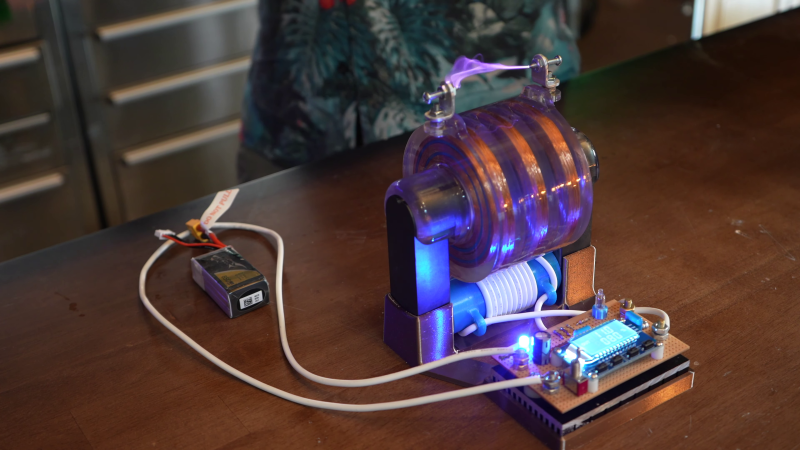
We’ve taken ICs apart before, but if they are in an epoxy package, it requires some lab gear and a lot of safety. Typically, you’ll heat the part and use fuming nitric acid (nasty stuff) in a cavity milled into the part to remove the epoxy over the die. While [100dollarhacker] doesn’t provide much detail, he appears to have used a Tesla coil to do it — no hot acid required.

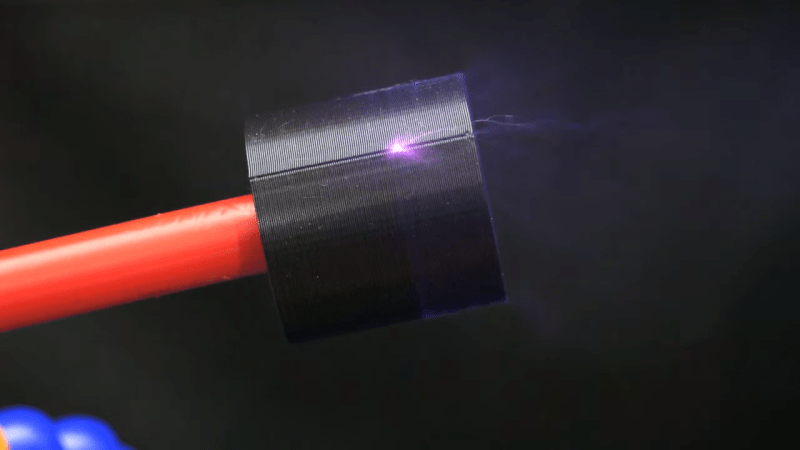
Initial results were promising but took a long time to work. In addition, the coil gets very hot, and there is a chance of flames. The next attempt used a 3D printed cone with a fan to push the plasma over the chip. The first attempt shorted something out, and so far, each attempt eventually burns out the MOSFET driver.

We are always interested in the practical uses of Tesla coils and what’s inside ICs, so this project naturally appealed to us. We hope to see more success reported on the Hackaday.io page soon. Meanwhile, if you have a coil and an old IC lying around, try it. Maybe you’ll figure out how to make it work well and if you do, let us know.

The easiest chips to open are ceramic packages with a gold lid. Just use a hobby knife. There are less noxious chemicals you can use. If you want to use fuming nitric, be sure you know what you are doing and maybe make some yourself.

Build A Tesla Coil With Just Three Components

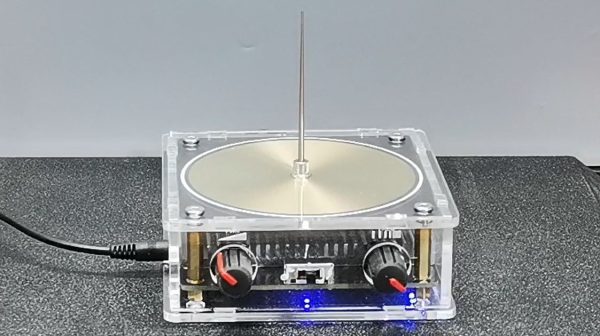
Tesla coils are beautiful examples of high voltage hardware, throwing sparks and teaching us about all kinds of fancy phenomena. They can also be quite intimidating to build. [William Fraser], however, has come up with a design using just three components.

It’s a simplified version of the “Slayer Exciter” design, which nominally features a transistor, resistor and LED, along with a coil, and runs on batteries. [William] learned that adding a capacitor in parallel with the batteries greatly improved performance, and allowed the removal of the LED without detriment. [William] also learned that the resistor was not necessary either, beyond starting the coil oscillating.

The actual 3-component build uses a 10 farad supercapacitor as a power source, hooked up to a 2N3904 NPN transistor and an 85-turn coil. It won’t start oscillating on its own, but when triggered by a pulse of energy from a piezo igniter, it jerks into life. The optimized design actually uses the shape of the assembled component leads to act as the primary coil. The tiny Tesla coil isn’t big and bold enough to throw big sparks, but it will light a fluorescent tube at close proximity.

If you like your Tesla coils musical, we have those too.

Continue reading “Build A Tesla Coil With Just Three Components”