Standing desks are either the best thing since sliced bread, or the fastest way to make your legs tired and get you ridiculed by your coworkers in the bargain. This leads some folks to compromise and make standing desks that can be re-lowered to sitting height when you need to take a break. But now the distance from your desktop to the light source that illuminates it has changed. We can’t have that!
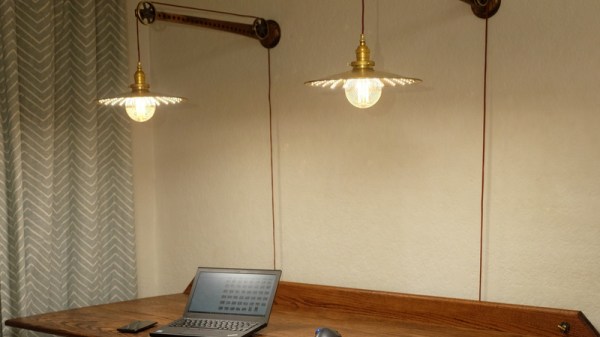
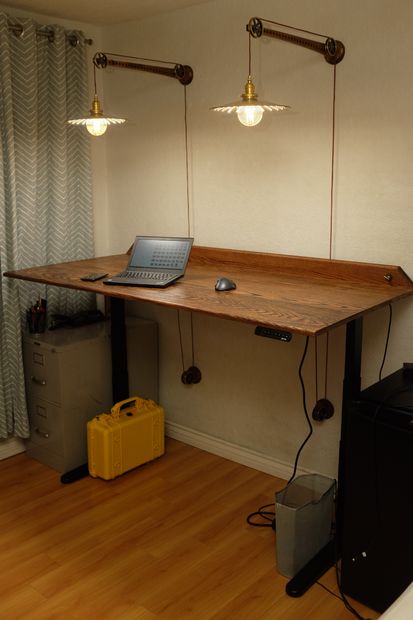 [John Culbertson] came up with a very elegant solution to the “problem”. He made lights that are suspended on pulleys that raise and lower with the desk itself. We’re not sure that you’re in the same situation he is, but we’re sure that you’ll agree that he did a nice job.
Besides the pulley mechanism, the light shades are a work of art. [John] clearly wanted a retro feel, so he used low-voltage lightbulbs, but augmented them with LED strips to pump out the lumens. All in all, there’s a tremendous attention to detail in the project, and it shows.
Disclaimer: your humble author is writing you this missive from a standing desk. Ours is just a regular desk put up on bricks — a temporary solution that’s become permanent. We’re always keeping our eyes out for mechanisms to make the desk convertible, but everything that we’ve seen is either overkill or ridiculously overpriced or both. It’s hard to beat 24 bricks at $0.35 apiece. Anyone have any suggestions?
Of course, with an adjustable desk come the problems of moving your lighting along with it, but [John] has solved that one for us.
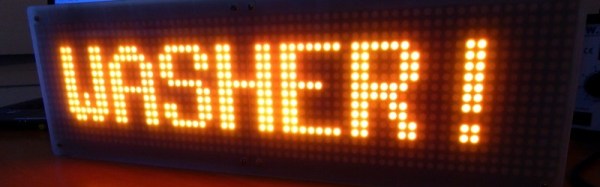
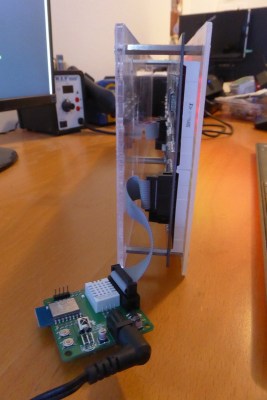 He wanted to try out SMD soldering so he built a custom PCB to hold the ESP-12, power supply, passive components, and a connector and he describes his methods and results. Instead of hardcoded messages, he wanted the system to be configurable and display messages coming in, not only from his laundry system, but also from other sensors. A web interface, built with jQuery and WebSockets, running on the ESP-12 allows the user to subscribe to a topic on the broker and show a customized name and value on the display when a payload is available.