Smart Can Crusher

[vimeo http://vimeo.com/4821403%5D

[Mangonha] has put together this interesting project involving aluminium can recycling (translated, sortof). They’re using an arduino to tally up how much aluminium they have accumulated. That information is then passed on and displayed on a google map. There are families that go around collecting the cans as a means of income, and this system could be very helpful to them. They state that their goal is to eventually have restaraunts and more families included. We’re a bit curious about how helpful this really is. How is that information actually changing the actions of the collectors? Would a simple flag on your door or window signalling enough cans to pick up or not be just as effective?

[via the Make flickr pool]
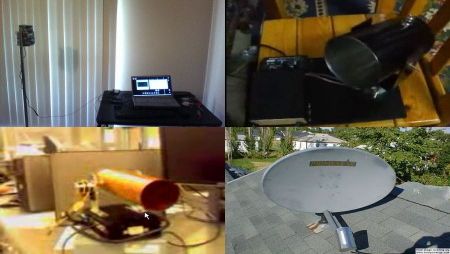
Various Cantenna Builds

Here is a classic project used to increase wireless signal strength. Cantennas focus using a waveguide very much like a magnifying glass focuses light. [Robert] made a Natural Light beer cantenna, pictured in the upper left. His approach used three beer cans, a paper towel holder, and a shower curtain rod. On the tipline, he noted a signal boost from 11Mbps to 54Mbps. This is certainly something we can hack together if our room lacks adequate signal. Read about parabolic and seeking versions after the break.

Continue reading “Various Cantenna Builds”

Automated Dorm Room Door

[youtube=http://www.youtube.com/watch?v=46s7nE72nvI]

[Chris] wrote in to tell us about this project he did while living in the dorms. He built a system to automate his dorm room door. It handles unlocking and opening/closing the door via iPhone, secret knock, and even the key.  The lock/knob portion is handled by a servo while the opening/closing action is hydraulic. After living with it for a year, he says that it never gets old, but there were a few bugs. Apparently it would randomly open in the middle of the night sometimes. If you’re interested in doing something like this, but not damaging the door, maybe you should check out the RFID dorm door lock project.

Home Power Monitoring

powermonitor

Reader [john] finished up his home power monitor over the holiday weekend. It uses a pair of current transducers clamped onto the mains. These output 0-3V and are read by the Arduino’s ADC. The Arduino averages samples over a 20 second period, calculates power used, and uploads it using an Ethernet Shield. The shield can’t do DNS lookups, so he uses a WRT54G to negotiate with the remote webserver. He admits that the system could be more accurate; it can’t detect small loads like wall warts. He also says that money could be saved by talking serial to the router instead of over ethernet. Here are the current usage charts.

You can find many power monitor projects like this in out Home Hacks category.

Capacitive Discharge Cutting

capacitive discharge cutting

Capacitive discharge cutting provides more control than linear transformer versions. A very large capacitor is charged to a precise voltage and then discharged through the material to produce a controlled cut. The same device can also be used for spot and tab welding. A video of copper roof flashing being cut is embedded below. An example of a linear transformer can be found in our our How-to: build your own spot welder.

Continue reading “Capacitive Discharge Cutting”

Lego Modded Antenna Tuner

legomoddedtunner

This antenna tuner is controlled remotely using geared motors and legos. The tuner needed to be closer to the antenna for performance reasons. This created a problem; most of the radio gear is inside while the tuner is outside. The gear motors and Legos combine to form a closed loop servo, operating two air core caps and an inductor switch. A control box placed near the radio is hard wired to the modded tuner outside. We would like to see something like this under gesture control using the Wii MotionPlus + Arduino.

Poor Man’s Thermographic Camera

thermographic camera

Using an IR thermometer, there are two ways to go about building a thermographic camera. The first uses a pan and tilt head. Scan lines are emulated, as a computer controls panning from left to right, taking a temperature sample from each step. Vertical resolution is accomplished by tilting. Another method uses a web cam attached to the thermometer. The thermometer’s laser pointer is captured with temperature annotations, as the computer records the field of view. We think the best outcome can be found with a combination of both methods. The video embedded below demonstrates the results. This would be a good addition to the Autonomous paintball sentry.

Continue reading “Poor Man’s Thermographic Camera”