How To Build A Pocket-Sized MBed Signal Generator

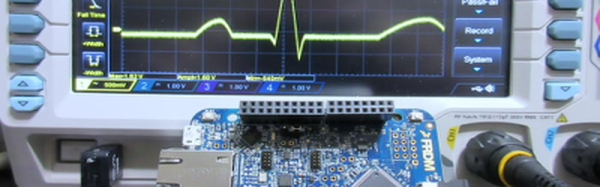
Last month, I talked about how to get started with mBed and ARM processors using a very inexpensive development board. I wanted to revisit mBed, though, and show something with a little more substance. In particular, I often have a need for a simple and portable waveform generator. It doesn’t have to be too fancy or meet the same specs as some of the lab gear I have, but it should be easy to carry, power off USB, and work by itself when required.

My requirements mean I needed a slightly more capable board. In particular, I picked up a K64F board. This is very similar to the KL25Z board but has a bit more of everything–speed, memory, etc. What I really wanted, though, was the SD card slot. I did, however, do my early testing on a KL25Z, so if you have one, you can still work through the code, although standalone operation won’t be possible. The price jumps from $13 to $35, but you get a lot more capability for the price.

Continue reading “How To Build A Pocket-Sized MBed Signal Generator”

Tint Your Epoxy Resin With Toner Powder

Epoxy resin is useful stuff. Whether for gluing stuff together or potting components, epoxy is a cheap and versatile polymer that finds its way into many hackish projects. But let’s face it – the stock color of most commercially available epoxies lacks a certain pizzazz. Luckily, [Rupert Hirst] at Tallman Labs shows us that epoxy is easily tinted with toner powder from a laser printer or copier.

Looking for a way to make his epoxy blend into a glue-up, [Rupert] also demonstrates that colored epoxy makes a professional looking potting compound. There’s just something about the silky, liquid look of a blob of cured black epoxy. [Rupert] harvested his toner powder from a depleted printer cartridge; only a smidgen is needed, so you should be able to recover plenty before recycling the cartridge. We’ve got to admit that seeing toner handled without gloves gives us the willies, though. And don’t forget that you can find cyan, magenta and yellow cartridges too if basic black isn’t your thing.

Sometimes it’s better to leave your epoxy somewhat clear, like when you’re potting an LED matrix for a pendant. But this neat trick might just spiff up your next project a bit.

[Thanks, Jake]

How To Build Anything Using Delrin And A Laser Cutter

Need a simple fab process to go from a humble vector graphic to a final part — in a matter of minutes? The CO2  laser cutter might be the right choice. As these tools open themselves up to widespread use through hackerspaces, I decided to give Delrin some well-deserved time under the spotlight.

The laser cutter yet-again proves itself a formidable tool with the construction of GameCube-Bot V2

This guide is a brief collection of tips and techniques that I’ve either learned from others or discovered on my own over the last couple years working with laser-cut Delrin (a.k.a Acetal) for functional prototypes. I hope this guide serves you well as we keep exploring the limits of the material.

As a disclaimer, keep in mind that in no way are these techniques unique or limited to Delrin. Many are not only years old but also common practice in either engineering design or the local machine shop. This article simply highlights the techniques shown here that perform both repeatably and predictably with Delrin and a couple hand-tools, and I hope to share them with a growing audience of laser cutter enthusiasts.

Continue reading “How To Build Anything Using Delrin And A Laser Cutter”

Transparent whiteboard

Make Your Own Transparent Whiteboard

Now this is seriously cool. Beyond seeing it in movies, having a transparent whiteboard that lights the ink up is absolutely awesome and pretty darn unique. [Andrew McNeil] shows us how — and it’s pretty simple too!

As an avid YouTuber, [Andrew] often has to explain things by drawing out diagrams and what not. If you’ve ever tried to film yourself doing this, you’ll know it’s not easy. So what if you could use the whiteboard like you normally would? And that whiteboard is also the window of which you, the audience, watches through? It’s really quite brilliant, and already in use for some teaching methods.

But wait, are we talking about literally using a glass window to write on? Well… kind of. But the trick is to have the glass edge-lit using LEDs. Doing so will literally make your dry erase markers glow. It practically looks like a neon sign.

Continue reading “Make Your Own Transparent Whiteboard”

sunflower engine

A Sunflower Heat Engine

Looking for a cool science experiment to do with the kids? Why not build a type of heat engine that resembles a sunflower? [Steve] from Rimstar.org shows us how!

It’s actually a pretty ingenious little project. Using metal foil scraps from a coffee bag, [Steve] created a perfectly balanced wheel that looks kind of like a sunflower. When the foil petals come close to heat they try to expand, but much like a bimetal strip, the materials making up the packaging expand at different rates to straighten the heated petal. This moves the center of gravity of the wheel off-axis, causing a rotation. As the wheel spins, the foil petal cools off, and another one is heated, creating continual movement — at least until the heat supply is taken away!

It’s a lot of work to get the balance just right, but thanks to an ingenious axle design it’s pretty easy to make adjustments. The wheel actually floats on a nail with its point stuck to a magnet, and the other end is suspended by a series of magnets. It’s pretty much as close to a friction free axle as you can get!

Continue reading “A Sunflower Heat Engine”

Fisher Price Bluetooth Speaker Hack

A good hacker hates to throw away electronics. We think [Matt Gruskin] must be a good hacker because where a regular guy would see a junky old 1980’s vintage Fisher Price cassette player, [Matt] saw a retro stylish Bluetooth speaker. His hack took equal parts of electronics and mechanics. It even required some custom 3D printing.

You might think converting a piece of old tech to Bluetooth would be a major technical challenge, but thanks to the availability of highly integrated modules, the electronics worked out to be fairly straightforward. [Matt] selected an off the shelf Bluetooth module and another ready-to-go audio amplifier board. He built a custom board to convert the stereo output to mono and hold the rotary encoder he used for the volume control. An Arduino (what else?) reads the encoder and also provides 3.3V to some of the other electronics.

The really interesting part of the hack is the mechanics. [Matt] managed to modify the existing mechanical buttons to drive the electronics using wire and hot glue. He also added a hidden power switch that doesn’t change the device’s vintage look. Speaking of mechanics, there’s also a custom 3D printed PCB holder allowing for the new board to fit in the original holder. This allows [Matt] to keep the volume control in its original location

Continue reading “Fisher Price Bluetooth Speaker Hack”

Learn 40 Years Of Mech Prototyping At Lightspeed

So, what are you doing for the next five and a half hours?  If you’re as busy as we are, you might have to digest this amazing 18 part series of videos over the course of a week or so, but we can almost guarantee you’ll learn a lot. It’s a speedrun through the best collection of Mechanical Engineering knowledge we’ve every come across.

In this epic Youtube video series [Dan Gelbart] shares his knowledge of 40 years of prototyping mechanical designs in a way we’ve never seen before. Not only does he show you how to build things, but he gives away a life time of “tips and tricks” that only a veteran builder would know. There are so many little gems of wisdom in this video series, it’s hard to know where to start with our description. He covers all the usual topics: everything from materials, adhesives, coatings, and such. But the real value of this series is all the little trinkets of information he shares along the way.

Don’t be intimated by some of the tools he’s using – chances are there is a DIY version of the piece of equipment out there, and often you can find a hackerspace or enthusiast in the area who will help you out with their gear. We think this video series should be a must watch for any engineering student or hacker. We made a video playlist for you so you can start watching the videos after the break.

Continue reading “Learn 40 Years Of Mech Prototyping At Lightspeed”