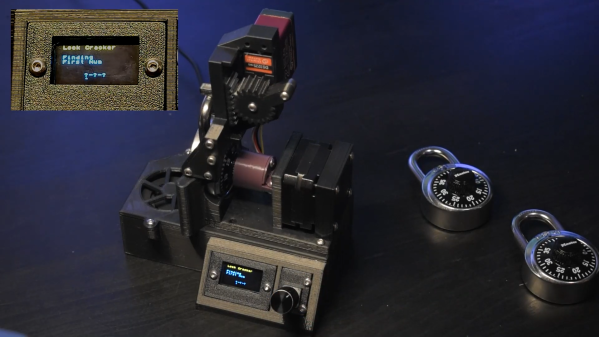
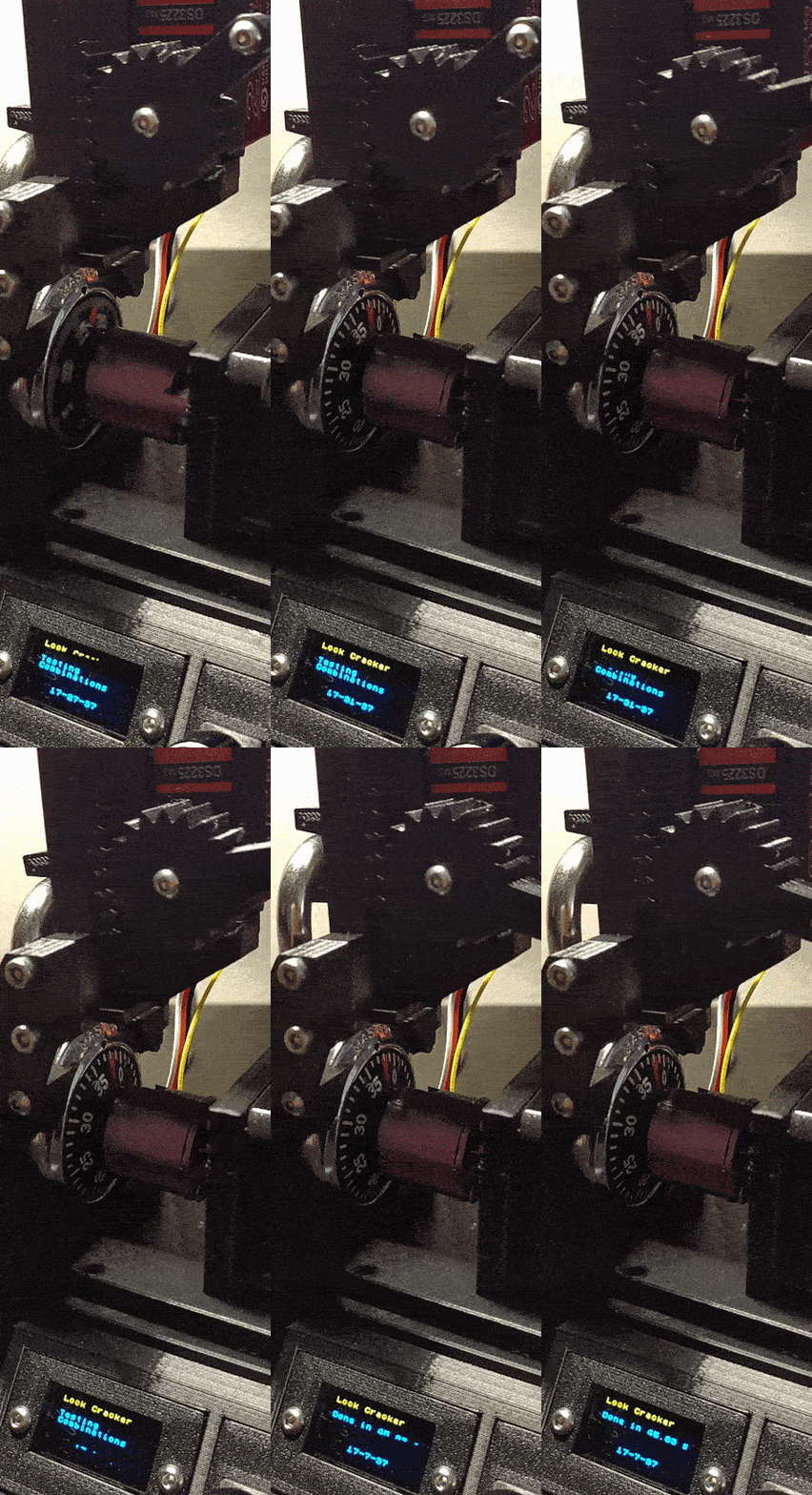
A machine that holds a combination padlock and turns its dial, with two padlocks next to it

Robot Opens Master Combination Locks In Less Than A Minute

A common trope in bank heist B-movies is someone effortlessly bypassing a safe’s combination lock. Typically, the hero or villain will turn the dial while listening to the internal machinery, then deduce the combination based on sounds made by the lock. In real life, high-quality combination locks are not vulnerable to such simple attacks, but cheap ones can often be bypassed with a minimum of effort. Some are so simple that this process can even be automated, as [Mew463] has shown by building a machine that can open a Master combination lock in less than a minute.

A machine that holds a combination padlock and turns its dialThe operating principle is based on research by Samy Kamkar from a couple of years ago. For certain types of Master locks, the combination can be found by applying a small amount of pressure on the shackle and searching for locations on the dial where its movement becomes heavier. A simple algorithm can then be used to completely determine the first and third numbers, and find a list of just eight candidates for the second number.

[Mew463]’s machine automates this process by turning the dial with a stepper motor and pulling on the shackle using a servo and a rack-and-pinion system. A magnetic encoder is mounted on the stepper motor to determine when the motor stalls, while the servo has its internal position encoder brought out as a means of detecting how far the shackle has moved. All of this is controlled by an Arduino Nano mounted on a custom PCB together with a TMC2208 stepper driver.

The machine does its job smoothly and quickly, as you can see in the (silent) video embedded below. All design files are available on the project’s GitHub page, so if you’ve got a drawer full of these locks without combinations, here’s your chance to make them sort-of-useful again. After all, these locks’ vulnerabilities have a long history, and we’ve even seen automated crackers before.

Continue reading “Robot Opens Master Combination Locks In Less Than A Minute”

This Week In Security: Zimbra RCE, Routers Under Attack, And Old Tricks In WebAssembly

There’s a problem in the unrar utility, and as a result, the Zimbra mail server was vulnerable to Remote Code Execution by simply sending an email. So first, unrar is a source-available command-line application made by RarLab, the same folks behind WinRAR. CVE-2022-30333 is the vulnerability there, and it’s a classic path traversal on archive extraction. One of the ways this attack is normally pulled off is by extracting a symlink to the intended destination, which then points to a location that should be restricted. unrar has code hardening against this attack, but is sabotaged by its cross-platform support. On a Unix machine, the archive is checked for any symbolic links containing the ../ pattern. After this check is completed, a function runs to convert any Windows paths to Unix notation. As such, the simply bypass is to include symlinks using ..\ traversal, which don’t get caught by the check, and then are converted to working directories.

That was bad enough, but Zimbra made it worse by automatically extracting .rar attachments on incoming emails, in order to run a virus and spam check. That extraction isn’t sandboxed, so an attacker’s files are written anywhere on the filesystem the zimbra user can write. It’s not hard to imagine how this turns into a full RCE very quickly. If you have an unrar binary based on RarLab code, check for version 6.1.7 or 6.12 of their binary release. While Zimbra was the application specifically called out, there are likely to be other cases where this could be used for exploitation.
Continue reading “This Week In Security: Zimbra RCE, Routers Under Attack, And Old Tricks In WebAssembly”

A lock picking robot

This 3D Printed Robot Can Actually Pick Locks

Lockpicking is more of an art than a science: it’s probably 10% knowledge and 90% feeling. Only practice will teach you how much torque to apply to the cylinder, how to sense when you’ve pushed a pin far enough, or what it feels like when a pin springs back. Surely a robot would never be able to replicate such a delicate process, wouldn’t it?

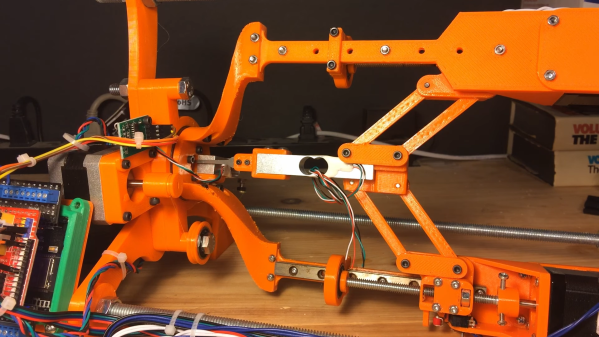
Well, not according to [Lance] over at [Sparks and Code], who thought that building a lock picking robot would be an interesting challenge. He started out with a frame to hold a padlock and a servo motor to apply torque. A load cell measures the amount of force applied. This helps to keep the lock under a constant amount of tension as each pin is picked in succession. Although slow, this method seemed to work when moving the pick manually.

The difficult part was automating the pick movement. [Lance] built a clever system driven by two motors that would keep the pick perfectly straight while moving it horizontally and vertically. This was hard enough to get working correctly, but after adding a few additional clamps to remove wobble in the leadscrew, the robot was able to start picking. A second load cell inside the pick arm would detect the amount of force on each pin and work its way across the lock, pin by pin.

At least, that was the idea: as it turned out, simply dragging the pick across all pins in one go was enough to open the lock. A much simpler design could have achieved that, but no matter: designing a robot for all these intricate motions was a great learning experience anyway. It also gave [Lance] a good platform to start working on a more advanced robot that can pick higher-quality locks in which the dragging technique doesn’t work.

We haven’t come across lockpicking robots before; perhaps the closest equivalent would be this 3D-printed Snap Gun. If you’re interested in all aspects of locks and how to apply them, check out our Physical Security Hack Chat with Deviant Ollam.

Continue reading “This 3D Printed Robot Can Actually Pick Locks”

Making A Car Key From A Ratcheting Wrench

Car keys these days are remarkably complex beasts. Covered in buttons and loaded with security transponders, they often cost hundreds of dollars to replace if you’re unlucky enough to lose them. However, back in the day, keys used to just be keys — a hunk of metal in a mechanical pattern to move some levers and open a door. Thus, you could reshape a wrench into a key for an old car if that was something you really wanted to do.

The concept is simple. Take a 12mm ratcheting wrench, and shape the flat section into a profile matching that of a key for an older car without any electronic security features. The first step is to cut down the shaft, before grinding it down to match the thickness and width of the original key.

The profile of the key is then drawn onto the surface, and a Dremel used with a cutting disc to create the requisite shape.  Finally, calipers are used to mark out the channels to allow the key to slide into the keyway, before these are also machined with the rotary tool.

Filing and polishing cleans up the final result to create a shiny, attractive ratchet wrench key. Even better, it does a great job of opening the car, too.

Similar machining techniques can be used to duplicate a key from just a photo (something I did back in 2019 to prank my friend). Alternatively, 3D printing can be great for reproducing even high-security keys. Video after the break.

Continue reading “Making A Car Key From A Ratcheting Wrench”

Making A “Unpickable” Lock

Every time manufacturers bring a new “unpickable” lock to market, amateur and professional locksmiths descend on the new product to prove them wrong. [Shane] from [Stuff Made Here] decided to try his hand at designing and building an unpickable lock, and found that particular rabbit hole to be a lot deeper than expected. (Video, embedded below.)

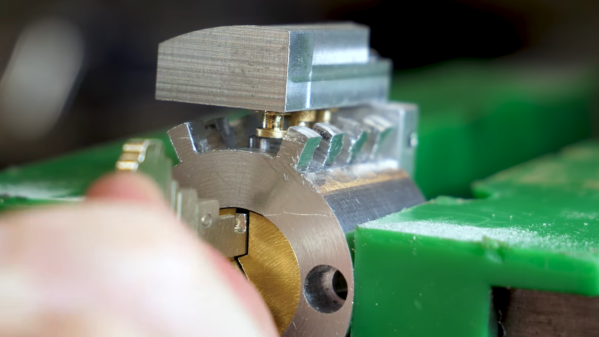
Most common pin tumbler locks can be picked thanks to slightly loose fits of the pins and tiny manufacturing defects. By lifting or bumping the pins while putting tension on the cylinder the pins can be made to bind one by one at the shear line. Once all the pins are bound in the correct position, it can be unlocked.

[Shane]’s design aimed to prevent the pins from being set in unlocked position one by one, by locking the all pins in whatever position they are set and preventing further manipulation when the cylinder is turned to test the combination. In theory this should prevent the person doing the picking from knowing if any of the pins were in the correct position, forcing them to take the difficult and time-consuming approach of simply trying different combinations.

[Shane] is no stranger to challenging projects, and this one was no different. Many of the parts had to be remade multiple times, even with his well-equipped home machine shop. The mechanism that holds the pins in the set position when the cylinder is rotated was especially difficult to get working reliably.  He explicitly states that this lock is purely an educational exercise, and not commercially viable due to its mechanical complexity and difficult machining.

A local locksmith was unsuccessful in picking the lock with the standard techniques, but the real test is still to come. The name [LockPickingLawyer] has probably already come to mind for many readers. [Shane] has been in contact with him and will send him a lock to test after a few more refinements, and we look forward to seeing the results! Continue reading “Making A “Unpickable” Lock”

Stealing Keys From The Sound Of The Lock

If you are smart, you wouldn’t hand your house key over to a stranger for a few minutes, right? But every time you use your key to unlock your door, you are probably broadcasting everything an attacker needs to make their own copy. Turns out it’s all in the sound of the key going into the lock.

Researchers in Singapore reported that analyzing metallic clicks as the key slides past the pins gives them the data they need to 3D print a working key. The journal published research is behind a paywall, but there is a copy on co-author [Soundarya Ramesh’s] website which outlines the algorithm used to decode the clicks of key teeth on lock pins into usable data.

The attack didn’t require special hardware. The team used audio capture from common smartphones. While pushing your phone close to the lock while the victim inserts a key might be problematic, it isn’t hard to imagine a hacked phone or smart doorbell picking up the audio for an attacker. Long-range mikes or hidden bugs are also possible.

There are practical concerns, of course. Some keys have a plateau that causes some clicks to skip, so the algorithm has to deal with that. It sounds like the final result be a small number of key possibilities and not just converge on one single key, but even if you had to carry three or four keys with you to get in, it is still a very viable vulnerability.

The next step is to find a suitable defense. We’ve heard that softening the pins might reduce the click, but we wondered if it would be as well to put something in that deliberately makes loud clicks as you insert the key to mask the softer clicks of the pins.

While a sound recording is good, sometimes a picture is even better. Of course, if you want to go old school, you can 3D print your lockpicks.

Continue reading “Stealing Keys From The Sound Of The Lock”

Son Of Rothult

We are continuously inspired by our readers which is why we share what we love, and that inspiration flows both ways. [jetpilot305] connected a Rothult unit to the Arduino IDE in response to Ripping up a Rothult. Consider us flattered. There are several factors at play here. One, the Arduino banner covers a lot of programmable hardware, and it is a powerful tool in a hardware hacker’s belt. Two, someone saw a tool they wanted to control and made it happen. Three, it’s a piece of (minimal) security hardware, but who knows where that can scale. The secure is made accessible.

The Github upload instructions are illustrated, and you know we appreciate documentation. There are a couple of tables for the controller pins and header for your convenience. You will be compiling your sketch in Arduino’s IDE, but uploading through ST-Link across some wires you will have to solder. We are in advanced territory now, but keep this inspiration train going and drop us a tip to share something you make with this miniature deadbolt.

Locks and security are our bread and butter, so enjoy some physical key appreciation and digital lock love.