FPGA Arduino Shield Uses Kickstarter As A Preorder System

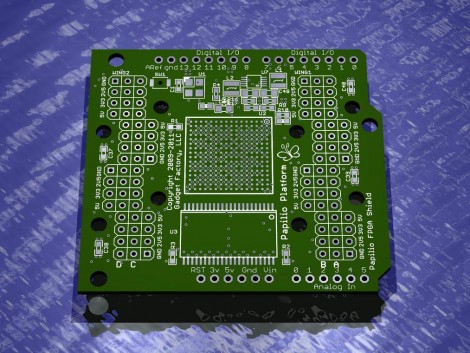
[ Jack Gassett] is working on an FPGA shield for the Arduino. At first the idea of this expansion board seemed a little silly. But [Jack] mentions that the FPGA board can be quite useful for adding higher-order electronic complexity like HDMI capabilities to an Arduino. We’re not totally sold on the idea, but he’s not making the board solely for use with an Arduino either.

The plan is to use a Xilinx Spartan 3A FPGA which comes in a ball-grid array package. And that is the reason [Jack] decided to use Kickstarter for this project. He shared some of his issues with BGA components in a home manufacturing process a while back. To get these working reliably you need to have them professionally assembled, and that requires a sizable upfront investment. But as we read through his proposal it struck us that he’s actually using Kickstarter as a preorder system. You can get a base model with just the FPGA soldered on the board for $55. Not bad considering the chip will cost you at least $20 without assembly. Each level up includes a few more components like SRAM or add-on PCBs.

We get a lot of tips pointing to Kickstarter proposals but this is one of the few that seems right on the mark for supporting open and innovative development. Great work [Jack]!

[Thanks Simon]
DIY Wiper Speed Control And Collision Avoidance

ir_sensor_rain_detection

On many new cars, automatic wiper speed control can be had as an upgrade, though most cars do not offer front-end collision prevention at all. [Rishi Hora] and [Diwakar Labh], students at the Guru Tegh Bahadur Institute of Technology in New Delhi, developed their own version of these features, (PDF warning, skip to page 20) which they entered into last year’s Texas Instruments Analog Design Contest. Under the guidance of professors [Gurmeet Singh] and [Pawan Kumar], the pair built the systems using easily obtainable parts, including of course, an MSP430 microcontroller from TI.

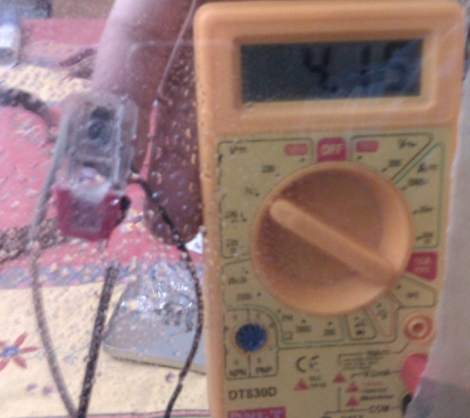
The collision prevention system uses a laser emitter and an optical detector to estimate the distance between your car and the vehicle in front of you, sounding an alarm if you are getting too close. In a somewhat similar fashion, the wiper speed control system uses an IR emitter and detector pair to estimate the amount of water built up on the windshield, triggering the wipers when necessary.

While not groundbreaking, the systems would be quite handy during monsoon season in India, and seem easy enough to install in an older vehicle. The only thing we’re not so sure about is pointing lasers at cars in traffic, but there are quite a few available alternatives that can be used to measure distance.

Continue reading to see a video walkthrough and demonstration of both systems.

Continue reading “DIY Wiper Speed Control And Collision Avoidance”

Sound Card Microcontroller/PC Communication

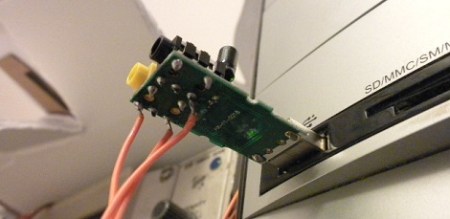
The usual way send data from a microcontroller is either over RS-232 with MAX232 serial ICs, crystals, and a relatively ancient computer, or by bit-banging the USB protocol and worrying about driver issues. Not content with these solutions, [Scott] came up with sound card μC/PC communication that doesn’t require any extra components.

[Scott] bought a cheap USB sound card dongle on eBay (although a built-in sound card will do) and wired up the tip and ring of the plug to the microcontroller. The data is sent from the microcontroller a lot like Morse code – a short gap between pulses is a zero, a long gap is a one. This is parsed by a Python script using PyAudio. Synchronization, timing, and calibration is automatic because of a 10-bit ‘packet header’ explained in this video.

Continue reading “Sound Card Microcontroller/PC Communication”

Hardware XOR For Output Pins On AVR Microcontrollers

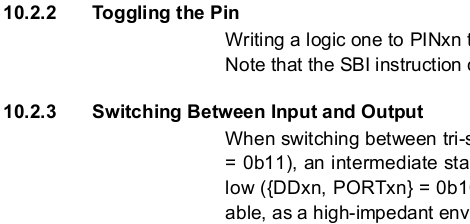
Did you know that most AVR chips have a type of hardware exclusive OR (XOR) option when it comes to the logic levels of the output pins? If you look in the datasheet (the image above is a screenshot from an ATtiny13 datasheet) you’ll find a section on Toggling the Pin. It turns out that if you set a PORT as an output, writing logic one to the corresponding PIN register will toggle the logic levels of that out. This is really easy to overlook if you’re writing in C, but I’ve been working on learning a bit of assembler language and found this to be very useful. Keep reading after the break and I’ll tell you how I happened upon this info and what it’s good for.

Continue reading “Hardware XOR For Output Pins On AVR Microcontrollers”

Playing Chess On A Microcontroller

[Arthur Benemann] started a little project for his electrical engineering program, and suffered the worst case of feature creep we’ve ever seen. He just posted an instructable of his picChess project that is able to play chess on a VGA monitor with a keyboard, with sound, a clock, temperature sensor. Apparently, [Arthur] was bored one evening and threw in an implementation of Conway’s game of life.

[Arthur] chose a DSPIC33F μC for his project with everything laid out on a bread board. He’s quite proud of his VGA routine, the first time he’s ever used DMA. We’re really impressed by [Arthur]’s chess engine – his is the first homebrew chess engine we’ve seen on Hack A Day. Although the engine is a brute-force search with Alpha-beta pruning, the engine itself seems fairly advanced that will even supports castling.

Although a few rules aren’t supported and the ELO rating of the engine isn’t known, [Arthur]’s engine should still be able to beat an amateur player. A fairly impressive feat indeed.

Check out [Arthur]’s video after the break.

Continue reading “Playing Chess On A Microcontroller”

MB LED Is Next Generation Of LED Video Block Puzzles

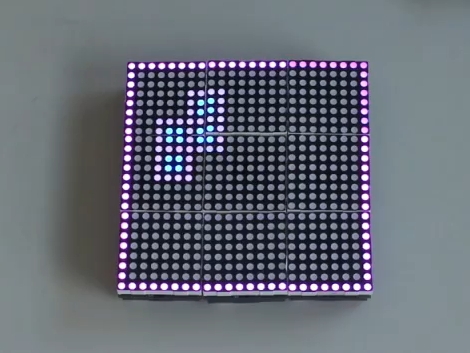
Meet MBLed, a set of interactive 8×8 LED tiles. Put them next to each other and they will orient themselves into a video screen which is the sum of the parts. If this sounds familiar it’s because we’ve seen the concept before in the GLiP project. [Guillaume] tells us that MB Led is the new version of GLiP and from what we’ve seen they’ve made a lot of progress.

The hardware is well designed. A PCB hosts the STM32 microcontroller and a pair of pin headers which receive the RGB LED matrix module. A pair of AA battery holders make up the legs for the device. Each has infrared receiver/emitter pairs on each of the four edges and constantly polls for its neighbors.

What really impresses us is the algorithms they’re using for communications. FreeRTOS runs on the ARM processors, and a series of messages was developed which allow the blocks to elect a leader, and follow its commands via the distributed system. Check out more about those algorithms on the page linked above, and join us after the break to see the demo video.

Continue reading “MB LED Is Next Generation Of LED Video Block Puzzles”

Your Snapshot On A Thermal Printed Receipt, Instantly!

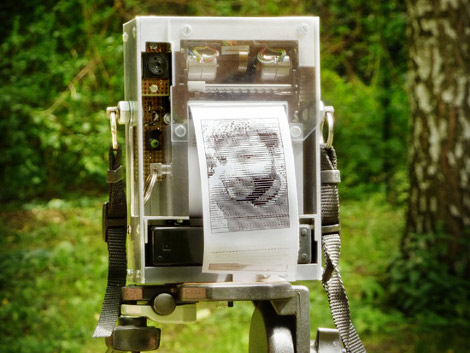
What could be better than a low-res black and white photograph printed instantly on paper that will yellow and crumple over time? Wow, we really need to work on our sales pitch. But all kidding aside, we love the idea that [Niklas Roy] came up with in order to build this thermal printing camera.

His Picasa album has two snapshots of the hardware. He’s using an LM1881 for video sync separation just like he did with his PING project. From there an ATmega8 microcontroller grabs each column from the image and prints it using the thermal printer. It looks like everything runs on a 9V battery which is nice for portability (although we still never got our hands on that rechargeable 9V we’ve been meaning to pick up). Perhaps just as impressive is that [Niklas] got this up and running with about 400 lines of code. Nice!

Of course you’ll want to see this in action so we’ve placed a video clip after the break. Just like old-timey cameras it looks like you’re going to need to sit still until the image is done printing.

Continue reading “Your Snapshot On A Thermal Printed Receipt, Instantly!”