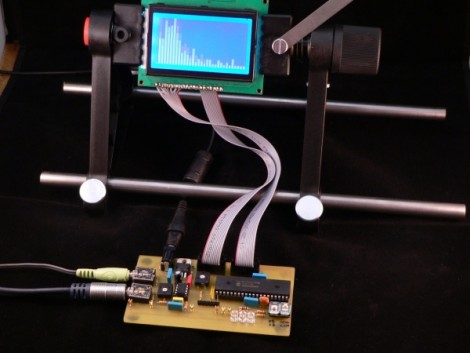
PIC Spectrum Analyzer Uses Fast Fourier Transform Routine

[Simon Inns] just rolled out his latest project, a PIC based spectrum analyzer. He’s using a Fast Fourier Transform routine crafted in C to run as efficiently as possible on the 8-bit chip. The video after the break shows that the results are quite pleasing, with just a bit of noticeable lag between the sound and the waveform representation on the graphic LCD. We found his notes about using an audio amplifier chip to be interesting. He utilizes the properties of an LM386 to move the input signals from a range of -0.5V to +0.5V into a very ADC friendly range of 0-5V.

Continue reading “PIC Spectrum Analyzer Uses Fast Fourier Transform Routine”
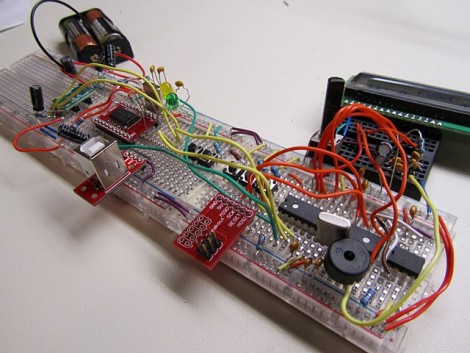
Developing An Electronic Board Game

[Zach] enjoys playing the game Catch Phrase, but the complexity of the words makes this game a no-go for the little ones. We remember that the game used to be mechanical, using paper disks with the words on them. Those would be easy to recreate with your own dictionary set, but since it has transitioned to an electronic unit that option is out the window. So [Zach] decided to build his own version of the game that lets you use custom word sets after drawing inspiration from another Catch Phrase hack.

He’s calling it AVRphrase since it uses an AVR ATmega328. You’ll also find five buttons, a piezo buzzer, and a character LCD included in the design. He saw the project all the way through to the end, having a PCB manufactured, and installing it in a project box. A demonstration of the finished game can be seen after the break. [Zach] ended up with 9 working units at a cost of about $30 each.

Continue reading “Developing An Electronic Board Game”

Getting Started With The Parallax Propeller

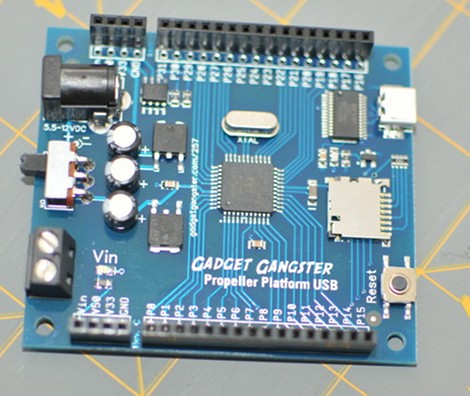
The folks at [gadget gangster] have been working on an excellent set of tutorials for getting started with the Propeller chip itself, the open-source Propeller Platform Modules and the Spin programming language that’s used to control things. All of the basics and a growing selection of more advanced topics are covered in gorgeous detail, with most of the tutorials containing helpful photographs and screen shots, source code listings and video walk-throughs to help you understand what the authors are talking about.

Parallax is not new to the microcontroller game. Almost two decades ago, their BASIC Stamp embedded microcontroller was the springboard for many tinkerers. The Parallax Propeller is an easy-to-use microcontroller that’s been gaining popularity for a while now. Several Propeller support modules have hit the market recently, providing power supply and interface functions to the Propeller similar to how the popular Arduino platform interfaces with AVR microcontrollers.

Christmas Light Controller

We get a lot of tips about Christmas light controllers but rarely do they contain the kind of juicy detail that [Vince Cappellano] included with his setup. His video explaining the controller he built is embedded after the break and it’s not to be missed.

We think there’s a lot of good design invovled in this porject. First off, he’s got eight physical channels, each with optisolation and a triac for 256 levels of power control. But he was able to double the control to sixteen virtual channels if you’re using LED lighting. That’s because on those strings half of the LEDs are reverse biased compared to the rest. By adding sensing circuitry to the incoming AC, he can switch the triacs to only send positive or negative voltage through the LED strands, which produces the additional virtual channels. And did we mention that he did all this using wire wrapping and point-to-point soldering?

Continue reading “Christmas Light Controller”

Reading NAND Flash Chips Without Removing Them

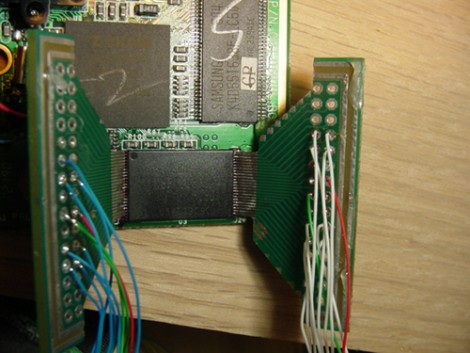
Here’s an interesting method of reading data off of a NAND flash chip. Often we see these chips desoldered in order to read and write data, but not this time. This method uses hacked adapters to match the pin pitch of the various chips. Above you see parts of a breakout board cut down to use as wedges. These are drag soldered to the pins of the chip, then the appropriate breakout pins were connected to a Smartmedia card reader, which can read NAND chips. There is also an example showing the flexible connector cable for a DVD rom used as the adapter to solder to a smaller chip. We still looks pretty tricky, but it might be less labor intensive than relocating the flash chip like we saw on that Sega Game Gear hack, as long as you only need to read or write the data once.

[Thanks Laurdy]

External RAM For An ATmega128

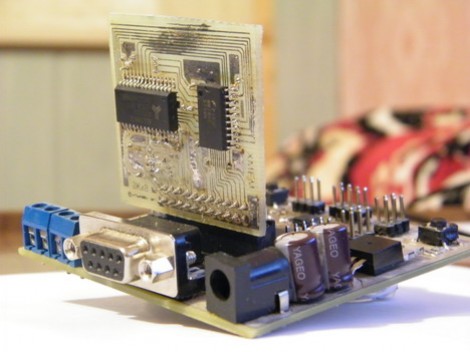
Those who are familiar with Atmel’s line of 8-bit AVR microcontrollers should already know that some of them have support for external RAM. But have you ever actually used this feature? We haven’t. Now you can learn how it’s done by reading through this guide. It touches on all of the hardware, but doesn’t dwell on it. Instead, you’ll get the background you need on how to write to, read from, and test an external module like the one sticking up in the image above. The test routine shows how to make sure everything’s working correctly with your memory mapping before you begin developing firmware around this increased capacity.

[Thanks Spman]

Reading A Digital Caliper With A Microcontroller

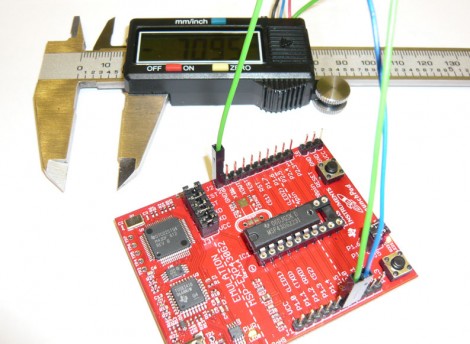
[Maris] wanted a way to read measurements from a digital caliper electronically. He ended up using the TI Launchpad to accomplish this, but not all of the necessary hardware is seen above. The calipers cost him about $7 on eBay, and they have four interface pins which made this hack quite a bit easier. After a bit of probing he established their purpose; voltage, ground, clock and data. A bit of scoping proved that data was being sent in 24-bit burst in packets that are quite easy to decode.

From there it’s just a matter of interfacing with a microcontroller. The chip he’s using is an MSP430G2231 that runs at 3.3V, but the caliper’s logic high is only 1.5v. By constructing an adapter using a pair of transistors, the data and clock from the calipers are able to pull pins on the MSP430 low. This is collected and analyzed by [Maris’] firmware and can be read on a PC using a terminal program.

[Thanks Chris]