Simple Demo Shows The Potential Of Magnetic Gears

We’ve probably all used gears in our projects at one time or another, and even if we’re not familiar with the engineering details, the principles of transmitting torque through meshed teeth are pretty easy to understand. Magnetic gears, though, are a little less intuitive, which is why we appreciated stumbling upon this magnetic gear drivetrain demonstration project.

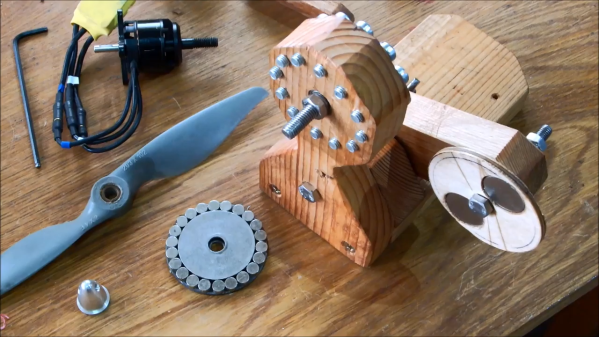
[William Fraser]’s demo may be simple, but it’s a great introduction to magnetic gearing. The stator is a block of wood with twelve bolts to act as pole pieces, closely spaced in a circle around a shaft. Both ends of the shaft have rotors, one with eleven pairs of neodymium magnets arranged in a circle with alternating polarity, and a pinion on the other side of the stator with a single pair of magnets. When the pinion is spun, the magnetic flux across the pole pieces forces the rotor to revolve in the opposite direction at a 12:1 ratio.

Watching the video below, it would be easy to assume such an arrangement would only work for low torque applications, but [William] demonstrated that the system could take a significant load before clutching out. That could even be a feature for some applications. We’ve got an “Ask Hackaday” article on magnetic gears if you want to dive a little deeper and see what these interesting mechanisms are good for.

Continue reading “Simple Demo Shows The Potential Of Magnetic Gears”
Touch Face, Lights Chase, Sirens Race

Let’s face it — people are gonna touch their faces. Sometimes faces itch, especially during allergy season. But the first step toward quitting something like that is to become cognizant of just how often you do it.

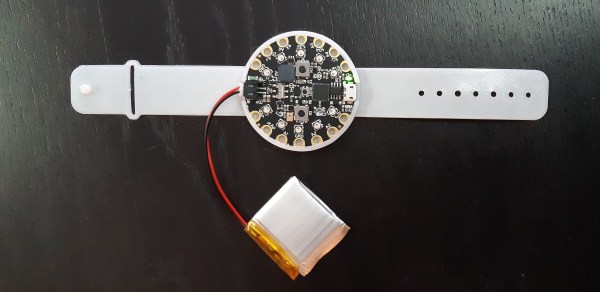
With a bracelet like this one from [Mauricio Martins], your face-touching frequency will quickly become apparent. Strap it to your favorite face-scratching arm and go about your day. The code constantly polls the accelerometer to see if your hand is in the vicinity of your visage. If so, red lights circle around and an emergency vehicle-type siren goes off to let everyone around you know you’ve sinned.

This no-touch-face bracelet is awesome because it’s simple and it works. It uses a Circuit Playground Express programmed in Make code, but it would be easy to port it to Arduino or CircuitPython. If you want to make something more elegant, we’re all for it, but you could be using this in the meantime to help condition yourself away from the habit. Check out the demo after the break.

Sometimes you gotta take a step back and make something that just works without getting all fancy. Did you hear the one about the astrophysicist who got magnets stuck up his nose trying to solve this very problem?

Continue reading “Touch Face, Lights Chase, Sirens Race”

Impressive Lever-Press Espresso Machine Has Finesse

Some people will do anything for a good cup of coffee, and we don’t blame them one bit — we’ve been known to pack up all our brewing equipment for road trips to avoid being stuck with whatever is waiting in the hotel room.

While this stylish lever-based industrial coffee machine made by [exthemius] doesn’t exactly make textbook espresso, it’s pretty darn close. Think of it like an Aeropress on steroids, or more appropriately, bulletproof coffee. As you can see in the demo after the break, the resulting coffee-spresso hybrid brew looks quite tasty.

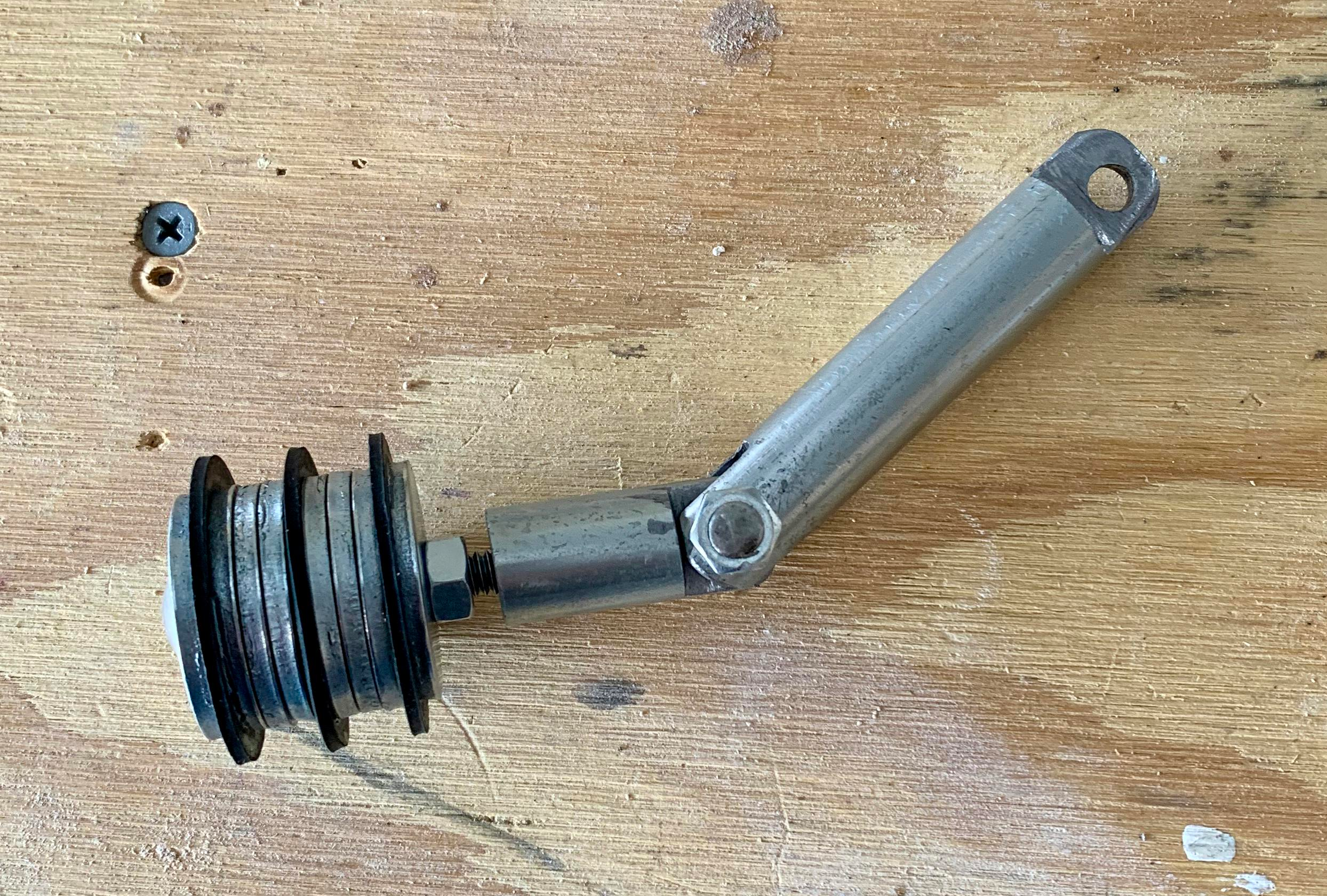
Here’s how it works: finely-ground beans go in a pressurized portafilter basket that was scavenged from an entry-level prosumer espresso machine. Pour boiling water into the top of the cylinder, and pull the giant lever down slowly to force it through the portafilter. Presto, you’re in thin, brown flavor town.

We love the piston-esque plunger that [exthemius] made by layering washers and rubber gaskets up like a tiramisu. Although there are no plans laid out, there’s probably enough info in the reddit thread to recreate it.

If you ever do find yourself stuck with hotel house brand, soak it overnight to make it much more palatable.

Continue reading “Impressive Lever-Press Espresso Machine Has Finesse”

An Arduino-Free Automatic Alcohol Administrator

With all the hands-free dispenser designs cropping up out there, the maker world could potentially be headed for an Arduino shortage. We say that in jest, but it’s far too easy to use an Arduino to prototype a design and then just leave it there doing all the work, even if you know going in that it’s overkill.

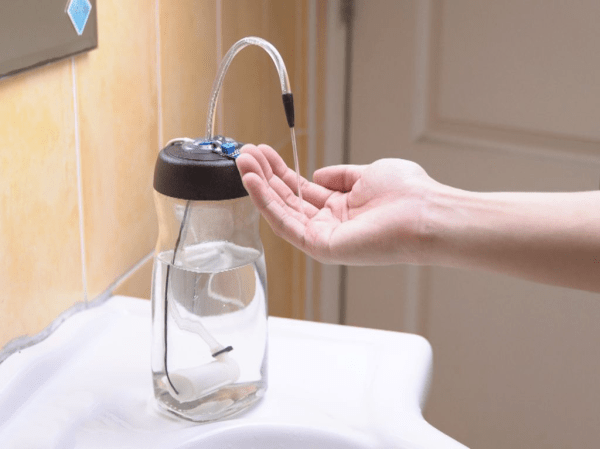
[ASCAS] took up the challenge and built a cheap and simple dispenser that relies on recycled parts and essential electronics. It uses an IR proximity sensor module to detect dirty digits, and a small submersible pump to push isopropyl alcohol, sanitizer, or soap up to your hovering hand. The power comes from a sacrificial USB cable and is switched through a transistor, so it could be plugged into the wall or a portable power pack.

We admire the amount of reuse in this project, especially the nozzle-narrowing ballpoint pen piece. Be sure to check out the build video after the break.

Hopefully, you’re all still washing your hands for the prescribed 20 seconds. If you’re starting to slip, why not build a digital hourglass and watch the pixels disappear?

Continue reading “An Arduino-Free Automatic Alcohol Administrator”

Particle Sniffer For Pollution Point Sources

When measuring air quality, particulate matter is an important metric to watch. The PM2.5 rating refers to particulate matter that has a diameter of less than 2.5 micrometers. While it’s often measured by authorities on a city-wide basis, [rabbitcreek] wanted a way to track down point sources indoors.

The tool [rabbitcreek] built is in a similar form factor to a typical infrared workshop thermometer. Inside, it packs a Honeywell HPMA115S0-TIR laser particle sensor, hooked up to an ESP32 which runs the show. The sensor chosen makes things easy, with the device already set up with a blower and inlet and outlet ports for taking accurate readings.. Results are displayed on an SSD1306 OLED screen. It’s all wrapped up in a 3D printed case with a trigger grip, and a dog nose on the front which hints at the devices true purpose.

In testing, the device proves capable of detecting point sources of atmospheric particulates like flowers and a toaster. It’s something we’re sure would prove handy to those working in HVAC and environmental assessment industries. We’ve seen other rigs for monitoring particulates before, too. Video after the break.

Continue reading “Particle Sniffer For Pollution Point Sources”

Ammo Can Battery; 50 Ah LiFePO4 Clad In Army Green

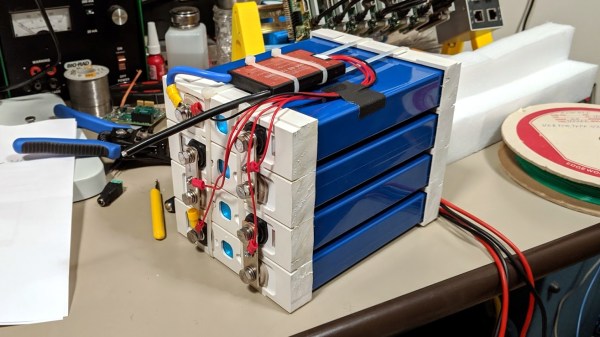
For the price of a mid-range Android phone, [Kenneth Finnegan] turned a 50 caliber ammo can into a 50 amp-hour portable power supply. The battery pack uses four 3.5 V LiFePO4 cells wired in series to achieve a nominal 12 V supply that stands in for a traditional lead-acid battery. The angel of second-hand purchases was smiling on this project as the cells were acquired on eBay in unused condition, complete with bus bars and mounting spacers. All it took to fit them in the case was to grind off the spacers’ dovetails on the outer edges.

There are many benefits to Lithium Iron Phosphate chemistry over traditional lead acid and [Kenneth] spells that out in his discussion of the battery management system at work here. While the newer technology has a much better discharge curve than lead-acid, there’s a frightening amount of power density there if these batteries were to have a catastrophic failure. That’s why there are Battery Management Systems and the one in use here is capable of monitoring all four cells individually which explains the small-gauge wires in the image above. It can balance all of the cells to make sure one doesn’t get more juice than the others, and can disconnect the system if trouble is a-brewin’. Continue reading “Ammo Can Battery; 50 Ah LiFePO4 Clad In Army Green”

BCD To I2C: Turning A Nixie Counter Into Whatever You Want It To Be

Whenever a project calls for displaying numbers, a 7-segment display is the classic and straightforward choice. However, if you’re more into a rustic, retro, almost mystical, and steampunky look and feel, it’s hard to beat the warm, orange glow of a Nixie tube. Once doomed as obsolete technology of yesteryear, they have since reclaimed their significance in the hobbyist space, and have become such a frequent and deliberate design choice, that it’s easy to forget that older devices actually used them out of necessity for lack of alternatives. Exhibit A: the impulse counter [soldeerridder] found in the attic that he turned into a general-purpose, I2C controlled display.

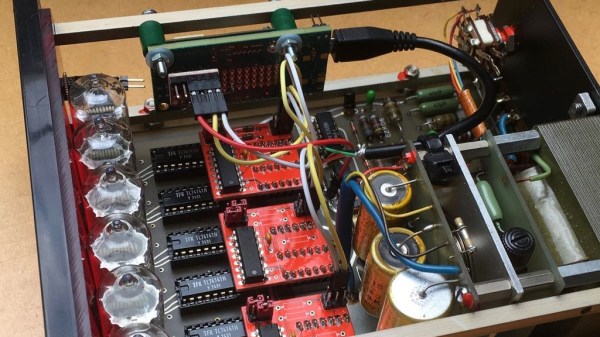
Instead of just salvaging the Nixie tubes, [soldeerridder] kept and re-used the original device, with the goal to embed an Intel Edison module and connect it via I2C. Naturally, as the counter is a standalone device containing mainly just a handful of SN74141 drivers and SN7490 BCD counters, there was no I2C connectivity available out of the box. At the same time, the Edison would anyway replace the 7490s functionality, so the solution is simple yet genius: remove the BCD counter ICs and design a custom PCB containing a PCF8574 GPIO expander as drop-in replacement for them, hence allowing to send arbitrary values to the driver ICs via I2C, while keeping everything else in its original shape.

Containing six Nixie tubes, the obvious choice is of course to use it as a clock, but [soldeerridder] wanted more than that. Okay, it does display the time, along with the date, but also some sensor values and even the likes on his project blog. If you want to experiment with Nixie tubes yourself, but lack a matching device, Arduino has you obviously covered. Although, you might as well go the other direction then.

Continue reading “BCD To I2C: Turning A Nixie Counter Into Whatever You Want It To Be”