Custom Hydraulic Cylinders From Off-the-Shelf Components

When your project needs power, you might need to turn to hydraulics. There is a lot of mystery about fluid power, but there is also a huge supply chain devoted to getting you the parts you need to power your project. Off-the-shelf components may not fit your application though, in which case it might be handy to know how to build your own custom hydraulic cylinders.

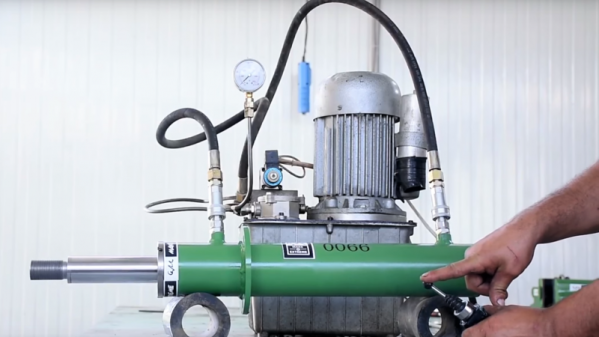
While it’s true that custom cylinder builds are pretty common, it’s still interesting to see the process [MakeItExtreme] used. Starting with an off-the-shelf piston and gland, this double-acting cylinder build is a pretty straightforward exercise in machining. The cylinder is threaded at the rod end and a cap is welded onto the piston end. Threaded bosses for fittings are welded on, the business end of the rod is threaded, and everything is assembled. The cylinder turned out to be pretty powerful as the video below shows.

As a product of the prolific team at [MakeItExtreme], we can tell this cylinder is destined for another even more interesting build. It’s hard to guess where this one will end up, but we’ll bet it ends up in another tool in their shop. Maybe it end up powering a beefed-up version of their recent roll bender.

Continue reading “Custom Hydraulic Cylinders From Off-the-Shelf Components”

A Simple, DIY GPS Tracker

Today, there are dozens of off-the-shelf solutions for a GPS tracking device. Most of them use GSM, some of them use satellites, and all of them are astonishingly inexpensive. If you want to track a car, dog, or your luggage, you’ve never had more options.

[Emilio] wanted to track his own car, and the original solution for this was a smartphone. This smartphone was also a good choice, as it’s a programmable GPS device connected to a cell network, but there had to be a simpler solution. It came in the form of an eight euro GPS module and a three euro GSM module (Google Translatrix right here). The rest of the hardware is an ATMega48V [Emilio] had sitting around and a 2500 mAh lithium cell. It’s a cellular tracker make out of eleven euro’s worth of hardware and some junk in a drawer.

There are only a few caveats to this hardware. First, the ATmega48V only has one UART. This is connected to the GPS module at 9600, 8N1. The connection to the GSM M-590 module is only 2400 bps, and slow enough for a bitbanged UART. This hardware is soldered to a piece of perfboard, thus ending the hardware part of this build.

The software is a little more complex, but not by very much. The GPS part of the firmware records the current latitude and longitude. If the GSM module receives a call, it replies with an SMS of the current GPS coordinates and a few GPS coordinates seen earlier. Of course, a pre-paid SIM is required for this build, but those are cheap enough.

Not even ten years ago, a simple, DIY GPS tracker would have cost a small fortune. Now that we have cheap GPS modules, GSM modules, and more magical electronics from the East, builds like this are easy and cheap. What a magical time to be alive.

Need For New Hobby Leads To Stone Marbles

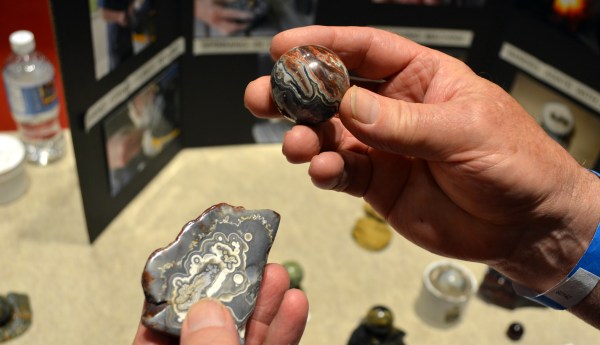
[Tom Lange] said he was looking for a new hobby when he saw a marble made out of stone and wondered what goes into making one for himself. Fast forward three years and he set up shop at the Madison Mini Maker Faire to show off the tools he built and the fascinating glossy orbs he’s produced. Read on to see the awesome process he uses to turn a hunk of stone into a perfect marble.

Continue reading “Need For New Hobby Leads To Stone Marbles”

Flamethrower skateboard

Light A Fire Under Your…Skateboard?

Kids, please don’t try this at home. Or at least make sure there’s nothing flammable around.

With that out of the way, we have to ask — who doesn’t love playing with fire? We’re betting that many of you also have enjoyed a little skateboarding at some point in your lives. [mikeasaurus] has married the two beloved activities and made a flame throwing skateboard! The parts count is fairly low, and it looks like everything can be purchased from Amazon if you can’t source all of the items locally.

[mikeasaurus] gives a few useful tips such as how he bent one of the two pipes on the fuel tank cap to prevent fuel from pouring out. Also, he used an adapter to bring down the diameter of the tubes from 1/4″ to 1/8″ which makes for a better performing fuel stream.

Instead of making this little foot cooker more complicated with additional electronics and wires to be operated by a hand-held remote control, [mikeasaurus] decided to build the controls directly into the skateboard with just a couple of foot-activated switches. This keeps his hands free to wave at all of the onlookers watching him speed by. Or better yet, to carry a fire extinguisher.

Admittedly, it appears from the video that the flame doesn’t really get ‘thrown’ too far, and [mikeasaurus] himself says:

“As long as you’re moving forward when the flames are activated, you’re good to go!”

Because of this, you probably don’t want to use your favorite board, as it’s going to be subject to direct flames.

You’ll see this when you watch the video after the break.

Continue reading “Light A Fire Under Your…Skateboard?”

Javascript Art Is In The URL

[Alexander Reben] makes tech art, and now he’s encouraging you to do the same — within a URL. The gimmick? Making the code small enough to fit the data portion of a link. And to help with that, he has set up a webpage that uncompresses and wraps code from the URL and inserts it into the HTML on the fly. His site essentially applies or un-applies all the tricks of JS minification in the URL, and turns that into content.

So, for instance,https://4QR.xyz/c/?eJzzSM3JyVcIzy_KSVEEABxJBD4 uncompresses to a webpage that says “Hello World!”. But the fun really starts when you start coding up “art” in Javascript or HTML5. There are a few examples up in the gallery right now, but [Alexander] wants you to contribute your own. The banner is from this link.

Something strikes us as fishy about passing JS code opaquely in links, but since the URL decodes on [Alexander]’s server, we don’t see the XSS attack just yet. If you can find the security problem with this setup, or better yet if you write up a nice animation, let us know in the comments.

Pool Playing Robot Destined For Trouble In River City

You’d think pool should be an easy game for a robot to play, right? It’s all math — geometry to figure out the angles and basic physics to deal with how much force is needed to move the balls. On top of that, it’s constrained to just two dimensions, so it should be a breeze.

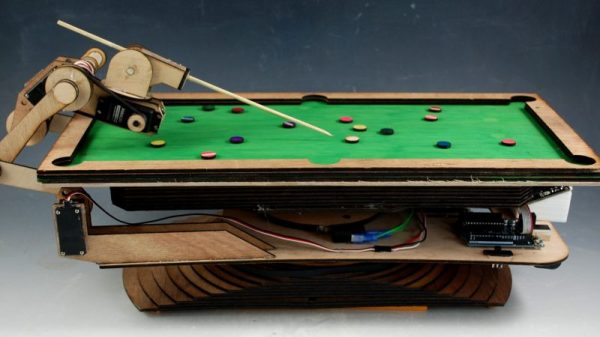
Any pool player will tell you there’s much, much more to the game in real life, but still, a robot to play pool against would be a neat trick. As a move toward that goal, [BVarv] wisely decided on a miniature mockup of a pool-playing robot, and in the process reinvented the pool table itself. Realizing that a tracked or wheeled robot would have a tough time maneuvering around the base of a traditional pool table, his model pool table is a legless design that looks like something from IKEA. But the pedestal support allows the robot to be attached to the table and swing around in a full circle, and this allowed him to work through the kinematics as shown in the charming stop-action video below.

[BVarv] has gotten as far as motion control on the swing axis, as well as on the arms that will eventually hold the cue. He plans overhead image analysis for identifying shots, and of course there’s the whole making it full-size thing to do. We’d love to play a game or two against a bot, so we hope he gets there. In the meantime, how about a little robo-air hockey?

Continue reading “Pool Playing Robot Destined For Trouble In River City”

Precision Pressure In A Piston

[Scott] is building a DIY yeast reactor for his aquarium. What’s a yeast reactor? [Scott] wants to pump carbon dioxide into his aquarium so his aquatic plants grow more. He’s doing this with a gallon of sugary, yeasty water bubbling into a tank of plants and fish. In other words, [Scott] is doing this whole thing completely backward and utilizing the wrong waste product of the yeast metabolism.

However, along the way to pumping carbon dioxide into his aquarium, [Scott] created a very high precision pressure sensor. It’s based on a breakout board featuring the MS5611 air pressure sensor. This has a 24-bit ADC on board, which translates into one ten-thousandths of a pound per square inch of pressure.

To integrate this pressure sensor into the aquarium/unbrewery setup, [Scott] created a pressure meter out of a syringe. With the plunger end of this syringe encased in epoxy and the pointy end still able to accept needles, [Scott] is able to easily plug this sensor into his yeast reactor. The data from the sensor is accessible over I2C, and a simple circuit with an ATmega328 and a character LCD displays the current pressure in the syringe.

We’ve seen these high-resolution pressure sensors used in drones and rockets as altimeters before, but never as a pressure gauge. This, though, is a cheap and novel solution for measuring pressures between a vacuum and a bit over one atmosphere.

Continue reading “Precision Pressure In A Piston”