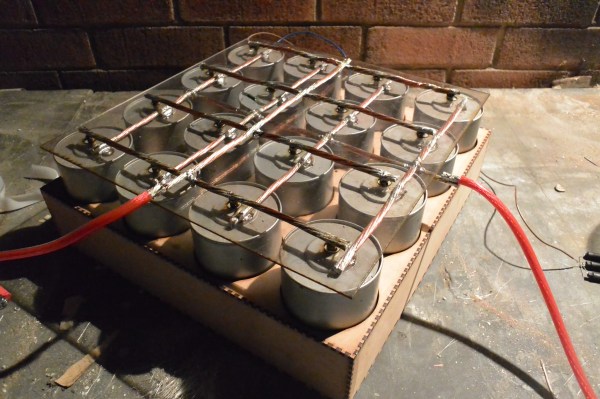
What happens when you wire up 16 capacitors? Sixteen 2500V 40uF capacitors to be precise… [Lemming] calls it the Box ‘O Bangs. Theoretically it outputs 4000A at 2500V for a split second.
They bought the capacitors off of eBay, and they appear to be good quality BOSCH ones, straight from Germany. They were apparently used for large-scale industrial photo-flashes, but who knows since they’re from eBay.
Soldering it all together proved to be a challenge, as once they realized just how many amps this thing was going to put out, they needed some thick wire. It looks like about 2ga wire, which, spoiler alert, still isn’t enough for 4000A — but since it’s only for a split second it seems to do fine.
Once everything was built, it was time for some scientific tests — what can we put between the leads to explode? Stay tuned for some slow-motion glory.
Okay, now we’ve seen it all. Someone put the effort in to port Flappy Bird… to run on an e-cigarette. An eVic-VTC Mini to be precise. So now, between puffs, you can play one of the most frustrating games ever.
The SDK for the e-cig is available on GitHub, which was provided by a group of Redditors last year. If you’re interested in the game, and happen to have this model of e-cig, [Bank] has provided download and flashing instructions in the description of the YouTube video.
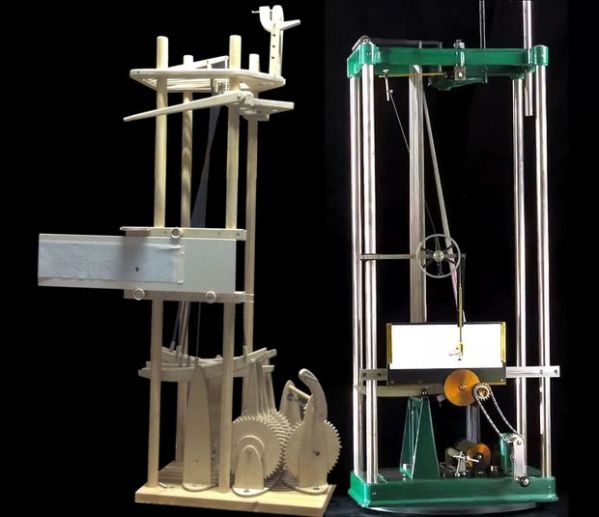
It’s funny how creation and understanding interact. Sometimes the urge to create something comes from a new-found deep understanding of a concept, and sometimes the act of creation leads to that understanding. And sometimes creation and understanding are linked together in such a way as to lead in an entirely new direction, which is the story behind this plywood recreation of the Michelson Fourier analysis machine.
For those not familiar with this piece of computing history, it’s worth watching the videos in our article covering [Bill “The Engineer Guy” Hammack]’s discussion of this amazing early 20th-century analog computer. Those videos were shown to [nopvelthuizen] in a math class he took at the outset of degree work in physics education. The beauty of the sinusoids being created by the cam-operated rocker arms and summed to display the output waveforms captured his imagination and lead to an eight-channel copy of the 20-channel original.
Working with plywood and a CNC router, [nopvelthuizen]’s creation is faithful to the original if a bit limited by the smaller number of sinusoids that can be summed. A laser cutter or 3D printer would have allowed for a longer gear train, but we think the replica is great the way it is. What’s more, the real winners are [nopvelthuizen]’s eventual physics students, who will probably look with some awe at their teacher’s skills and enthusiasm.
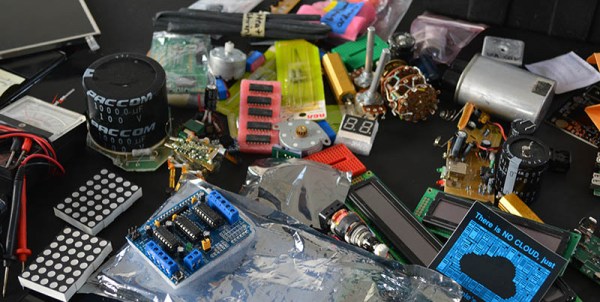
Imagine if the Snap-on tool truck wasn’t filled with hand tools. Imagine if that Snap-on truck was a mobile electronics surplus shop. That’s the idea behind the Travelling Hacker Box. It’s a box, shipped from hacker to hacker, filled with weird and esoteric components, enough parts to build a 3D printer, and enough capacitors to stop an elephant’s heart.
If this is the first time you’ve heard about the Travelling Hacker Box, here’s the quick FAQ to get you up to speed. Has this been done before? Yes, yes it has. The Great Internet Migratory Box of Electronics Junk was a ‘thing’ done by Evil Mad Scientist back in the ‘aughts. Hackaday (or rather the old commander in chief Eliot) received one of these boxes, and sent it off to [Bre Pettis]. Keep in mind, this was in 2008. Is there more than one Travelling Hacker Box actively travelling? No. Because I don’t want to organize a second. Either way, the Travelling Hacker Box has two goals: distance travelled and number of people visited. With just one box, we can maximize both objectives. What are the current travel plans? That’s the next paragraph.
The travels of the Travelling Hacker Box Mk. 2
As of right now, the second version of the Travelling Hacker Box – the first box was stolen by some waste of oxygen in Georgia – has travelled at least 21,838 miles around the United States, visiting 11 prolific hackaday.io contributors in Wyoming, New York, Alaska, Hawaii, New Hampshire, Florida, Wisconsin, Maine, and California. The goal for the first dozen or so trips across the United States was to put miles on the box. 25,000 miles would be equivalent to a trip around the world using only US Postal Service flat rate boxes. Thanks to [Lloyd T Cannon]’s reinforcement of a medium flat rate box with canvas, foam, Kevlar, and custard, this iteration of the Travelling Hacker Box has held up spectacularly.
The goal for the next two months is to make a trip around the United States to maximize the number of US hackers who contributed to the box. This trip will start in Pasadena, CA, go up the west coast to Seattle, loop around the Canadian border to New England, go down the Eastern seaboard, across to Texas, over the desert, and land back at Home Base in Pasadena. From there, the Travelling Hacker Box is off to England, the EU, Asia, India, maybe Africa, and Australia.
While there are already a few people scheduled for this last trip around the US, more are needed. If you’re interested, check out the project on hackaday.io, request to join the project, send a message on the team chat, and generally bug me on the hackaday.io chat. There are plenty of spaces to fill in this last trip around the US and the current inventory is quite a haul. Not bad for a project that will eventually be stolen.
What’s more seductive than a claw machine? After all, how hard can it be to snag that $2 teddy bear that is practically poking out of the pile of merchandise? But after 20 quarters, you realize you’ve spent $5, and you still don’t have anything to show for it.
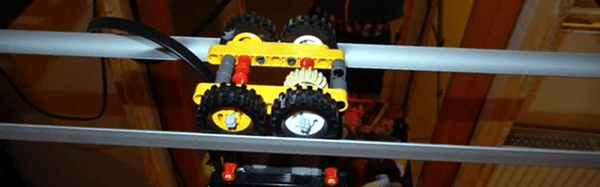
[CreativeGuy88] decided to build his own claw machine (that way, he gets to keep the quarters). This sizable build is as much woodworking project as anything. However, the motors and control joysticks require electrical wiring and [CreativeGuy88] used Lego bricks to make much of the carriage.
Think you made a cool tree-house for your kids? Sorry to burst your bubble, but we don’t think anything can top this full-size 1:1 replica of a Star Wars AT-ST — complete with sound effects and moving turrets! Did we mention it seats two?
Built in his backyard, this AT-ST is constructed of wood, plastic, and sheet metal. On the inside it is decked out with joysticks, display panels, and other knobs and buttons for your imagination to go wild with. It even features solar panels on the roof to power two ventilation fans to keep you cool while daydreaming of blowing up Rebel scum on Hoth.
Stay tuned after the break to see a video of it in action.
[REDNIC79] lives somewhere in Canada where key terrain features include mud and snow. Half pontoon boat, half auger, screw-propelled vehicles excel in this kind of terrain as long as you’re okay with going really slow.
In his 11-and-counting part video series, [REDNIC79] goes through the conversion of a lawn tractor into a slow, theoretically unstoppable, Canadian screw-propelled tractor. He welds a frame, plonks some beefy chains on it, and throws a few hefty looking bearing mounts on there to boot. Then he makes some screws out of gas tanks; which was an enormous amount of work.
It was time to fire up the tractor. On the first muddy incline encountered, the tractor ceased to move. The culprit? A cracked transmission housing. Ouch. The end of the shaft holding the chain for the right screw was unsupported. When the shaft turned, it imparted its rotational force, but there was also an unconsidered down force on the end of the shaft, which resulted in a moment the bell housing wasn’t designed for.
Undeterred, [REDNIC79] welded the housing back together and threw a bearing on the end of the offending shaft to balance the moments. He fired it up, engaged the transmission, and the right screw bearing pillow block completely shattered. Ouch again. We can safely begin to assume that screw-propelled vehicles see a lot of forces.
[REDNIC79] hasn’t shelved the project yet. His next plan is to beef up the supports and build a much larger set of screws with smaller blades out of some propane tanks. This should reduce the force the power house needs to put out. Video of the first fail after the break. Continue reading “Screw Drive Tractor Hasn’t Conquered Canada Yet”→