Building Triodes With Blinker Fluid

The triode is one of the simplest kinds of vacuum tubes. Inside its evacuated glass envelope, the triode really is just a few bits of wire and metal. Triodes are able to amplify signals simply by heating a cathode, and modulating the flow of electrons to the anode with a control grid. Triodes, and their semiconductor cousin the transistor, are the basis of everything we do with electricity.

Because triodes are so fantastically simple, they’re the parts most commonly crafted by the homebrew tube artisans of today. You don’t need a glass blowing lathe to make the most basic vacuum tube, though: [Marcel] built one from the light bulb used in a car’s tail light.

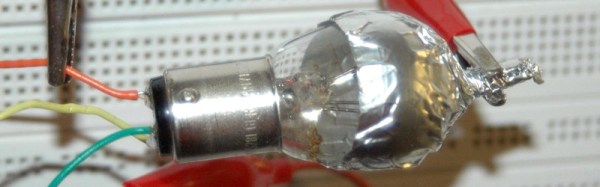
The light bulb in your car’s tail light has two filaments inside: one for the normal tail light, and a second one that comes on when you brake. By burning out the dimmer filament, [Marcel] created the simplest vacuum tube device possible. In his first experiment, he turned this broken light bulb into a diode by using the disconnected filament as the anode, and the burning filament as the cathode. [Marcel] attached a 1M resistor and measured 30mV across it. It was a diode, with 30μA flowing.

The triode is just a diode with a grid, but [Marcel] couldn’t open up the light bulb to install a piece of metal. Instead, he wrapped the bulb in aluminum foil. After many attempts, [Marcel] eventually got some amplification out of his light bulb triode.

The performance is terrible – this light bulb triode actually has an “amplification” of -108dB, making it a complete waste of energy and time. It does demonstrate the concept though, even though the grid isn’t between the anode and cathode, and this light bulb is probably filled with argon. It does work in the most perverse sense of the word,  and makes for a very interesting build.

Video Gives You The Basics Of DIY Rotary Encoders

Is it really possible to build a rotary encoder out of a flattened tin can and a couple of photodetectors? Sure it’s possible, but what kind of resolution are you going to get from such a contraption? Is there any way that you’d be able to put them to work in a DIY project like a CNC router? If you pay attention to the basics then the answer is yes, and [HomoFaciens] wants to prove that to you with this detailed video on homebrew encoder design.

Faithful Hackaday readers will no doubt recognize [HomoFaciens] from a number of prior appearances on these pages, including this recent hardware store CNC router build. When we first ran across his builds, we admit a snicker or two was had at the homemade encoders, but if you watch the results he manages to get out of his builds, you quickly realize how much you can accomplish with very little. The video is a primer on encoder design, walking you through the basics of sensing rotation with phototransistors, and how a pair of detectors is needed to determine the direction of rotation. He also discusses the relative merits of the number of teeth in the chopper; turns out more isn’t necessarily better. And in the end he manages to turn a car wiper motor into a high-torque servo, which could be a handy trick to have filed away.

Continue reading “Video Gives You The Basics Of DIY Rotary Encoders”

“Reverse engineering” a real candle

Reverse Engineering A Real Candle

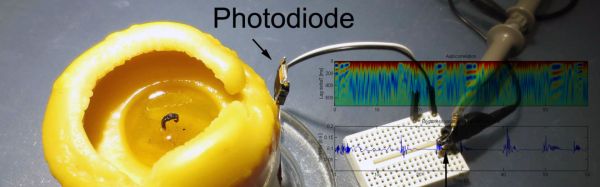
[cpldcpu] just can’t leave the mysteries of candles alone. We’ve covered his explorations of candle flicker LEDs before, but this time he’s set his sensors on the real thing. [cpldcpu] hooked a photodiode to his oscilloscope, pointed it at a candle flame, and recorded the result.

The first interesting observation was the candle slowly changed brightness, whether it was interacted with or not. Next he measured the effect when the flame was disturbed by small gusts of air. This produced a bright flicker with an oscillation at 5Hz before returning to steady state, which as [stygiansonic] mentioned in a the Hacker News comment, is a known phenomenon used in flame detectors. Neat! There’s even an equation:

Under normal gravity conditions, the flames have a well defined oscillation frequency which is inversely proportional to the square root of the burner diameter, D, and to a good approximation can be written as f » 1.5/D½, with D given in meters.

[cpldcpu] then compiled his measurements into a series of graphs and ultimately an animated gif comparing the candle steady state, a real candle’s flicker, and the flicker he recorded from a candle flickr LED. It’s surprising how different the fake is from the real thing. You can look at his measurements and code at his github.

[via Hacker News]

The Most Plausible Apollo Moon Landing Conspiracy Ever Devised

The Internet is polluted with craziness, and there is no better example than YouTube. If you’ve ever wondered what would happen when you give everyone on the planet the power to show everyone else on the planet their innermost thoughts, desires, and insane ramblings, you need only look at YouTube.

One of the biggest offenders of incoherent ramblings is the subject of spaceflight. Simply search ‘space shuttle’ on YouTube, and you’ll find accusations of the crew of Columbia being abducted by aliens. Crazy, incoherent, and somewhat insulting. Accusations of a moon landing conspiracy are unavoidable in the ‘related videos’ section and are similarly filled with videos from people with either a tenuous grasp of reality or too much time on their hands.

A broken clock is right twice a day, a broken calendar is right every twenty-eight years or so, and every once in a while, simply from the volume of videos on the subject, one conspiracy theorist will present a new and novel idea. Here we present perhaps the only moon landing conspiracy theory that makes sense, is consistent with physical laws, and that may actually be true.

Continue reading “The Most Plausible Apollo Moon Landing Conspiracy Ever Devised”

Hack Your Brain: The McCollough Effect

There is a fascinating brain reaction known as the McCollough Effect which is like side-loading malicious code through your eyeballs. Although this looks and smells like an optical illusion, the science would argue otherwise. What Celeste McCollough observed in 1965 can be described as a contingent aftereffect although we refer to this as “The McCollough Effect” due to McCollough being the first to recognize this phenomena. It’s something that can’t be unseen… sometimes affecting your vision for months!

I am not suggesting that you experience the McCollough Effect yourself. We’ll look at the phenomena of the McCollough Effect, and it can be understood without subjecting yourself to it. If you must experience the McCollough Effect you do so at your own risk (here it is presented as a video). But read on to understand what is happening before you take the plunge.

Continue reading “Hack Your Brain: The McCollough Effect”

Your Fingers Will Never Leave Your Hands With This Firecracker Launcher

Who doesn’t like to ring in the New Year with explosives? But speaking from personal experience – I can neither confirm not deny nearly blowing my hand off once with a small dry-ice grenade – a hands-off way to launch your fireworks can be a plus, in which case you might want to check out this automatic firecracker launcher.

[Valentin]’s build has all the earmarks of an inspired afternoon of hasty hacking. Mostly built of wood and hot glue, there’s a feed ramp for fresh ammo and an elastic-powered sled on a ramp. Fireworks are metered onto the sled with one turn of a small gear motor, the fuse is light by a butane torch, and another gear motor pulls the sled back and launches the firecracker. The launch is somewhat anemic – perhaps some stouter rubber bands or latex tubing would provide a little more oomph. But it’s still a fun build with plenty of potential for improvement – perhaps something along the lines of this automated beer catapult?
Continue reading “Your Fingers Will Never Leave Your Hands With This Firecracker Launcher”

This Project Will Be Stolen Again

The Travelling Hacker Box is the physical implementation of the hackaday.io community. While most of what happens on hackaday.io happens online, sometimes the activities leak out to the real world. One such activity is a box, filled with random electronics stuff, shipped around to different members of the hackaday.io community.

hackerboxIt’s a great idea in theory. In practice, people are bastards. The first Travelling Hacker Box was stolen by a member of the hackaday.io community. After travelling 14,167 miles through Philadelphia, San Francisco, Boston, Seattle, New York, Boston again, and the middle of Texas, the first travelling Hacker Box met its fate along the Georgia border, two hours outside of Atlanta. Who is responsible? We’re not going to talk about him. He knows who he is and what he did.

All is not lost, even though hundreds of dollars in electronic doo dads are. There’s a new Travelling Hacker Box already on its way around the US. It’s slowly being filled up with goodies, and has already visited Wyoming and upstate New York, and is currently somewhere around Anchorage, AK. The latest update shows this box is filled with goodies including a mini CRT assembly from an old camcorder, stepper motor drivers, and other weird electronics paraphernalia.

The travels of the current Travelling Hacker Box

The current plan for the Travelling Hacker Box is the same as the old box: put 25,000 miles on the odometer while taking advantage of the economics of a USPS flat-rate box. From there, it will go further afield, travelling the circumference of the Earth a second time, hitting stops in Europe, Africa, Asia, India, Australia, and South America. If you’re a subcontractor for Raytheon, part of the NY Air National Guard, or are otherwise able to receive mail in Antarctica, you are encouraged to email me.

Feel like you’re up for adding a few hundred miles to the Travelling Hacker Box? There’s no set process to get on the list; destinations are chosen by distance from the current node, trustworthiness, and distance to the next node, if planned. The best way to get on the list is to click the ‘Request to join this project’ link on the Travelling Hacker Box project. Then, hang out in the Hacker Box chatroom, and you might have a chance at receiving a magical box of random electronics.