[Igor b] plays in a band and wanted a way to use a foot pedal to trigger samples. Since he had a STM32F429 evaluation board handy, he decided to build the Stmpler using the board, a touch screen, an SD card, and not much else.
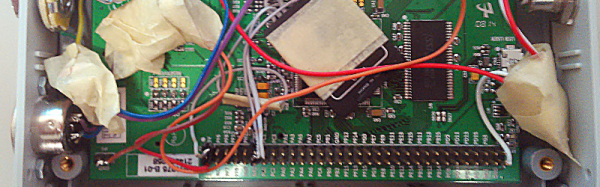
[Igor b] plays in a band and wanted a way to use a foot pedal to trigger samples. Since he had a STM32F429 evaluation board handy, he decided to build the Stmpler using the board, a touch screen, an SD card, and not much else.
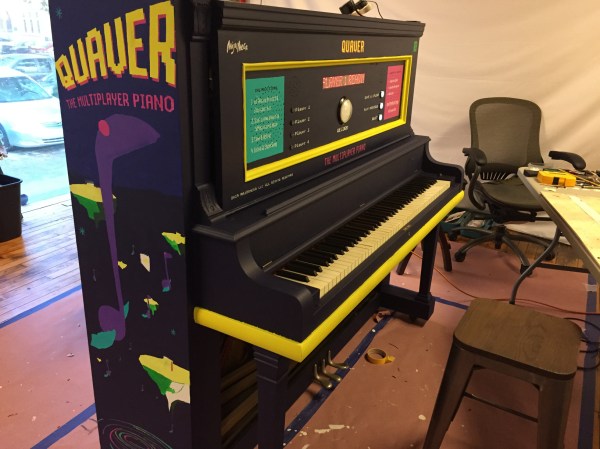
We don’t really get out much, but we have noticed that there are brightly painted upright pianos in public places these days. Research indicates that these pianos are being placed by small, independent local organizations, most of which aim to spread the joy of music and encourage a sense of community.
[Sean and Mike] took this idea a couple of steps further with Quaver, their analog looping piano. Both of them are maker/musicians based in Lancaster, Pennsylvania, which happens to be a hot spot for public pianos. [Sean and Mike] often stop to play them and wanted a good way to capture their impromptu masterpieces. Quaver is an antique upright that has been modified to record, save, loop, and upload music to the internet. It does all of this through a simple and intuitive user interface and a Raspi 2. Quaver works a lot like a 4-track recorder, so up to four people can potentially contribute to a song.
The player sits down, cracks their knuckles, and presses our personal favorite part of the interface: the giant, irresistible record button. A friendly scrolling LED matrix display tells them to start playing. Once they are satisfied, they press the button again to stop the recording, and the notes they played immediately play back in a loop through a pair of salvaged Bose speakers from the 1980s. This is just the beginning of the fun as you play along with your looping recording, building up several voices worth of song!
Continue reading “It’s An Upright Piano, It’s A Looper, It’s A Pi Project”
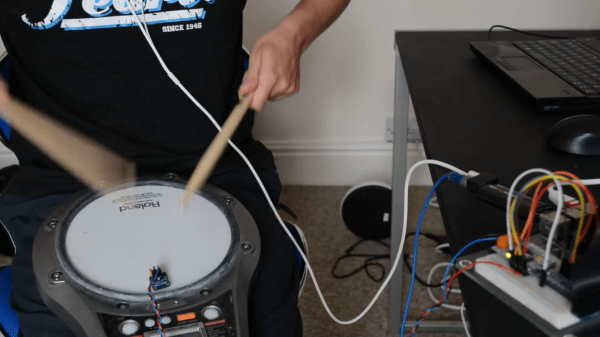
Piezoelectric sensors are great for monitoring mechanical impacts with a microcontroller. Whether you’re monitoring knocks on a door or watching a heartbeat, they are a cheap way to get the job done. They do have their downsides, though, so when [Jeremy] wanted to build an electronic drum set, he decided to use more expensive accelerometers to measure the percussive impacts instead.
Even though piezo sensors are cheap, they require a lot of work to get them working properly. The ADXL377 3-axis accelerometer that [Jeremy] found requires much less work, plus provides more reliable data due to a 1kHz low-pass filter at the output. In his setup, a Raspberry Pi handles all of the heavy lifting. An ADC on each drum sends data about each impact of the drum, and the Raspberry Pi outputs sound via the native Alsa driver and a USB sound card.
This project goes a long way to show how much simpler a project like this is once you find the right hardware for the job. [Jeremy]’s new electronic drums are very well documented as well if you are curious about using accelerometers on your newest project rather than piezo sensors. And, if you’re into drums be sure to see how you can have drums anywhere, or how you can build your own logic drums.
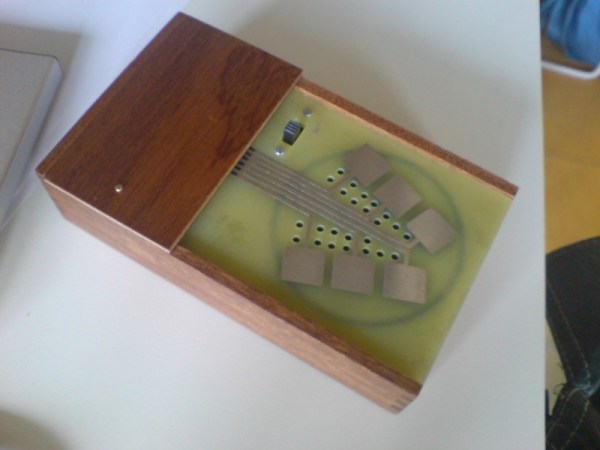
A friend from the newly founded Yeovil Hackerspace introduced me to a device known as “The Kraakdoos” or cracklebox.
The cracklebox is an early electronic instrument produced by STEIM in the 1970s. The instrument consists of a single PCB with a number of copper pads exposed on one side. The player touches the pads and the instrument emits… sounds which can perhaps best be described as squeeze and squeals.
While the cracklebox was original sold as a complete instrument, the device has been reverse engineered, and the schematic documented. What lies inside is quite fascinating.
The heart of the cracklebox is an ancient opamp, the LM709. The LM709 is the predecessor to the famous LM741. Unlike the 741 the 709 had no internal frequency compensation. Frequency compensation is used to intentionally limit the bandwidth of an opamp. As input frequency increases, the phase shift of the opamp also increases. This can result in undesirable oscillation, as the feedback network forms an unintentional phase-shift oscillator.
Most modern opamps have internal frequency compensation, but the 709 doesn’t. Let’s see how this is used in the cracklebox:
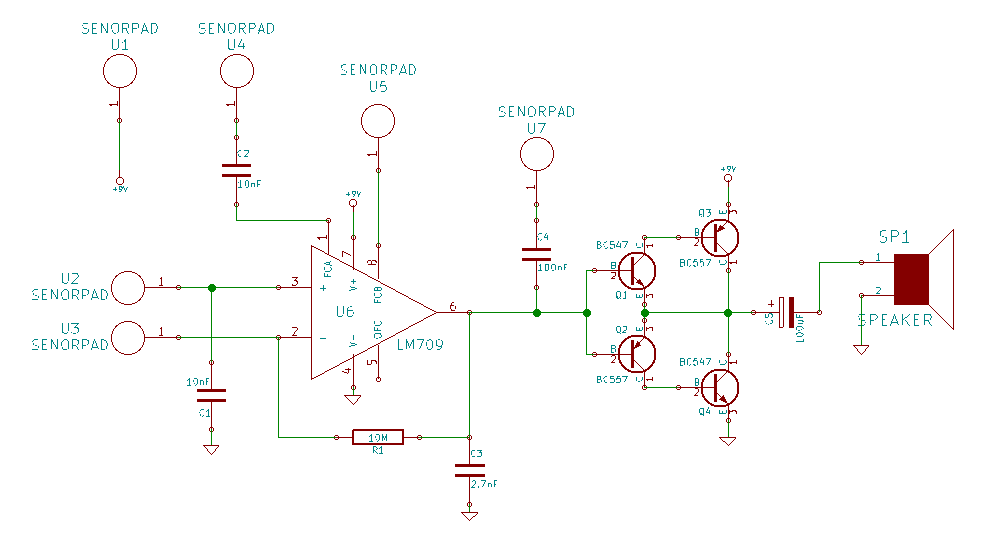 Rather than using the frequency compensation pins as intended the cracklebox just routes them out to pads. In fact the cracklebox routes almost all the pins on the opamp out to pads, including the inverting and non-inverting inputs. A single 1MOhm feedback resistor is used in a non-inverting configuration. However reports suggest the instrument can work without a feedback resistor at all!
Continue reading “The Kraakdoos — Musical Abuser Of An Ancient OpAmp”
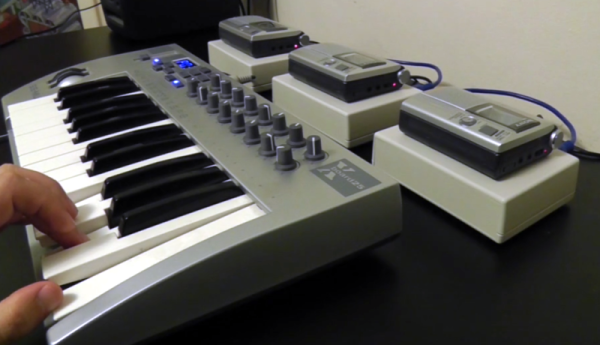
Ever heard of the Mellotron? It was a British made audio sampler that used the most cutting edge technology available back in 1963… Magnetic tapes. You could record different sounds, music, beats or rhythm onto these magnetic tapes, and then play it back with the keyboard, much like a MIDI Sampler keyboard today. Well, someone has gone and made a newer version of one.
He calls it the Crudman, and it’s the same concept of a Mellotron, but uses slightly more modern components. Specifically, audio cassettes.
A MIDI keyboard sends output commands to a series of cassette players outfitted with Teensy microcontrollers. Depending on the settings, pressing a key can speed up or slow down a tape in order to generate a note. If it sounds simple, trust us, it’s not. The project has been a labor-of-love for the unnamed creator, who has spent nearly 10 years designing it. He now sells them (but demand is pretty high) — you’ve gotta take a listen — they produce some of the most unique sounds we’ve ever heard.
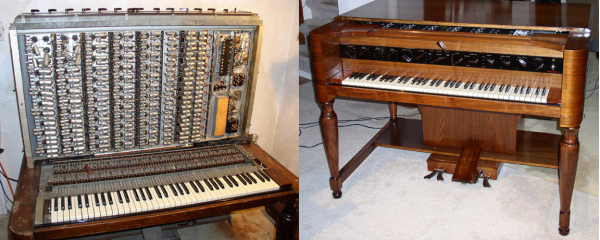
Just when we thought we’d heard of all the cool early synthesizers, a tipster rattled our jar with news that someone completely restored a Novachord. These spinet piano-shaped prototypical synthesizers were made by Hammond for only four years. About a thousand of them were built before sales sagged and parts became scarce in 1942. It is estimated that only 200 or so are still around today.
The Novachord’s sounds are generated by a bank of twelve monostable vacuum tube oscillators. Each one is tuned to a pitch of the chromatic scale in what is called divide-down architecture. [Hammond] and his co-creators [John Hanert] and [C.N. Williams] used the property of dividing a frequency in half to generate the same tone, but one octave lower. This design means that all 72 notes can be played at the same time. Adjustable formant filters shape the often otherworldly sounds, which are then passed through flexible tube-based envelopes.
[Phil] knew it would be a big job to restore a Novachord in any condition. Thousands of passive components all had to be replaced. The cabinet bore all the hallmarks of a well-used parlor instrument—water rings from cocktails, scratches, and cigarette burns galore. [Phil] says that woodworking really isn’t his thing, but he did an outstanding job nonetheless of sanding every nook and cranny and applying several coats of stain. There are tons of drool-inducing pictures on his project site, and several clips of [Phil] really putting it through its paces.
Thanks for the tip, [Mike]!
Retrotechtacular is a weekly column featuring hacks, technology, and kitsch from ages of yore. Help keep it fresh by sending in your ideas for future installments.
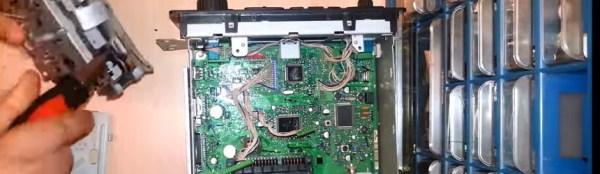
When you have an older vehicle there’s not a lot of options in the stock stereo department, often a CD player and tape deck is what you get. When you want to play your tunes from your mobile what do you do? Buying an adapter, or a new head unit for that matter, isn’t any fun. So why not hack it? This isn’t just a mechanical marriage of a Bluetooth dongle and an elderly stereo. Some real work went into convincing the stereo that the BT receiver was the stock tape deck.
 Attacking the outdated Cassette deck [kolonelkadat] knew that inside the maze of gears and leavers, most of it is moving around actuating switches to let the radio know that there is a tape inside and that it can switch to that input and play. Tricking the radio into thinking there is a tape inserted is handled by an Arduino. Using a logic analyzer [kolonelkadat] figured out what logic signals the original unit put out and replicating that in his Arduino code.
Audio is handled by the guts of a bluetooth speaker with the output redirected into the radio where the signal coming off the tape head normally would have been directed. Join us after the break for a couple of videos with all of the details.
Continue reading “Tricking A Car Stereo To Think Your Cellphone Is A Tapedeck”