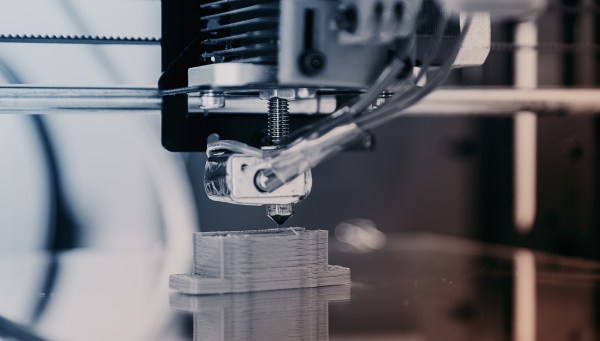
Can you create 3D printed designs and distribute them freely and without restriction? Maybe, and it’s likely to become easier in the future. A settlement has been reached in the saga of the US Department of State versus Cody Wilson, and beginning August 1st the Defense Distributed library of gun designs will once again become available.
Cody is well known for creating the first 3D printed gun. He went on to found Defense Distributed, a company that published designs and technical files for 3D printing firearms before being pulled into litigation that sought to curb the distribution of such plans by subjecting them to International Traffic in Arms Regulations (ITAR) restrictions. Read that carefully, it’s the (international) distribution of CAD files at question here, and not the act of 3D printing, and Defense Distributed has been granted an ITAR exemption. Will other arms-related design files be similarly exempted? The settlement mentions upcoming rule changes seeking to make this type of exemption the standard.
As members of the Hackaday community, we’re the people to whom our friends and family turn for perspective when new technology makes it into their news feeds. Those with little or no exposure to 3D printing may easily fall to doom and gloom reports. But is this a story of doom and gloom? Absolutely not, guns are still guns and 3D printers are still 3D printers. Let’s take a look.
When word first broke that Elon Musk was designing a kid-sized submarine to help rescue the children stuck in Thailand’s Tham Luang cave, it seemed like a logical thing for Hackaday to cover. An eccentric builder of rockets and rocket-launched electric sports cars, pushing his engineering teams and not inconsiderable financial resources into action to save children? All of that talk about Elon being a real life Tony Stark was about to turn from meme into reality; if the gambit paid off, the world might have it’s first true superhero.
With human lives in the balance, and success of the rescue attempt far from assured (regardless of Elon’s involvement), we didn’t feel like playing arm-chair engineer at the time. Everyone here at Hackaday is thankful that due to the heroics of the rescuers, including one who paid the ultimate price, all thirteen lives were saved.
Many said it couldn’t be done, others said even saving half of the children would have been a miracle. But Elon’s submarine, designed and built at a breakneck pace and brought to Thailand while some of the children were still awaiting rescue, laid unused. It wasn’t Elon’s advanced technology that made the rescue possible, it was the tenacity of the human spirit.
Now, with the rescue complete and the children well on their way to returning to their families, one is left wondering about Elon’s submarine. Could it have worked?
Unless you live in a cave, you’ve probably heard a little about the thirteen people — mostly children — trapped in the Tham Luang Nang Non cave in Thailand. What you may have missed, though, is the hacker/ham radio connection. The British Cave Rescue Council (BCRC) was asked for their expert help. [Rick Stanton], [John Volanthen] and [Rob Harper] answered the call. They were equipped with HeyPhones. The HeyPhone is a 17-year-old design from [John Hey, G3TDZ]. Sadly, [G3TDZ] is now a silent key (ham radio parlance for deceased) so he didn’t get to see his design play a role in this high-profile rescue, although it has apparently been a part of many others in the past.
The HeyPhone is actually considered obsolete but is still in service with some teams. The radio uses USB (upper sideband, not universal serial bus) at 87 kHz. The low frequency can penetrate deep into the ground using either induction loop antennas like the older Molephone, or — more commonly — with electrodes injecting RF energy directly into the ground.
If you’ve followed any of our coverage of quantum computing, you probably know that the biggest challenge is getting quantum states to last very long, especially when moving them around. Researchers at Princeton may have solved this problem as they demonstrate storing qubits in a lab-created diamond. The actual publication is behind a paywall if you want to learn even more.
Generally, qubits are handled as photons and moved in optical fibers. However, they don’t last long in that state and it is difficult to store photons with correct quantum information. The impurities in diamonds though may have the ability to transfer a photon to an electron and back.
Congratulations and thank you go to Theodore Yapo for authoring the first paper to complete the peer review process for the Hackaday Journal. You can read the standalone paper here; it will be included in the first volume of the Hackaday Journal officially released later this year.
The Hackaday Journal is an open access, peer reviewed journal that seeks to ensure hard-won domain knowledge is preserved and made available for the benefit of all. Before jumping into Ted’s topic, please take a moment to consider submitting your own paper for the journal.
Paper Submissions Wanted
We have other submissions in the pipleline now but we still need more papers to round out the first volume of the Hackaday Journal. Please consider authoring a paper on any creative research, engineering, or entertaining discovery in the areas of interest to the Hackaday community. The full name of our journal is the Hackaday Journal of What You Don’t Know — it will be a tome of infinite appeal to any who seek to broaden their minds in the engineering space. But for that to happen we need you to share your knowledge.
We are in an age of unparalleled opportunity for individuals and small teams to make interesting discovery. You should not need to be working on a degree to have your findings published, but of course students and faculty are encouraged to submit their papers. Do not hesitate to get in touch with us about topics you want to write about.
Scalar Network Analyzer Leakage Correction by Theodore Yapo
Low-pass filter being tested by a Rigol DSA-815 using the phase shifting correction technique
The title of Ted’s paper is a mouthful and the subject material wades into radio frequency knowledge with gusto. We applaud him, and the peer reviewers, for the attention to detail while moving toward publication.
In his work, Ted finds an interesting opportunity to get more performance out of relatively inexpensive bench equipment used to characterize RF components. This task is often reserved for Vector Network Analyzers (VNA) but with a heafty price tag these tools aren’t available to everyone. Spectrum Analyzers with Tracking Generators (SA/TG) have come onto the market, but especially with early versions, there is a leakage problem that causes inaccuracy. Ted found a simple technique that can correct for the leakage.
The solution is based on phase shifting the measurement. Starting with a properly calibrated machine, Ted uses a small board he built to electronically shift the phase of the Tracking Generator where the leakage is a problem. The signal is first measured, then measured again with a phase shift of 180 degrees. This effectively cancels out the error while preserving the signal being measured.
This paper goes into great technical detail in the RF domain. It is worth noting that the Hackaday Journal is open to discovery on multiple topics and levels of complexity. Don’t let what you think is a simple, useful idea go unpublished. We’re interested in a wide range of the simple, the obscure, and the frighteningly technical as long as the ideas of both novel and well supported.
This is Your Journal
You, yes you reading this right now, embody a movement of inventive and curious people working both inside and outside of formal academic structures. This is our time to contribute to the knowledge base of humanity. Pour yourself a refreshing beverage, saddle up your headphones, crack those knuckles, and let the writing process begin. Let us now what we don’t know. Submit your paper now.
Summer is here, and it’s time for the question on everyone’s mind: how are they going to get the fuselage of a 747 from the California desert to Burning Man? You can’t put it on a train, and it’s much wider than any truck.
Our guest for this Hack Chat will be [Kevin Bracken], best known as the founder of International Pillow Fight Day, but now he’s the project lead fo Heavy Meta, Canada’s largest art car and fire-breathing dragon sculpture/stage. Heavy Meta is a 30-foot long mutant vehicle with flame effects and a 15,000 watt sound system. It’s also the 3tress, a 2,000 square foot workshop founded with the purpose of building this gigantic art car, and it’s the Toronto Art Car Community, a group of people tasked with manufacturing gigantic lumbering behemoths.
Kevin will be discussing how the Heavy Meta crew transformed a GMC school bus into a dragon, how the team learned to build flame effects, how the pneumatics work, and what it’s like to be on tour with half a dozen Maker Faires.
During this Hack Chat, we’ll be talking about:
What an art car is
How do you make the electronics
What precautions do you take to keep it working on the road
How do you control flame effects
What are the legal and regulatory considerations of art cars
You are, of course, encouraged to add your own questions to the discussion. You can do that by leaving a comment on the Hack Chat Event Page and we’ll put that in the queue for the Hack Chat discussion.
Mere weeks ago, the United States announced it was set to impose a 25% tariff on over 800 categories of Chinese goods. These tariffs include nearly every component that goes into the manufacture of any piece of electronic hardware, from resistors to capacitors, semiconductors to microcontrollers, and even the raw components that are turned into printed circuit boards. These tariffs will increase the cost of materials for electronics, even if those electronics are ultimately manufactured in the United States because suppliers and subcontractors must source their materials from somewhere, and more often than not, that place is China.
In the world of musical synthesizers, there is no bigger name than Moog. The company was founded in the 1950s manufacturing theremins, and in the 1960s, production moved to synthesizers. The famous Minimoog, launched in 1970, has been featured on tens of thousands of albums. Modern music simply wouldn’t exist without Moog synthesizers. After a buyout, mismanagement, and bankruptcy in the 1980s, the company was reborn in the early 2000s, moved into a beautiful factory in Asheville, North Carolina, and has gone on to produce some of the most popular synthesizers ever made.
The company’s statement says these new tariffs will, ‘immediately and drastically increase the cost of building our instruments, and have the very real potential of forcing us to lay off workers and could.. require us to move some, if not all, of our manufacturing overseas’. In a statement on Twitter, Moog says they source half their PCBs and a majority of other materials domestically, already paying up to 30% more than if the PCBs were sourced from China. However, because the raw materials for PCB manufacture are also sourced from China, board manufacturers for Moog’s synths will be forced to pass along the 25% tariff to their customers.
The threat of Moog being forced to move production of their instruments to China is real. Like cell phones, laptops, and other finished goods, synthesizers are not covered by the new tariff. As noted by Bunnie Huang, these tariffs have the perverse incentive of shifting US manufacturing jobs to China.
These tariffs have been a point of contention for the electronics and engineering communities. Anyone can easily pull up the distributor information from a Mouser or Digikey order and find the country of origin for an entire Bill of Materials. It has already been confirmed that most of the FR4 and other raw components that go into manufacturing PCBs in the United States come from Chinese suppliers. These items can be cross-referenced with the list of items that will be subject to a 25% tariff next week. Manufacturing electronics in the United States, even if you get your PCBs from US manufacturers and parts from US suppliers, will cost more in just a few short days.