Bluetooth PS3 Controllers Modernize The Nintendo GameCube

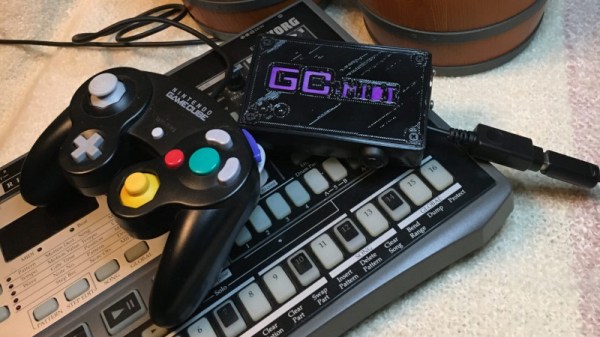
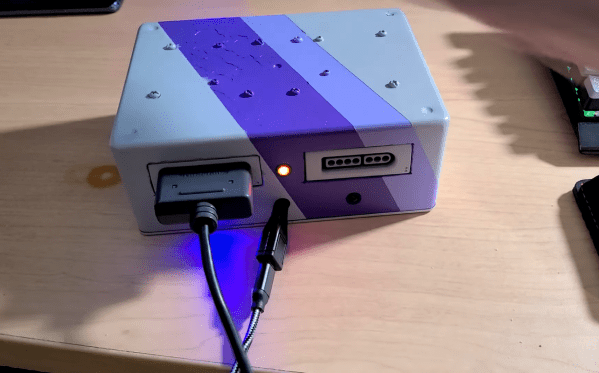
While the PlayStation 3 and Gamecube come from opposing sides of the aisle, and in fact aren’t even from the same generation of hardware, this DIY adapter built by [Jeannot] allows Nintendo’s console to use Sony’s Bluetooth controllers with surprisingly little fuss. This might seem unnecessary given the fact that Nintendo put out an official wireless controller for the system, but given how expensive they are on the second-hand market, you’d need to have pretty deep pockets for an untethered four-player session. Plus, there’s plenty of people who simply prefer the more traditional control layout offered by Sony’s pad.

The internals of the 3D printed adapter are actually quite straightforward, consisting of nothing more than an Arduino Nano wired to a MAX3421E USB host shield. A common USB Bluetooth adapter is plugged into the shield, and the enclosure has an opening so it can be swapped out easily; which is important since that’s what the PS3 controller is actually paired to.

A Gamecube controller extension cable must be sacrificed to source the male connector, though if you wanted to fully commit to using Bluetooth controllers, it seems like you could turn this into an internal modification fairly easily. That would let you solder right to the controller port’s pads on the PCB, cutting the bill of materials down ever further.

[Jeannot] says the firmware is the product of combining a few existing libraries with a fair amount of experimentation, but as demonstrated in the video below, it works well enough to navigate the console’s built-in menu system. Future enhancements include getting the stick sensitivity closer to the values for the Gamecube’s standard controller, and adapting the code to work with newer PS4 controllers.

We’ve seen a fair amount of projects dedicated to the Gamecube’s official wireless controller, the Wavebird. From reverse engineering its RF communications protocol to adapting it for use with Nintendo’s latest console. There’s little debate that the Wavebird is a fine piece of engineering, but with how cheap and plentiful PlayStation controllers are, they tend to be the one hackers reach for when they want a dual-stick interface for their latest creation.

Continue reading “Bluetooth PS3 Controllers Modernize The Nintendo GameCube”

Building The Dolphin Emulator In Ubuntu On A Nintendo Switch

[LOE TECH] has made a habit of trying out various emulation methods on his Nintendo Switch and recording the results for our benefit. Of that testing, some of the best performance he’s seen makes use of the Dolphin emulator running in Ubuntu Linux, and he has made a tutorial video documenting how to build the project, as well as how to make some performance tweaks to get the most out of the mod.

We love seeing Linux run on basically anything with a processor. It’s a classic hack at this point. Nintendo has traditionally kept its consoles fairly locked down, though, even in the face of some truly impressive efforts; so it’s always a treat to see the open-source OS run relatively smoothly on the console. This Ubuntu install is based on NVIDIA’s Linux for Tegra (L4T) package, which affords some performance gains over Android installations on the same hardware. As we’ve seen with those Android hacks, however, this software mod also makes use of the Switchroot project and, of course, it only works with specific, unpatched hardware. But if you’ve won the serial number lottery and you’re willing to risk your beloved console, [LOE TECH] also has a video detailing the process he used to get Ubuntu up and running.

Check out the video below for a medley of Gamecube game test runs. Some appear to run great, and others, well… not so much. But we truly appreciate how he doesn’t edit out the games that stutter and lag. This way, we get a more realistic, more comprehensive overview of unofficial emulation performance on the Switch. Plus, it’s almost fun to watch racing games go by in slow motion; almost, that is, if we couldn’t empathize with how frustrating it must have been to play.

Continue reading “Building The Dolphin Emulator In Ubuntu On A Nintendo Switch”

Arduino Micro Pushes Animal Crossing’s Buttons

Repetitive tasks in video games often find a way of pushing our buttons. [Facelesstech] got tired of mashing “A” while catching shooting stars in Animal Crossing, so he set out to automate his problem away. After briefly considering rigging up a servo to do the work for him, he recalled a previous effort that used an Arduino Teensy to automate a bowling mini-game in Zelda: Breath of the Wild and decided to use a microcontroller to catch stars for him.

[Facelesstech] programmed an Arduino Pro Micro to fake controller button presses. It starts with a couple of presses to identify itself to the Switch, before generating an endless stream of button presses that automatically catch every shooting star. Hooking it up is easy—an on-the-go adapter allows the Switch’s USB-C port to connect directly to the Arduino’s Micro-USB port, even supplying power!

[Facelesstech] also designed a compact 3D-printed case that packages up the Arduino Pro Micro along with an ISP header for easy updating. The case even lets the Arduino’s power LED shine through so you know that it’s working!

If you, too, need to automate video game button-pushing, [Facelesstech] has kindly uploaded the source code and 3D designs for you to try. If you’d prefer something a little more low-tech, perhaps you might try a mechanical button pusher.

Continue reading “Arduino Micro Pushes Animal Crossing’s Buttons”

RetroArch Open Hardware Aims For Plug-and-Play

At its core, the RetroArch project exists to make it easier to play classic games on more modern hardware. The streamlined front-end with its tailored collection of emulators helps take the confusion out of getting your favorite game from decades past running on whatever gadget you please, from your smartphone to the venerable Raspberry Pi. But there’s always room for improvement.

In a recent blog post, the folks behind RetroArch took the wraps off of an exciting hardware project that’s been in the works for about a year now. Referred to simply as “RetroArch Open Hardware”, the goal is to develop a fully open source cartridge adapter that will integrate seamlessly with the RetroArch software. Just plug in your original cartridge, and the game fires right up like back in the good old days.

Now to be clear, this isn’t exactly a new idea. But the team at RetroArch explain that previous devices that blurred the line between hardware and emulation have been expensive, hard to find, and worst of all, proprietary. By creating an open hardware project, they hope to truly unleash this capability on the community. Instead of having to deal with one vendor, multiple companies will be free to spin up their own clones and potentially even improve the core design. Should none of the ones on the market fit your particular needs, you’d even be free to build your own version,

What’s more, the gadget will also make it easier to create your own ROMs from cartridges you own. By appearing to the operating system as a USB Mass Storage device, users can literally drag and drop a game ROM to their computer’s desktop. No arcane software fired off from the command line; as much as we might enjoy such things, it’s not exactly intuitive for the gaming community at large. The same technique will also allow users to backup their saved progress before it’s inevitably lost to the ravages of time. The device demonstrated by the team currently only works on Nintendo 64 games, but presumably compatibility with be expanded to other cartridges in the future.

Over the years, we’ve seen a number of hombrew devices designed to read and copy game cartridges. We’ve even seen some rather polished examples that were released as open hardware. But those devices never had the public backing of such a well known group in the emulation scene, and we’re excited to see what kind of development and adoption can be spurred on by this level of legitimacy.

[Thanks to Nick for the tip.]

Hidden TV-Out On The Nintendo DS Lite

The DS Lite was one of Nintendo’s most popular handheld gaming consoles, but unbeknownst to all, it has a hidden feature that could have made it even more popular. Digging through the hardware and firmware, the [Lost Nintendo History] team discovered the System-on-Chip (SoC) in the DS Lite can output a composite video signal.

The SoC can output a 10-bit digital output running at 16.7 MHz, but it is disabled by the stock firmware early in the boot process, so custom firmware was required. It still needs to be converted to an analog signal, so a small adaptor board with a DAC (digital-analog converter) and op-amp is attached to the flex cable of the upper screen. A set of buttons on the board allow you to select which screen is displayed on the TV. The adaptor board is open source, and the Gerbers and schematics are available on GitHub.

The current version of the adaptor board disables the upper screen, but the [Lost Nintendo History] team is considering designing a pass-through board to eliminate this disadvantage. The TV-out mod can also be combined with the popular Macro mod, in which the upper screen is removed to turn it into a Game Boy Advance. The Nintendo DS is a popular hacking subject, and we’ve been covering them for well over a decade.

How Did The Nintendo Virtual Boy Work?

What do you know about the Nintendo Virtual Boy? Everybody knows that it was the console giant’s mid-90s foray into 3D graphics and VR, and that it was a commercial flop. Sickness and headache-inducing graphics are probably first to mind, and that’s it. But since most of us will never have handled one in real life, all we have on this legendary console is this Received Opinion. What was it Really like? [Rodrigo Copetti] has put up a detailed technical examination, and it reveals a machine well ahead of its time in more than just the market it was trying to create.

The first surprise is that this machine eschews the expected LCD screens that were the norm on handheld consoles of the day, instead using a persistence-of-vision display with a single vertical bar of LEDs facing a vibrating mirror through a lens system. He goes into significant detail on how this system worked, and in doing so gives us a new respect for the console.

The meat of this article lies though in a detailed look at the console’s architecture. The NEC V810 CPU was significantly more powerful than those in other portable consoles of the day, and we get a peek of how it and the custom silicon handled the graphics. The GPU had dual framebuffers for each display to ensure each frame could be delivered smoothly while the next one was being created.

Everything that can be said about the Virtual Boy in the marketplace has been done to death, leading to the received opinion we mentioned at the start of the article. This write-up provides new information on one of Nintendo’s rarer machines and casts it in an entirely new light.

There have been understandably few Virtual Boy projects that have made it to these pages. One that has, was a VGA interface for the console.

Via Hacker News.

Cosmic Ray Flips Bit, Assists Mario 64 Speedrunner

We’ve all heard about cosmic rays flipping bits here and there, but by and large, it occurs rarely enough that we don’t worry too much about it on a day-to-day basis. However, it seems just such a ray happened to flip a crucial bit that assisted a speedrunner in the middle of a competition.

The flip happened to [DOTA_Teabag], who suddenly found Mario flying upward to a higher part of a level, completely unexpectedly. Testing by [pannenkoek12] seems to indicate that this may have been due to a single-bit change to Mario’s height value, from C5837800 to C4837800, leading to the plucky Italian plumber warping upwards through the level. The leading theory is that this bit flip was caused by a cosmic ray event, though the likelihood of such an event is exceedingly rare.

It’s possible that there remains another cause for the flip, though after much work from the community replicating the situation in emulation, none has been found. Other suggestions involve electrical noise or other malfunctions causing the flip, though one would rarely expect such an occurrence to change just one bit of RAM. For now, the jury remains out, but who knows – maybe in the future we’ll find out it was a hidden, undiscovered exploit all along. Of course, if Nintendo doesn’t get you going, try speedrunning Windows 95.  Video after the break.

Continue reading “Cosmic Ray Flips Bit, Assists Mario 64 Speedrunner”