Beat This Mario Block Like It Owes You Money

People trying to replicate their favorite items and gadgets from video games is nothing new, and with desktop 3D printing now at affordable prices, we’re seeing more of these types of projects than ever. At the risk of painting with too broad a stroke, most of these projects seem to revolve around weaponry; be it a mystic sword or a cobbled together plasma rifle, it seems most gamers want to hold the same piece of gear in the physical world that they do in the digital one.

But [Jonathan Whalen] walks a different path. When provided with the power to manifest physical objects, he decided to recreate the iconic “Question Block” from the Mario franchise. But not content to just have a big yellow cube sitting idly on his desk, he decided to make it functional. While you probably shouldn’t smash your head into the thing, if you give it a good knock it will launch gold coins into the air. Unfortunately you have to provide the gold coins yourself, at least until we get that whole alchemy thing figured out.

Printing the block itself is straightforward enough. It’s simply a 145 mm yellow cube, with indents on the side to accept the question mark printed in white and glued in. A neat enough piece of decoration perhaps, but not exactly a hack.

The real magic is on the inside. An Arduino Nano and a vibration sensor are used to detect when things start to get rough, which then sets the stepper motor into motion. Through an ingenious printed rack and pinion arrangement, a rubber band is pulled back and then released. When loaded with $1 US gold coins, all you need to do is jostle the cube around to cause a coin to shoot out of the top.

If this project has got you interested in the world of 3D printed props from the world of entertainment, don’t worry, we’ve got you covered.

Continue reading “Beat This Mario Block Like It Owes You Money”

LEGO Meets Nintendo Switch

As you probably know, the Nintendo Switch is the incredibly popular console of the moment. You of course also know that LEGO has been popular since the beginning of recorded history. So it was only a matter of time before somebody decided that these two titans of youthful entertainment needed to combine up like some kind of money-printing Voltron. You know, for science.

[Vimal Patel], a known master of all things plastic brick related, decided to take up the challenge with a few experimental LEGO accessories for the Switch. These add-ons are largely designed to make playing the Switch a bit more comfortable, but represent an interesting first step to more complex hardware modifications down the road.

The key to these experiments are a set of 3D printed rails which allow you to attach standard LEGO parts to the Switch. With the rails installed, [Vimal] demonstrates a simple “kick stand” which improves the system’s stability when not being used in handheld mode.

A few different steering wheel modifications are also demonstrated, which use an impressive bit of engineering to move the controller’s analog stick left and right with rotational input on the wheel. Both variations are shown in-use with Mario Kart, and seem to do the job.

It will be interesting to see what kind of projects will be made possible at the intersection of Switch and LEGO when Nintendo Labo goes live later this month.

Continue reading “LEGO Meets Nintendo Switch”

It Looks Like A Nintendo, But It’s Running A Pi: A Gamer’s Long-Sought Dream Handheld

[Christopher Foote] didn’t play quite as many games as he wanted to as a child. After years of catching up using the RetroPie and the PiGRRL 2, it was when he first picked up a Switch’s joy-cons that inspiration struck. Behold: the PiSwitch!

Realizing they operated on Bluetooth tech, [Foote] spent a fair chunk of time getting the joy-cons to properly pair to the Raspberry Pi 3 and function as one controller. Once done, he relied on Linux Joystick Mapper to manage the keybindings with some extra legwork besides to get the analog sticks working properly.

To make this console mobile, he’s packed a 6600mAh battery and Adafruit Powerboost 1000c into the device, added a second headphone jack and speaker for commuting and home enjoyment, and a Pi V2 camera module. A 3D printed case, encapsulating these components and a seven-inch touchscreen, also allows the joy-cons to be detached — though he plans on updating its design in the future.

The PiSwitch boots into a custom UI  that lets you select different services — RetroPie, Kodi, Debian, and the terminal — while the joy-cons seamlessly function together or individually regardless of the activity. Check out the quick intro tour for this project after the break!

Continue reading “It Looks Like A Nintendo, But It’s Running A Pi: A Gamer’s Long-Sought Dream Handheld”

Gamecube Dock For Switch Mods Nintendo With More Nintendo

[Dorison Hugo] let us know about a project he just completed that not only mods Nintendo with more Nintendo, but highlights some of the challenges that come from having to work with and around existing hardware. The project is a Gamecube Dock for the Nintendo Switch, complete with working Gamecube controller ports. It looks like a Gamecube with a big slice out of it, into which the Nintendo Switch docks seamlessly. Not only that, but thanks to an embedded adapter, original Gamecube controllers can plug into the ports and work with the Switch. The original orange LED on the top of the Gamecube even lights up when the Switch is docked. It was made mostly with parts left over from other mods.

The interesting parts of this project are not just the attention to detail in the whole build, but the process [Dorison] used to get everything just right. Integrating existing hardware means accepting design constraints that are out of one’s control, such as the size and shape of circuit boards, length of wires, and often inconvenient locations of plugs and connectors. On top of it all, [Dorison] wanted this mod to be non-destructive and reversible with regards to the Nintendo Switch dock itself.

To accomplish that, the dock was modeled in CAD and 3D printed. The rest of the mods were all done using the 3D printed dock as a stand-in for the real unit. Since the finished unit won’t be painted or post-processed in any way, any scratches on both the expensive dock and the Gamecube case must be avoided. There’s a lot of under-cutting and patient sanding to get the cuts right as a result. The video (embedded below) steps through every part of the process. The final screws holding everything together had to go in at an odd angle, but in the end everything fit.

Continue reading “Gamecube Dock For Switch Mods Nintendo With More Nintendo”

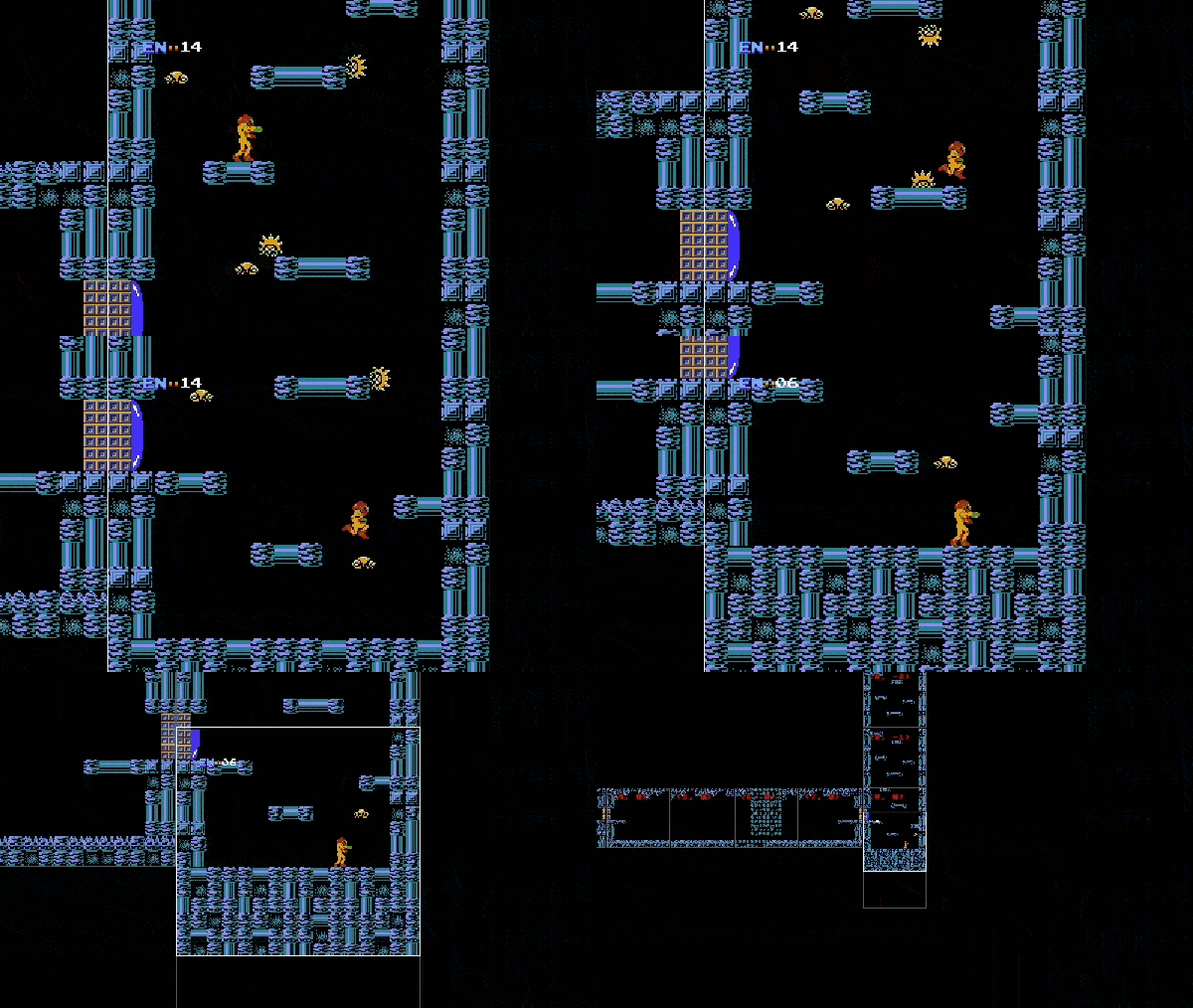
NES ZIP Polyglot shown in NES emulator

This NES ROM Is A ZIP Of Its Source

Polyglots, in computing terms, are files have multiple valid meanings. We’ve seen some amazing examples of polyglot files in releases of The International Journal of PoC||GTFO. One example: a PDF that is also a ZIP, HTML file, and BPG image.

[Vi Grey] was inspired by PoC||GTFO’s release of a PDF/ZIP/NES ROM hybrid file for issue 0x14. Using a different method, [Vi] created a file which is both an NES ROM and ZIP, where the full contents of the ZIP are stored in the NES ROM.

When PoC||GTFO created their NES ROM polyglot, they stuck most the information outside the bounds of the NES ROM. While the file is valid, you’d lose the ZIP archive if it was burnt to a cartridge.

[Vi]’s polyglot is different. Rip it from a real NES cartridge and you get a ZIP file. Unzip it, and you get the source. Compile that source, and you get a valid ZIP file containing the source. Burn that to a cartridge and… hopefully you grok the recursion at this point.

The source and scripts to mangle the polyglot together are up on Github.

Repairs You Can Print: Nintendo 3DS XL Lives Again!

Handheld game consoles have a hard life, and even the most well-built models can sometimes fail. The Nintendo 3DS XL, for example, can fail at its hinge, which is what happened to the one owned by [Mark]. Would he fix the hinge? No, he had a far simpler if a little less flexible solution, a 3D-printed bracket that clips over the whole device.

Sometimes the best pieces of work are also the simplest ones, and this one certainly fits that bill on both counts. When your console dies, you want it fixed, and though this doesn’t extend as far as providing a working hinge action it should allow you to play without further damaging anything. It’s not impossible to imagine that it could be made to incorporate a flexible zig-zag section to produce a closeable hinge, but if your Nintendo is broken you’ll care little for such niceties. The project can be downloaded from its Thingiverse page.

A common failure that we’d expect to accompany a broken hinge would be a faulty flexible ribbon cable. Fortunately, those are fixable on the 3DS, too.

What Is This, A Controller For Ants?!

What’s the smallest controller you’ve ever used? [BitBuilt] forum user [Madmorda] picked up a cool little GameCube controller keychain with semi-working buttons at her local GameStop. As makers are wont to do, she figured she could turn it into a working controller and — well — the rest is history.

This miniaturized controller’s original buttons were essentially one piece of plastic and all the buttons would depress at once — same goes for the D-pad. Likewise, the original joystick and C-stick lacked springs and wouldn’t return to a neutral position after fidgeting with them. To get the ball rolling, [Madmorda] picked up a GC+ board — a custom GameCube controller board — just small enough to fit this project, eleven hard tact switches for the various buttons, and two squishy tact switches to replicate the original controller’s L and R button semi-analog, semi-digital functionality.

Continue reading “What Is This, A Controller For Ants?!”