How Magnetic Fonts Twisted Up Numbers And Saved Banking Forever

If you’ve ever looked at the bottom of a bank check, you probably glanced over some strangely formed numbers? If you’re a fan of science fiction or retro computers, you’ve probably spotted the same figures on any number of books from the 1980s. They’re mostly readable, but they’re chunky and thin in places you don’t expect.

Those oddball numerals didn’t come from just anywhere—they were a very carefully crafted invention to speed processing in the banking system. These special fonts were created to be readable both by humans and machines—us with our eyes, and the computers with magnetic sensors. Let’s explore the enigmatic characters built for Magnetic Ink Character Recognition (MICR). Continue reading “How Magnetic Fonts Twisted Up Numbers And Saved Banking Forever”

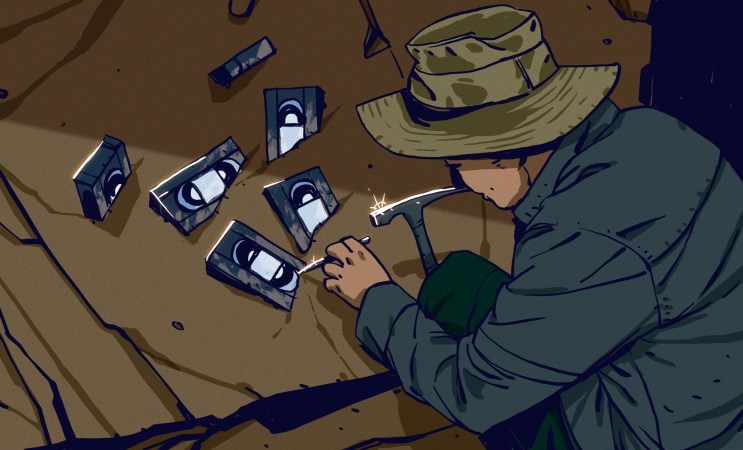
What Happens If You Die In Space?

There are no two ways about it—space will kill you if you give it half a chance. More than land, sea, or air, the space environment is entirely hostile to human existence. Precision-engineered craft are the bare minimum just to ensure human survival. Even still, between the vacuum, radiation, micrometeorites, and equipment failures, there are plenty of ways for things to go catastrophically wrong beyond Earth’s atmosphere.

Despite the hazards, most spacefaring humans have completed their missions without injury. However, as we look to return to the Moon, tread on Mars, and beyond, it’s increasingly likely that future astronauts could pass away during longer missions. When that inevitably happens, the question is simple—how do you deal with death in space?

Continue reading “What Happens If You Die In Space?”

Big Chemistry: Catalysts

I was fascinated by the idea of jet packs when I was a kid. They were sci-fi magic, and the idea that you could strap into an oversized backpack wrapped in tinfoil and fly around was very enticing. Better still was when I learned that these things weren’t powered by complicated rockets but by plain hydrogen peroxide, which violently decomposes into water and oxygen when it comes in contact with a metal like silver or platinum. Of course I ran right to the medicine cabinet to fetch a bottle of peroxide to drip on a spoon from my mother’s good silverware set. Needless to say, I was sorely disappointed by the results.

My little impromptu experiment went wrong in many ways, not least because the old bottle of peroxide I used probably had little of the reactive compound left in it. Given enough time, the decomposition of peroxide will happen all by itself. To be useful in a jet pack, this reaction has to proceed much, much faster, which was what the silver was for. The silver (or rather, a coating of samarium nitrate on the silver) acted as a catalyst that vastly increased the rate of peroxide decomposition, enough to produce jets of steam and oxygen with enough thrust to propel the wearer into the air. Using 90% pure peroxide would have helped too.

As it is for jet packs, so it is with industrial chemistry. Bulk chemical processes can rarely be left to their own devices, as some reactions proceed so slowly that they’d be commercially infeasible. Catalysts are the key to the chemistry we need to keep the world running, and reactors full of them are a major feature of many of the processes of Big Chemistry.

Continue reading “Big Chemistry: Catalysts”

Contrails Are A Hot Topic, But What Is To Be Done?

Most of us first spot them as children—the white lines in the blue sky that are the telltale sign of a flight overhead. Contrails are an instant visual reminder of air travel, and a source of much controversy in recent decades. Put aside the overblown conspiracies, though, and there are some genuine scientific concerns to explore.

See, those white streaks planes leave in the sky aren’t just eye-catching. It seems they may also be having a notable impact on our climate. Recent research shows their warming effect is comparable to the impact of aviation’s CO2 emissions. The question is then simple—how do we stop these icy lines from heating our precious Earth?

Continue reading “Contrails Are A Hot Topic, But What Is To Be Done?”

Mining And Refining: The Halogens

I was looking at the periodic table of the elements the other day, as one does, when my eye fell upon the right-hand side of the chart. Right next to the noble gases at the extreme edge of the table is a column of elements with similar and interesting properties: the halogens. Almost all of these reactive elements are pretty familiar, especially chlorine, which most of us eat by the gram every day in the form of table salt. As the neighborhoods of the periodic table go, Group 17 is pretty familiar territory.

But for some reason, one member of this group caught my attention: iodine. I realized I had no idea where we get iodine, which led to the realization that apart from chlorine, I really didn’t know where any of the halogens came from. And as usual, that meant I needed to dig in and learn a little bit about the mining and refining of the halogens. At least most of them; as interesting as they may be, we’ll be skipping the naturally occurring but rare and highly radioactive halogen astatine, as well as the synthetic halogen tennessine, which lives just below it in the group.

Continue reading “Mining And Refining: The Halogens”

The Many Leaning Towers Of Santos, Brazil

If you’ve ever gazed at the shoreline of Santos, Brazil, and felt like something was tugging at your inner eye level, you’re not alone. In fact, you’ve spotted one of the world’s most bizarre architectural phenomena.

Santos is an interesting contradiction—it’s a sunny coastal city with pristine beaches that also plays host to a bustling port. What draws the eye, however, is the skyline—it’s decidedly askew. This isn’t a Photoshop job or some avant-garde urban planning experiment, either. It’s a consequence of engineering hubris, poor planning, and geology just doing its thing.

Continue reading “The Many Leaning Towers Of Santos, Brazil”

2024: As The Hardware World Turns

With 2024 now officially in the history books, it’s time to take our traditional look back and reflect on some of the top trends and stories from the past twelve months as viewed from the unique perspective Hackaday affords us. Thanks to the constant stream of tips and updates we receive from the community, we’ve got a better than average view of what’s on the mind of hardware hackers, engineers, and hobbyists.

This symbiotic relationship is something we take great pride in, which is why we also use this time of year to remind the readers just how much we appreciate them. We know it sounds line a line, but we really couldn’t do it without you. So whether you’ve just started reading in 2024 or been with us for years, everyone here at Hackaday thanks you for being part of something special. We’re keenly aware of how fortunate we are to still be running a successful blog in the era of YouTube and TikTok, and that’s all because people like you keep coming back. If you keep reading it, we’ll keep writing it.

So let’s take a trip down memory lane and go over just a handful of the stories that kept us talking in 2024. Did we miss your favorite? Feel free to share with the class in the comments.

Continue reading “2024: As The Hardware World Turns”