Internet Controlled Scrolling Numitron

How’s this for a first microcontroller project: a ticker that pulls messages from the Internet and scrolls them on a set of numitrons. [David Barton] built this using an mbed microcontroller. Tapping an ethernet library he got this to pull data from his server by connecting directly to the cat5 cables. The display consists of three numitrons which are incandescent 7-segment displays. In the video after the break you can see him sending messages to it from his iPod touch. This is just a PHP form that writes the submitted message to a file for the mbed to read. As [David] points out, there’s obvious Twittering applications here, but we just like the way it looks! Continue reading “Internet Controlled Scrolling Numitron”

Teletype Machine From An Electric Typewriter

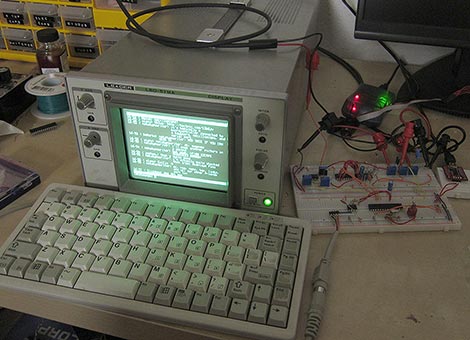
This project, by an unknown hacker, patches into an electric typewriter and uses it as a Teletype. An AVR ATmega168 microcontroller patches into the key matrix of the typewriter which allows it to artificially type. Now, data can be sent over a serial connection to the AVR for output on the typewriter.

We’re not quite sure what this is going to be used for.  We’ve seen hacks like this for Twitter reading in the past but he makes no mention of that type of use. Personally, we’d like to have this just to “print” out the occasional letter. Typewriters are so rarely used these days it would be a bit peculiar to get a letter that has the dimpled impressions associated with slamming a die into a piece of paper.

Keyboard Keepalive

[youtube=http://www.youtube.com/watch?v=Zq25CTEJEMQ]

We’re not going to debate the necessity of this one. [Todd] plays online games that will log you out after a few minutes of inactivity. To resolve this, he has created a circuit that mimics keyboard activity at a preset interval. While he notes that there is software for this, he points out that many games block the software. They can’t block legitimate keyboard activity.

[via HacketGadgets]

Interfacing With An Analog Joystick

[Firestorm_x1] put together a tutorial about interfacing an analog joystick with a microcontroller. These analog sticks are easy to find; he got his from Goodwill but we’ve got a couple in our junk box right now. The stick uses variable resistors to report its position so it’s just a matter of reading and interpreting that data. After explaining the concepts he demonstrates how to use the joystick to control a Basic Stamp 2 based robot, the Boe-Bot. This could easily be adapted for use with other robot platforms.

Game Controllers Using USB Host Shield

[I-Bot] has put together some libraries that make it easy to use gaming controllers with an Arduino. They interface through the USB host shield. This means that PS3 controllers connect via USB through a cable or a dongle. With the Wii remote things get a little more interesting. A Bluetooth dongle is used to make the connection wirelessly. What we have here is a cheap and easy way to add Bluetooth connectivity to your projects either through the USB Host shield, or by building your own hardware with the schematics and code that are available from Circuits@Home. There are several pages that walk you through the protocols using as well as a demonstration video you can see after the break. Continue reading “Game Controllers Using USB Host Shield”

Wii Motion Plus Direct PC Interface

You can pick up a Wii Motion Plus module for under $20 and that’s not bad for an I2C gyroscope. This hack taps into the device through a PC parallel port. The connection calls for some level conversion to step down to the 3.3v needed by the module. The communication protocol borrows from the Wii on Arduino code examples that we saw last year. You can see the Wii Motion Plus controlling a virtual cube in the video after the break.

Continue reading “Wii Motion Plus Direct PC Interface”

Face Tracking With X10

If you are looking to do some face tracking and don’t know where to start, this explanation of how to do it with X10 modules could be pretty helpful. Aside from having, what some could consider to be, the absolute most annoying website ever for a company, X10 also makes modular systems for home automation. X10 also refers to the industry standard for home automation, so sometimes just saying you did something with X10 can get confusing.   He is using the SDK to write custom code for the tracking, which you can download from the project page.

[via HackedGadgets]