The Amiga We All Wanted In 1993

To be an Amiga fan during the dying days of the hardware platform back in the mid 1990s was to have a bleak existence indeed. Commodore had squandered what was to us the best computer ever with dismal marketing and a series of machines that were essentially just repackaged versions of the original. Where was a PCI Amiga with fast processors, we cried!

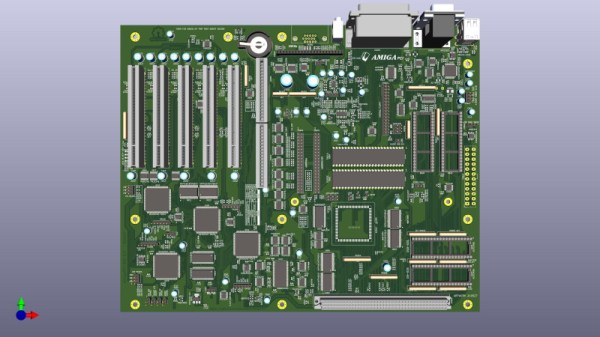
Now, thirty years too late, here’s [Jason Neus] with just the machine we wanted, in the shape of an ATX form factor Amiga motherboard with those all-important PCI slots and USB for keyboard and mouse.

What would have been unthinkable in the ’90s comes courtesy of an original or ECS Amiga chipset for the Amiga functions, and an FPGA and microcontroller for PCI and USB respectively. Meanwhile there’s also a PC floppy drive controller, based on work from [Ian Steadman]. The processor and RAM lives on a daughter card, and both 68040 and 68060 processors are supported.

Here in 2024 of course this is still a 1990s spec board, and misty-eyed speculation about what might have happened aside, it’s unlikely to become your daily driver. But that may not be the point, instead we should evaluate it for what it is. Implementing a PCI bus, even a 1990s one, is not without its challenges, and we’re impressed with the achievement.

If you’re interested in Amiga post-mortems, here’s a slightly different take.
Inside A Mystery Aerospace Computer With [Ken Shirriff]

When life hands you a mysterious bit of vintage avionics, your best bet to identifying it might just be to get it in front of the biggest bunch of hardware hounds on the planet. After doing a teardown and some of your own investigation first, of course.

The literal black box in question came into [Ken Shirriff]’s custody courtesy of [David] from Usagi Electric, better known for his vacuum tube computer builds and his loving restoration of a Centurion minicomputer. The unit bears little in the way of identifying markings, but [Ken] was able to glean a little by inspecting the exterior. The keypad is a big giveaway; its chunky buttons seem optimized for use with the gloved hands of a pressure suit, and the ordinal compass points hint at a navigational function. The layout of the keypad is similar to the Apollo DSKY, which might make it a NASA artifact. Possibly contradicting all of that is the oddball but very cool electromechanical display, which uses reels of digits and a stepper-like motor to drive them.

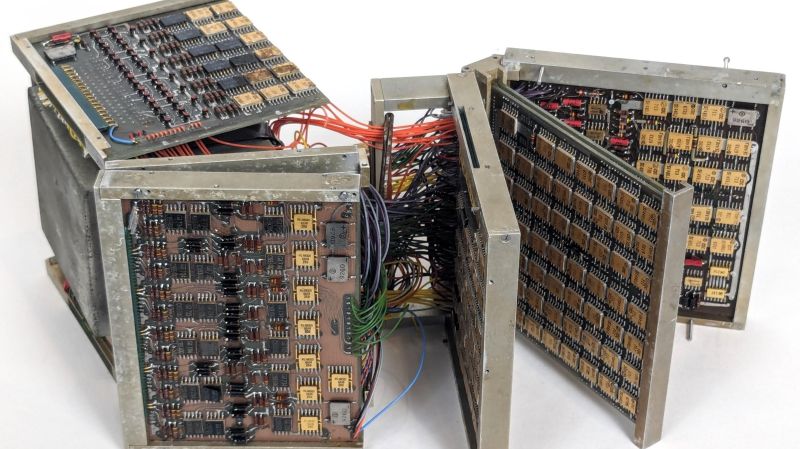
Inside, more mysteries — and more clues — await. Unlike a recent flight computer [Ken] looked at, most of the guts are strictly electronic. The instrument is absolutely stuffed with PCBs, most of which are four-layer boards. Date codes on the hundreds of chips all seem to be in the 1967 range, dating the unit to the late 60s or early 70s. The weirdest bit is the core memory buried deep inside the stacks of logic and analog boards. [Ken] found 20 planes with the core, hinting at a 20-bit processor.

In the end, [Ken] was unable to come to any firm conclusion as to what this thing is, who made it, or what its purpose was. We doubt that his analysis will end there, though, and we look forward to the reverse engineering effort on this piece of retro magic.

CH32V003 Makes For Dirt Cheap RISC-V Computer

These days, when most folks think of a computer they imagine a machine with multiple CPUs, several gigabytes of RAM, and a few terabytes of non-volatile storage for good measure. With such modern expectations, it can be difficult to see something like a microcontroller as little more than a toy. But if said MCU has a keyboard, is hooked up to a display, and lets you run basic productivity and development software, doesn’t that qualify it as a computer? It certainly would have in the 1980s.

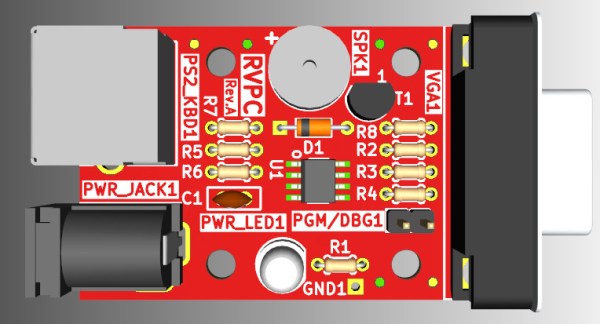
With that in mind, [Olimex] has teased the RVPC, which they’re calling the “world lowest cost Open Source Hardware All-in-one educational RISC-V computer” (say that three times fast). The tiny board features the SOIC-8 variant of the CH32V003 and…well, not a whole lot else. You’ve got a handful of passives, a buzzer, an LED, and the connectors for a PS/2 keyboard, a power supply, and a VGA display. The idea is to offer this as a beginner’s soldering kit in the future, so most most of the components are through-hole.

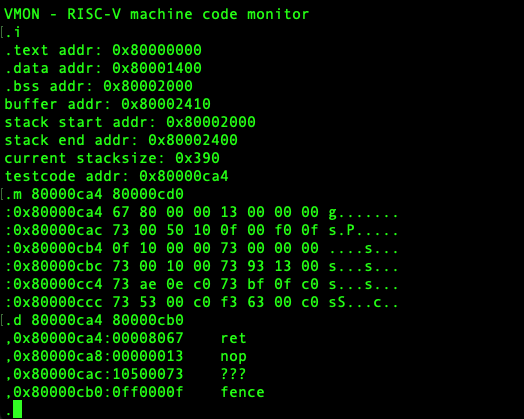
On the software side, the post references things like the ch32v003fun development stack, and the PicoRVD programmer as examples of open source tools that can get your CH32V computer up and running. There’s even a selection of retro-style games out there that would be playable on the platform. But what [Olimex] really has their eye on is a port of VMON, a RISC-V monitor program.

When paired with the 320×200 VGA text mode that they figure the hardware is capable of, you’ve got yourself the makings of an educational tool that would be great for learning assembly and playing around with bare metal programming.

It might not have the timeless style of the Voja4, but at least you can fit it in a normal sized pocket.

Thanks to [PPJ] for the tip.

Walking Through A Scene From Riven On The Apple II

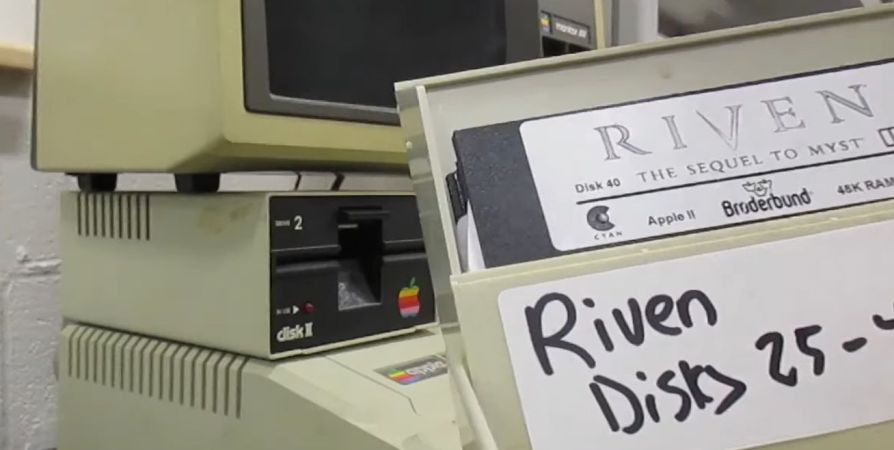
Twenty years before the 1997 release of Riven – Cyan’s sequel to the critically acclaimed title Myst – a fruity company in California released the Apple II, a 6502-based microcomputer that would be produced until 1993. With the upcoming remake by Cyan of Riven into a fully 3D experience, [deater] found themselves wondering how much of the original game’s click-and-puzzle game would fit on a 140 kB floppy for the Apple II series of computers. Since Myst was able to be squeezed  onto a mere three floppies and provide a reasonably playable version of the game on the Apple II, surely the same could be done for this sequel?

The Maglev in the Apple II port of Riven. (Credit: [deater])
Just a look at the system requirements for Riven (Win95+, 100 MHz Pentium, 16 MB RAM and 75 MB disk space) and the knowledge that the game came on five CD-ROMs (until the DVD release) should instill some trepidation that a serious demake would be needed. Ultimately [deater] managed to set the system requirements for the port to any Apple II with at least 48 kB of RAM. The same custom game engine as for the Myst port is used, with the original CG stills downsampled and the movies rotoscoped at fairly low framerate.

Although the ‘Disk 39’ in the video is currently the sole floppy, containing part of Dome Island and the Maglev, it is probably a fair assessment of how many 140 kB disks would be needed to port the entire game. Even with the downsampled graphics, [deater] reckons it would take on the order of hundreds of floppies to fit the whole thing.

Continue reading “Walking Through A Scene From Riven On The Apple II”

The 6809 Lives On In An FPGA

At one point, the Motorola 6809 seemed like a great CPU. At the time it was a modern 8-bit CPU and was capable of hosting position-independent code and re-entrant code. Sure, it was pricey back in 1981 (about four times the price of a Z80), but it did boast many features. However, the price probably prevented it from being in more computers. There were a handful, including the Radio Shack Color Computer, but for the most part, the cheaper Z80 and the even cheaper 6502 ruled the roost. Thanks to the [turbo9team], however, you can now host one of these CPUs — maybe even a better version — in an FPGA using Verilog.

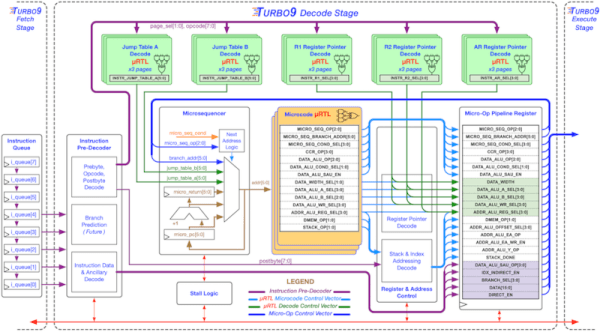
The CPU may be old-fashioned on the outside, but inside, it is a pipeline architecture with a standard Wishbone bus to incorporate other cores to add peripherals. The GitHub page explains that while the 6809 is technically CISC, it’s so simple that it’s possible to translate to a RISC-like architecture internally. There are also a few enhanced instructions not present on the 6809.

In addition to the source code, you’ll find a thesis and some presentations about the CPU in the repository. While the 6809 might not be the most modern choice, it has the advantage of having plenty of development tools available and is easy enough to learn. Code for the 6800 should run on it, too.

Even using through-hole parts, you can make a 6809 computer fit in a tiny space.You can also break out a breadboard.

One Man’s Trash Is… A Rare $60,000 Historical Computer

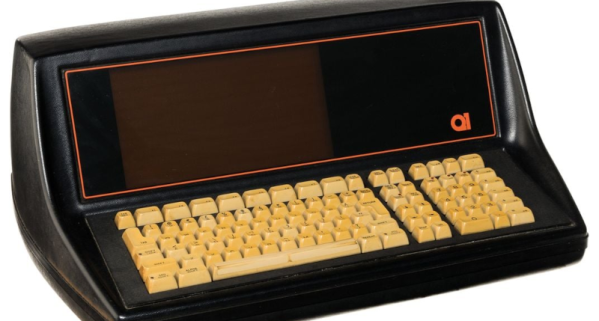
According to Smithsonian Magazine, a salvage company in London was cleaning out a property and found an odd-looking computer device. No one knew what it was, and they couldn’t find anything with a quick online search. The devices in question were two ultra-rare Q1 computers dating from the early 1970s.

While these machines looked formidable, they contained Intel 8008 CPUs but did have built-in screens, keyboards, and printers. The two machines had a few minutes of fame at Kingston University London and are now for sale. They will probably bring about $60,000 each. Not bad for salvage junk.

Continue reading “One Man’s Trash Is… A Rare $60,000 Historical Computer”

How A DOS Format Blunder Revealed Some Priceless Source Code

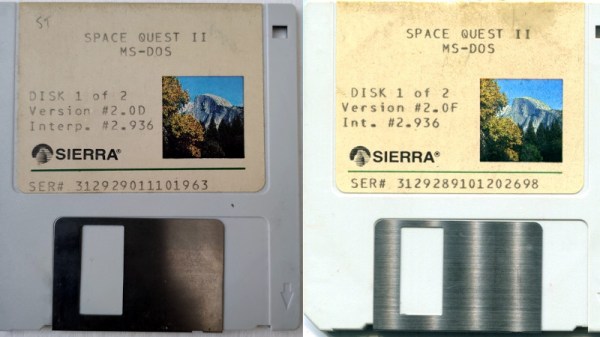
As those of us who worked in the consumer software world back when physical media was king can attest, when a master disc has been sent for duplication and distribution there is no turning back from whatever code is in the hands of thousands of users. Usually such worries were confined to bugs or inadvertently sending out pre-release software versions, but [Lance Ewing] is here with the story of how Sierra On-Line once inadvertently released most of the source code for their game engine.

If you have some 720k floppy disk versions of the 1988 game Space Quest II, the first disk in the set appears to have nothing out of the ordinary, but a closer look reveals that the free space on the disk reported by DOS is greater than its used space. Diving in to the disk block contents with a hex editor reveals that many of the unused blocks in fact contain C code, and some further detective work allows the recovery of a not-quite complete set of source files for the company’s AGI, or adventure game interpreter. They had been left behind when the original master disk had been emptied by deleting them, rather than by formatting it afresh.

In commercial terms this would in 1988 have been something of a disaster for Sierra had it been discovered at the time, because it was the cornerstone of their success. As it was we’re told the code sat peacefully undetected until 2016, since when it has proved invaluable to those interested in computer game archaeology. Or did it? We’ll never know if a sharp-eyed competitor snagged it, and kept quiet.

Of course, these days, there are game engines that are open source. Some of them are very modern. Others… not so much.