PenPal, A Robotic Drawing Assistant

Emergent properties include examples like murmurations of starlings which can’t be predicted from looking at a single bird, weather which can’t be predicted by looking at a few air molecules, and consciousness which can’t be predicted by looking at a neuron. Likewise, when adding a new tool to a workflow, emergent properties can show up as well. A group at Chicago University developed a robotic drawing tool and a few artists developed some unique drawing methods using it.

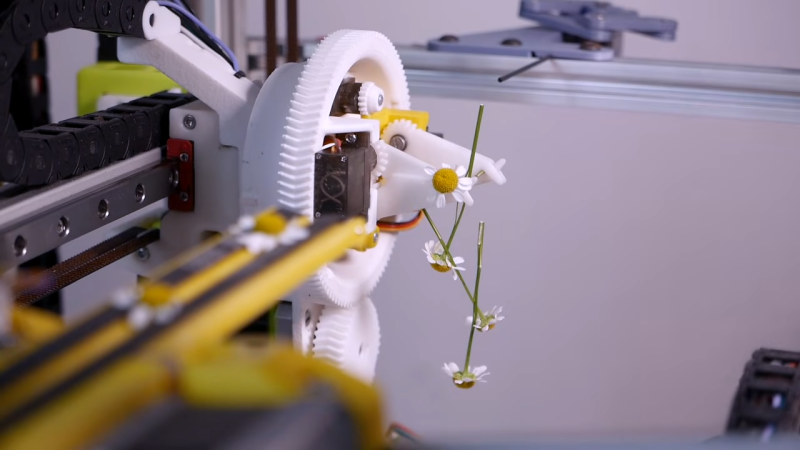
The robotic pen uses a pair of tendons to extend the working end out a certain amount. From there it uses a set of servos to can be programmed to revolve around in a defined path, making repeating movements while the artist makes larger movements over the paper. Originally meant for shading, small circles or simpler back-and-forth movements were preset, but with full control over the pen’s behavior the artist can shift focus away to other tasks within the creative process. A study with ten participants was done which showed artists coming up with novel ways of using a tool like this, and others reporting that it’s almost like drawing together with another person.

Looking for novel ways that humans can interact with computers and robots can often lead to surprising outcomes like this. Members of this group aren’t new to novel human interface devices either; they’ve also built a squishy dynamic button as well.

Continue reading “PenPal, A Robotic Drawing Assistant”

Robot Bird Decoys Work For Good

Usually, you think of bird decoys as being a tool to lure birds to an untimely encounter with a hunter. However, [Interesting Engineering] has a story about robotic bird decoys in Grand Teton National Park that are helping restore the dwindling number of sage grouse in the park.

While some decoys are static, others are motorized to replicate mating rituals. The goal: lure real birds to safer areas to breed. Particularly, they want the birds to avoid areas around the Jackson Hole Airport. The robots are built with help from local students and robotics teams. While some of the construction is made of fabric and foam, actual bird feathers are also used.

The robots mimic lekking behavior, a courtship ritual where male grouse do repetitive motions combined with recorded mating calls. This attracts other grouse and, of course, results in chicks who will be raised nearby.

Assuming the effort is successful, the same technique could help other areas where restored areas are difficult to repopulate. You can find more pictures on the Park’s Instagram, and the title picture is from that collection.

Usually, when we see something like this, the robot is trying to remove something dangerous to the endangered plant or animal, not attract them.

3D Printed Robot Arm Built For Learning Purposes

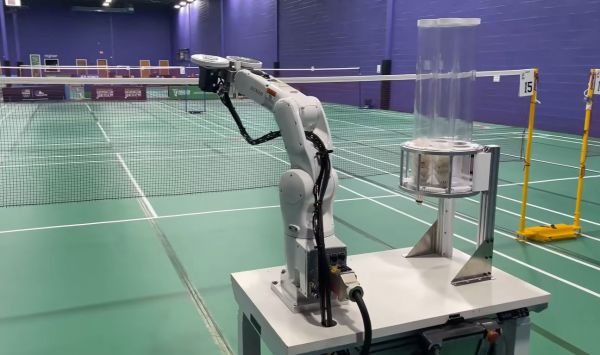
If you want to work with robots you can do all sorts of learning with software and simulation, but nothing quite beats getting to grips with real machinery. That was the motivation for [James Gullberg] to build this impressive robot arm. 

Featuring six degrees of freedom, the robot arm is mostly constructed of 3D printed components. This let [James] experiment with a wide variety of joint and reducer designs for the sake of learning and investigation. The base of the robot uses a fairly conventional planetary gear drive, while shoulder and elbow joints rely on split-ring planetary gearboxes to allow for high torque density with regards to size. [James] implemented a neat sensing technique here, integrating alternating magnets into the output ring gear which are monitored via a magnetic encoder. The wrist joint switches things up again, running via an inverted belt differential.

Running the show is an STM32 microcontroller, which talks to all the encoders, communicates with a Raspberry Pi over CAN bus, and handles all the necessary PID control loops and step generation for the drive motors. The plan is to run higher-level control on the Raspberry Pi which will run a ROS 2-based software stack. Already, the various joints look smooth and impressive in motion.

If you’re looking to learn about robot arms, you really can’t beat building one. We’ve featured a few projects along these lines before. Most of them aren’t exactly production-line ready, but they will teach you a ton about control, motion planning, and all sorts of associated skills. That experience can be invaluable if you intend to work with robots in industry.

Continue reading “3D Printed Robot Arm Built For Learning Purposes”

Real Robot Makes Debut In Programming Game

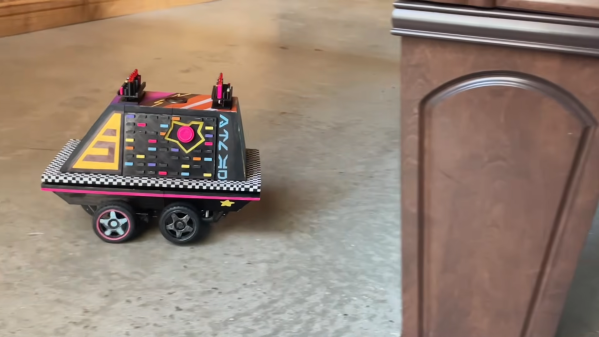
Sometimes the right tool for the right job appears almost out of nowhere. That was certainly the case for [Jonathan] who came across an unusual but well-designed robot at a secondhand shop. The robot needed a bit of work to get back into a usable condition, but after that it was ready for use. For such a unique machine, it needed a unique place to work as well, so in this build [Jonathan] uses it as a real robot to recreate a popular board game meant to teach programming to children.

In the original board game, called Robot Turtles, there are no actual robots. Instead, players use cards to control turtles to reach objectives in much the same way that a programmer would solve a similar problem with a computer. A board game with such a name almost demands a robot, so [Jonathan] found a larger playing surface in the form of soft matting blocks, each with a number or letter, that can be assembled into a grid. To make the game, he built a Python application on top of the interface he reverse-engineered in a previous build. It handles the robot interface, control, input, and a PyGame GUI. The game can either be played in real-time, or the robot’s moves can be queued.

In addition to keyboard input, the bot can also be controlled by putting cards from the actual board game itself on an NFC reader he made. [Jonathan] has a four-year-old at home, so he hopes that all of these projects will have an impression and encourage experimentation and discovery of computers and programming.

Continue reading “Real Robot Makes Debut In Programming Game”

Building A Robot Partner To Play Air Hockey With

Air hockey is one of those sports that’s both incredibly fun, but also incredibly frustrating as playing it by yourself is a rather lonely and unfulfilling experience. This is where an air hockey playing robot like the one by [Basement Builds] could come in handy. After all, after you finished building an air hockey table from scratch, how hard could it be to make a robot that merely moves the paddle around to hit the puck with?

An air hockey table is indeed not extremely complicated, being mostly just a chamber that has lots of small holes on the top through which the air is pushed. This creates the air layer on which the puck appears to float, and allows for super-fast movement. For this part countless chamfered holes were drilled to get smooth airflow, with an inline 12 VDC duct fan providing up to 270 CFM (~7.6 m3/minute).

Initially the robot used a CoreXY gantry configuration, which proved to be unreliable and rather cumbersome, so instead two motors were used, each connected to its own gearbox. These manipulate the paddle position by changing the geometry of the arms. Interestingly, the gearbox uses TPU for its gears to absorb any impacts and increase endurance as pure PLA ended up falling apart.

The position of the puck is recorded by an overhead camera, from where a Python script – using the OpenCV library running on a PC – determines how to adjust the arms, which is executed by Arduino C++ code running on a board attached to the robot. You could just copy this code yourself, but as the video makes clear, this is basically cheating as you don’t get to enjoy doing all the trigonometry and physics-related calculating and debugging fun.

Continue reading “Building A Robot Partner To Play Air Hockey With”

Cynus Chess Robot: A Chess Board With A Robotic Arm

Downward-facing camera and microphone in the arm. (Credit: Techmoan, YouTube)

There are many chess robots, most of which require the human player to move the opposing pieces themselves, or have a built-in mechanism that can slide the opposing pieces around to their new location. Ideally, such a chess robot would move the pieces just like how a human would, of course. That’s pretty much the promise behind the Manya Cynus chess robot, which [Matt] over at the Techmoan YouTube channel bought from the Kickstarter campaign.

Advertising itself as a ‘Portable AI Chess Robot’, the Manya Cynus chess robot comes in the form of a case that unfolds into a chess board and also contains the robotic arm that contains the guts of the operation. Powered by the open source Stockfish chess engine, it can play games against a human opponent at a few difficulty levels without requiring any online connectivity or a companion app. It moves its own pieces by picking up the metal-cored chess pieces with its arm, while its front display tries to display basic emotions with animated eyes. A 3-MP downward-facing camera is located on the head section, along with a microphone.

As for how well it works, [Matt] isn’t the best chess player, but he had a fair bit of fun with the machine. His major complaints circle around how unfinished the firmware still feels, with e.g., invalid moves basically ignored with only a barely visible warning popping up on the screen. In general, he’d rather classify it as an interesting development kit for a chess robot, which is where the BLE 5.1-based interface and a purported Python-based development environment provided by Manya seem to come into focus.

Continue reading “Cynus Chess Robot: A Chess Board With A Robotic Arm”

Fish Drives Tank

Fish are popular animals to keep as pets, and for good reason. They’re relatively low maintenance, relaxing to watch, and have a high aesthetic appeal. But for all their upsides, they aren’t quite as companionable as a dog or a cat. Although some fish can do limited walking or flying, these aren’t generally kept as pets and would still need considerable help navigating the terrestrial world. To that end, [Everything is Hacked] built a fish tank that allows his fish to move around on their own. We presume he’s heard the old joke about two fish in a tank. One says, “Do you know how to drive this thing?”

The first prototype of this “fish tank” is actually built on a tracked vehicle with differential steering, on which the fish tank would sit. But after building a basic, driveable machine, the realities of fish ownership set in. The fish with the smallest tank needs is a betta fish, but even that sort of fish needs much more space than would easily fit on a robotics platform. So [Everything is Hacked] set up a complete ecosystem for his new pet, making the passenger vehicle a secondary tank.

The new fish’s name is [Carrot], named after the carrots that [Everything is Hacked] used to test the computer vision system that would track the fish’s movements and use them to control the mobile fish tank. There was some configuration needed to ensure that when this feisty fish swam in circles, the tank didn’t spin around uncontrollably, but eventually he was able to get it working in an “arena” where [Carrot] could drive towards some favorite items he might like to interact with. Mostly, though, he drove his tank to investigate the other fish in the area.

The ultimate goal was for [Everything is Hacked] to take his fish on a walk, though, so he set about training [Carrot] to respond to visual cues and swim towards them. In theory, this would have allowed him to be followed by his fish tank, but a test at a local grocery did not go as smoothly as hoped. Still, it’s an interesting project that pushes the boundaries of pet ownership much like other fish-driving projects we’ve seen.

Continue reading “Fish Drives Tank”